
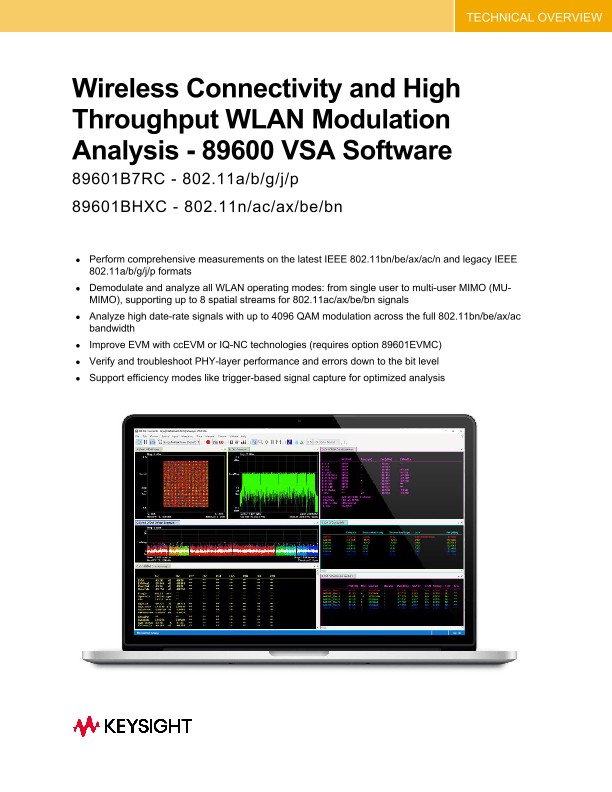
Wireless Connectivity and High Throughput WLAN Modulation Analysis 89600 VSA Software
Technical Overviews
This technical overview presents Keysight’s 89600 Vector Signal Analysis (VSA) Software for Wireless Connectivity and High‑Throughput WLAN Modulation Analysis, a comprehensive solution for demodulating, analyzing, and troubleshooting IEEE 802.11 wireless LAN signals from legacy formats through the latest Wi‑Fi generations. The document explains how the software enables deep physical‑layer insight for design validation, compliance verification, troubleshooting, and production testing of complex WLAN systems.
The 89600 VSA software supports a broad range of IEEE 802.11 standards, including legacy 802.11a/b/g/j/p, high‑throughput 802.11n (Wi‑Fi 4), very high throughput 802.11ac (Wi‑Fi 5), high efficiency 802.11ax (Wi‑Fi 6 and 6E), extremely high throughput 802.11be (Wi‑Fi 7), and emerging 802.11bn (Wi‑Fi 8 / Ultra High Reliability). Dedicated measurement options — 89601B7RC for legacy WLAN and 89601BHXC for high‑throughput WLAN — allow engineers to tailor analysis capabilities to their specific testing needs while maintaining backward compatibility and coexistence validation.
The document provides a clear overview of WLAN technology evolution, describing how successive generations introduced wider channel bandwidths, higher‑order modulation, advanced coding schemes, and increasingly sophisticated spatial and multi‑user techniques.
A major focus of the asset is modulation and Error Vector Magnitude (EVM) analysis. The 89600 VSA software enables engineers to evaluate modulation formats from BPSK through 4096QAM, across channel bandwidths from 10 MHz to 320 MHz, depending on the standard. EVM can be analyzed at multiple levels of granularity, including overall burst, per symbol, per subcarrier, per spatial stream, per user, and per Resource Unit (RU). These capabilities are critical for diagnosing PHY‑layer impairments such as phase noise, frequency error, I/Q imbalance, timing offset, and nonlinear distortion.
The document details advanced analysis features for OFDMA and multi‑user WLAN transmissions, particularly in 802.11ax, 802.11be, and 802.11bn systems. The VSA software can compute and display EVM, power, and modulation performance for individual RUs and users within the same transmission, enabling clear visualization of how resources are allocated and how performance varies across users. Color‑coded displays simplify interpretation of complex multi‑user results and accelerate root‑cause analysis in dense network scenarios.
Extensive coverage is also given to MIMO analysis, supporting configurations up to 8×8 SU‑MIMO and MU‑MIMO. Per‑stream and per‑channel measurements provide insight into channel frequency response, equalizer behavior, phase and timing alignment, IQ impairments, and stream‑specific EVM. These capabilities help engineers validate advanced spatial processing, beamforming, and multi‑antenna designs across all supported WLAN standards.
To address the increasing difficulty of achieving low EVM with wide bandwidths and high‑order modulation, the overview describes enhanced EVM techniques, including Cross‑Correlated EVM (ccEVM) and IQ Noise Correction (IQ‑NC). These techniques reduce analyzer‑contributed noise and extend EVM dynamic range, enabling more accurate characterization of transmitters and power amplifiers, especially at low signal levels. Practical examples demonstrate how ccEVM and IQ‑NC can deliver several decibels of EVM improvement without masking device‑under‑test impairments.
Beyond demodulation accuracy, the document highlights the integration of spectrum‑domain and compliance‑related measurements. The 89600 VSA software can perform Spectral Emission Mask (SEM) and modulation analysis from a single acquisition, ensuring time‑correlated results and reducing overall test time. Time‑gated spectrum measurements further enable isolation of specific burst segments, such as preambles or training fields, which is essential for debugging burst‑based WLAN signals.
Usability and workflow efficiency are emphasized throughout the overview. Engineers can start quickly using standard‑based presets for each WLAN generation, then fine‑tune parameters such as FFT size, guard interval, equalizer training, pilot tracking, and synchronization behavior for advanced troubleshooting. The Dynamic Help feature provides context‑sensitive guidance directly within the user interface, supporting faster learning and more efficient measurement setup.
The asset also describes how the 89600 VSA software fits into the entire product development lifecycle, supporting analysis from simulation to hardware. Engineers can work with data from signal generators, vector signal analyzers, oscilloscopes, modular PXIe platforms, and wireless test sets, as well as replay captured signals for offline analysis. Automation through SCPI and programming APIs enables repeatable test development for verification and manufacturing environments.
Finally, the document outlines licensing models, configuration options, and supported hardware platforms, allowing users to scale capabilities from entry‑level validation to advanced research and production systems. Together, these features position the Keysight 89600 VSA WLAN Modulation Analysis software as a future‑ready, flexible platform for engineers developing and validating Wi‑Fi 4 through Wi‑Fi 8 technologies in increasingly complex wireless environments.