How to Measure Lithium-Ion Cell Self-Discharge Current

Measure Cell Self-Discharge Current Directly
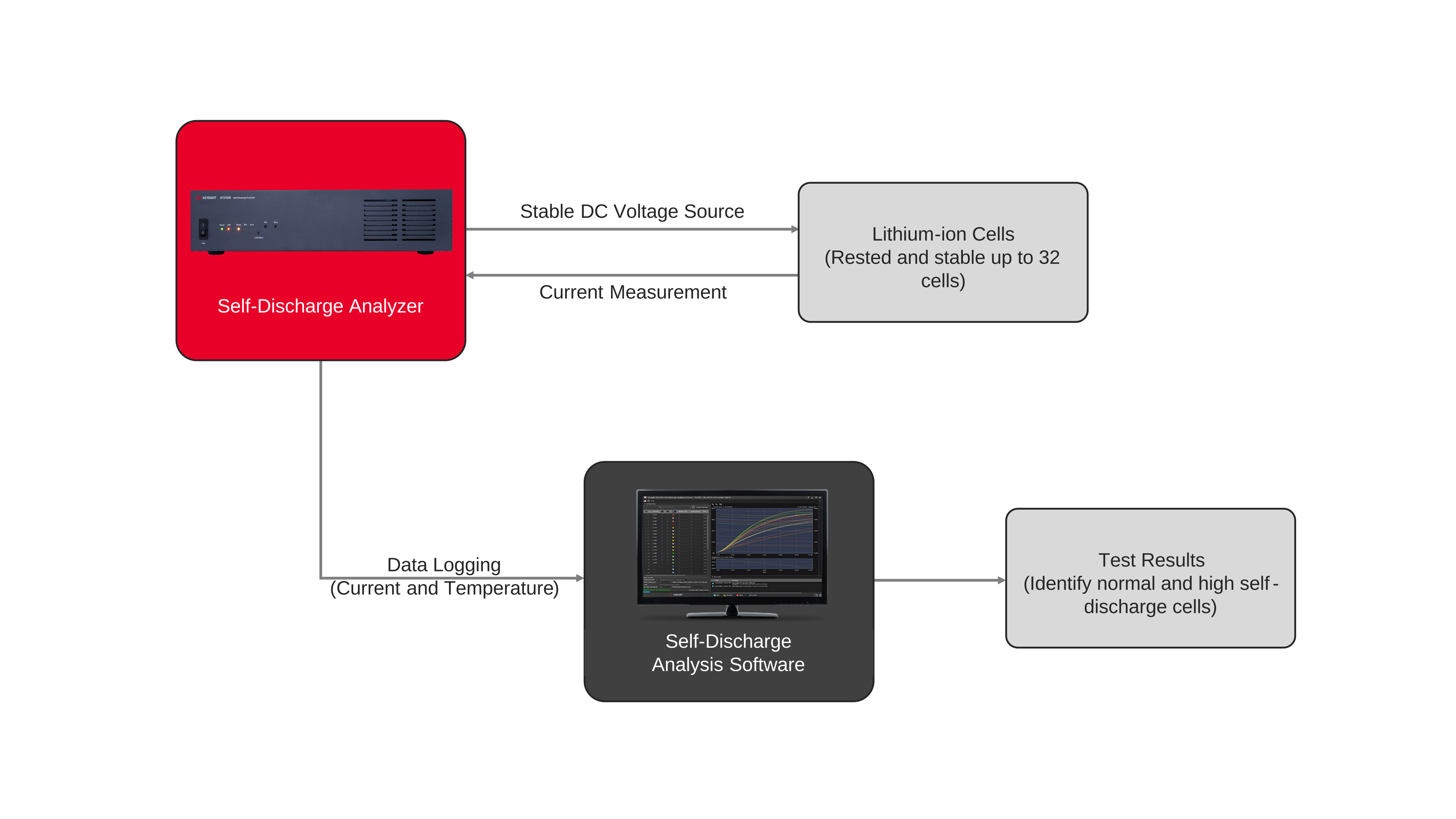
Lithium-ion cell self-discharge current measurement with the potentiostatic method requires a low-noise, highly stable direct current source, a microammeter capable of resolving very small currents, and controlled cell conditions. The measurement begins with a rested cell whose open-circuit voltage (OCV) has stabilized after charging or discharging. The direct current source is adjusted to match that OCV as closely as possible before it is connected to the cell. Once connected, the source holds the cell at essentially constant voltage and state of charge (SOC), while the microammeter measures the current flowing between the source and the cell. As the cell continues its internal self-discharge process, the external source progressively supplies the charge that would otherwise be lost from the cell. After the source and cell reach equilibrium, the externally supplied current corresponds to the cell’s self-discharge current, providing a direct measurement of charge loss over time. This potentiostatic self-discharge measurement differs from the delta-OCV method, which infers self-discharge from a small voltage decrease over an extended interval. Because lithium-ion cell voltage changes only slightly across much of its SOC range, delta-OCV testing can require days to weeks of monitoring. Direct self-discharge current measurement instead resolves the current associated with the loss of charge and can reach a usable result in hours or less, depending on cell condition and the measurement objective.
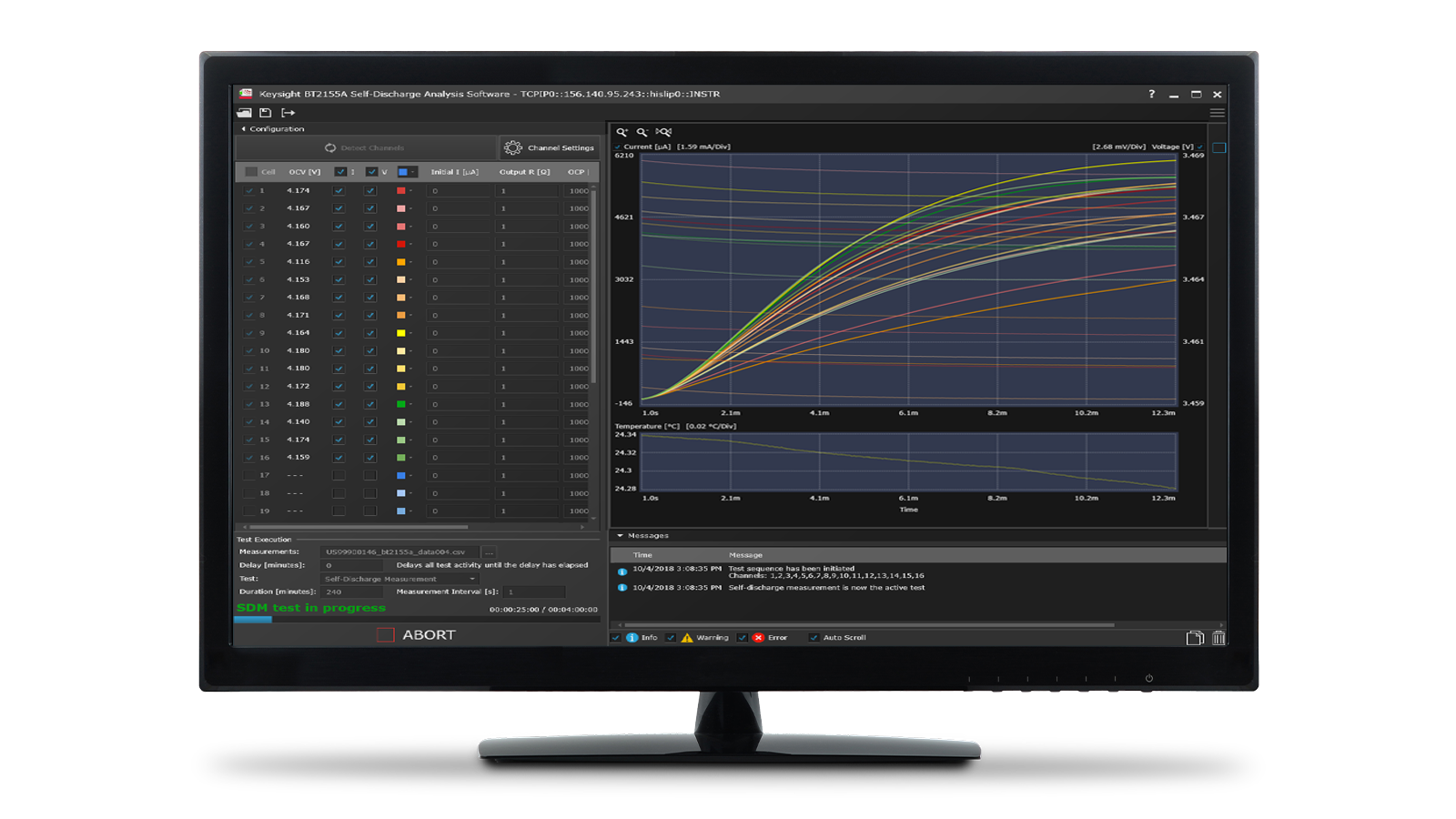
Cell preparation and environmental control determine how quickly the measured current settles to the true self-discharge level. After charging or discharging, charge redistribution within the cell can continue for an extended period; a cell that has not reached equilibrium can initially source or absorb additional current that decays with time and is superimposed on the desired self-discharge current. Temperature must also remain stable because a lithium-ion cell’s voltage has a temperature coefficient that can produce changes of many tens of microvolts per degree Celsius. State of charge also affects the measurement: self-discharge decreases considerably at low SOC, making the current more difficult to resolve, while the temperature coefficient of voltage generally increases. During acquisition, engineers should continuously log cell current, voltage, and temperature so that current settling can be evaluated alongside environmental and electrical conditions. The resulting current-versus-time traces show the approach toward equilibrium; when a trace levels off, the external source is furnishing the cell’s self-discharge current. In the documented 18650-cell example, a 2.4 Ah cell settled near 7 µA after two hours, while cells with excessive self-discharge separated from the main population within minutes. For multi-cell lithium-ion battery self-discharge testing, comparing aligned current traces also helps engineers distinguish normal population behavior from unusually high self-discharge while retaining voltage and temperature records for measurement context.


Lithium-Ion Self-Discharge Current Measurement Solution
See Block Diagram of Lithium-Ion Self-Discharge Current Measurement Solution

Explore Products in Our Lithium-Ion Self-Discharge Current Measurement Solution
-

![]()
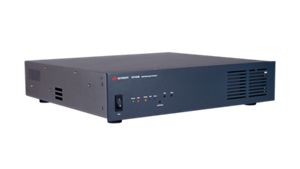
BT2152B Self-Discharge Analyzer
-

![]()
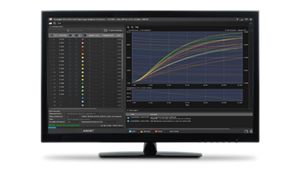
BT2155A Self-Discharge Analysis Software


Discover Resources and Insights
Additional Resources for Lithium-Ion Self-Discharge Current Measurement
Related Use Cases


-
![]()
Learn More
How to Streamline DC-to-DC Converter Testing
Performing DC-to-DC converter tests require multiple test instruments. Learn how to use an integrated DC power analyzer, an oscilloscope, and automation software to characterize DC-to-DC converters accurately and efficiently.
Learn More

-
![]()
Learn More
How to Reduce Lithium-Ion Self-Discharge Test Time
Reduce lithium-ion cell self-discharge test time by directly measuring self-discharge current with a potentiostatic method instead of relying on extended open-circuit voltage monitoring. Control voltage matching, source stability, cell equilibrium, temperature, and settling behavior to obtain self-discharge measurements in less time.
Learn More
-
![]()
Learn More
How to Characterize Lithium-Ion Self-Discharge Versus Temperature
Characterize temperature effects on lithium-ion cell self-discharge measurements by monitoring current, voltage, and cell temperature over time. Control cell temperature, terminal temperature differences, state of charge, and settling conditions to distinguish self-discharge current from thermally induced measurement variations.
Learn More

Get in Touch with One of Our Experts
Need help finding the right solution for you?