
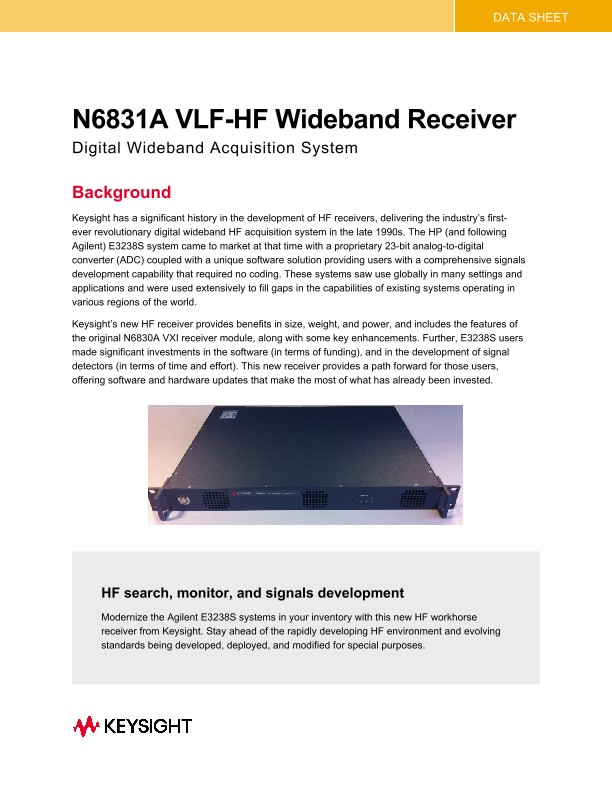
N6831A VLF-HF Wideband Receiver
Data Sheets
Digital Wideband Acquisition System
Background
Keysight has a significant history in the development of HF receivers, delivering the industry’s firstever revolutionary digital wideband HF acquisition system in the late 1990s. The HP (and following Agilent) E3238S system came to market at that time with a proprietary 23-bit analog-to-digital converter (ADC) coupled with a unique software solution providing users with a comprehensive signals development capability that required no coding. These systems saw use globally in many settings and applications and were used extensively to fill gaps in the capabilities of existing systems operating in various regions of the world.
Keysight’s new HF receiver provides benefits in size, weight, and power, and includes the features of the original N6830A VXI receiver module, along with some key enhancements. Further, E3238S users made significant investments in the software (in terms of funding), and in the development of signal detectors (in terms of time and effort). This new receiver provides a path forward for those users, offering software and hardware updates that make the most of what has already been invested.
General Description
The N6831A receiver will communicate with the N6820ES Surveyor 4D software on a VITA-49 streaming interface, also making it compatible with other software packages capable of processing that form of data. It will need to be paired with an appropriate server to support the applications. The built-in GPS receiver (L1) provides frequency and time references for accurate time stamping to support precision timedependent applications.
This receiver is designed to process the full VLF-HF band (9 kHz to 32 MHz) with 16-bit resolution making use of a 1-million-point FFT for remarkable speed and resolution. Several thoughtfully placed preselection filters optimize the sensitivity and integrity of the spectral content. The user manually controls these filters. Additionally, 128 DDC channels provide a robust narrowband signal processing capability to classify signal candidates, make recordings, tip, and source data to other systems.
An important design goal was to match the sampling rates of the N6830A VXI receiver to make previously created USD (Universal Signal Detector) wideband detectors work properly with the new N6831A hardware. This detail may save significant effort in updating existing E3238S systems. Another important design goal was to satisfy the frequency ranges called out in Recommendation ITU-R SM.377 and 378 for frequency and bandwidth measurement in the VLF through HF spectrums.
As shown in Figure 1, the system has two basic inputs – the HF antenna, and the GPS antenna. The 10 MHz and 1PPS references on the HF receiver can come from either the embedded GPS receiver or from external references. There are two network connections between the HF receiver and the measurement server – the Gigabit Ethernet carries command and control, and the high-speed SFP+ connection carries the data output, including FFT spectral, and DDC narrowband streaming data. The interfaces are compliant with VITA 49.2.
Specifications
This section lists the specifications and supplemental information that applies to the N6831A HF receiver. The measurement hardware consists of a 1U standard rack-mounted unit. The specifications are based on 10 separate tests on 10 different units at room temperature.
Frequency tuning range |
9 kHz to 32 MHz |
Usable IF bandwidth |
Up to 32 MHz (full band) |
DDC tuning resolution |
1 Hz steps |
Frequency Specifications |
|
Frequency reference |
N6831A can use the internal GPS disciplined oscillator or external 10 MHz and 1PPS references. |
Frequency reference accuracy |
+/- 20 ppb (typical, with internal GPS reference) |
Frequency span |
Up to 32 MHz |
DDC bandwidths |
400 Hz to 800 kHz (on up to 128 narrowband channels) |
Snapshot bandwidth |
400 Hz to 4.096 MHz (wideband acquisition) |
Snapshot memory |
64 MB 3.27 seconds at 4 MHz bandwidth 9.3 hours at 400 Hz bandwidth |
RBW (Resolution bandwidths) |
Filters and shape factors • Hanning window – 9.0:1 (best selectivity) • Gausstop window – 4.0:1 • Flattop window – 2.6:1 (best amplitude accuracy) |
RBW range (for 9.0:1 shape factor) |
60 Hz to 40 kHz in 2x steps |
Number of frequency points in spectrum display (at minimum RBW) |
1,048,576 |
Phase Noise |
100 Hz offset: < -92 dBc/Hz 1 kHz offset: < -118 dBc/Hz 10 kHz offset: < -146 dBc/Hz 100 kHz offset: < -157 dBc/Hz 1 MHz offset: < -160 dBc/Hz |
Amplitude Specifications (all at maximum gain, minimum attenuation without pre-selection unless otherwise noted) |
|
Analog-to-Digital-Converter |
16-bit at 40.96 MSa/second (complex) |
Full-scale level (ADC overload level) at RF input |
+19.5 dBm (max attenuation, min gain) |
Gain control range |
47 dB (gain 33 dB, attenuation 14 dB) |
Amplitude accuracy |
+/- 2.3 dB (15 kHz to 32 MHz) |
Noise figure (at maximum gain, minimum attenuation) |
8 dB (5 MHz to 32 MHz) 10 dB (50 kHz to 4.9 MHz) 24 dB (9 to 49kHz) |
Third-order intercept (TOI) |
+3 dBm (0.5 MHz to 32 MHz) |
Second-order intercept (SOI) |
+40 dBm (0.5 MHz to 32 MHz) |
Image rejection |
110 dBc (9kHz to 32 MHz) |
Single tone SFDR @ >2 MHz |
>100 dBc, center frequency > 2 MHz, ignoring harmonics |
Residual spurs |
-110 dBm |
Antenna radiation |
-108 dBm |
Inputs and outputs |
|
RF input connector |
SMA (female) 50 ohm |
VSWR |
< 1.3:1 (without pre-selection) |
Pre-selection filtering (Chosen manually & saved with the N6820ES state file) |
High Pass Filter 9 kHz, 1.5 MHz, 3 MHz, 5 MHz, 9 MHz, and 15 MHz Low Pass Filter 5 MHz, 15 MHz, and 32 MHz |
Absolute Maximum Input Power |
+27 dBm at minimum gain, maximum attenuation |
Data interface (FFT, IQ time series) |
VITA-49.2 |
General |
|
Size |
426 mm wide x 373 mm deep x 31.7 mm high |
Weight |
4.6 kg (10.1 lbs.) |
Power |
< 65 Watts typical |
Operating altitude |
10,000 ft (3 km) |
Operating temperature |
0 to 55 degrees C [Class GP ETM 757] |
Storage temperature |
-40 to 70 degrees C [Class GP ETM 757] |
Humidity |
Maximum Relative Humidity (non-condensing): 95%RH up to 40°C, decreases linearly to 45%RH at 55°C * |
Altitude |
3000 m
|
VITA-49 Radio Access (VRA)
The N6831A is controlled through a comprehensive API referred to as the VITA Radio Access (VRA). The purchase of the receiver includes the VRA.