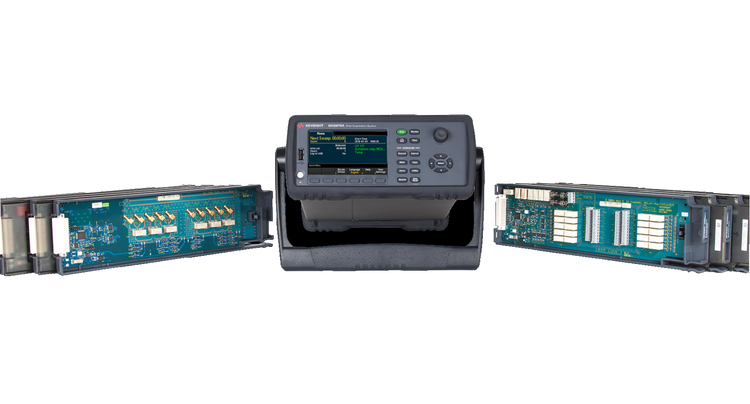
Data Loggers: The Answer to Test Scalability Bottlenecks
Key takeaways:
- Data loggers enable massively parallel measurements from hundreds of test points on one or more devices under test.
- Data loggers are also a type of data acquisition system but with specific connotations about their capabilities.
- With rapid innovations in many industries, data loggers are set to become more prominent than ever in their testing.
For rapid time-to-market and maximum customer satisfaction, engineers must be able to thoroughly test electronic systems as quickly and productively as possible.
Data loggers facilitate rapid, convenient testing of large numbers of devices. In this blog post, learn more about data loggers, find out which industries use them, and understand what makes them advantageous for your electronics testing.
What is a data logger?

Figure 1. Testing with data logger versus multiple instruments
The term "data logger" can refer to several things in the electronics industry. In general, a data logger is a device or software that measures some electrical or physical parameters and stores them. However, data loggers vary significantly in form and function. Below are four commonly used types of data loggers:
- Specialized instrument for data logging during testing: In lab and production environments, a data logger can refer to a data acquisition (DAQ) instrument that can simultaneously measure electrical and physical parameters from a large number of test points across one or more devices under test (DUTs). For a complex DUT that requires a variety of parallel measurements, connecting a single data logger is more convenient and faster than wiring up dozens of multimeters and other instruments, as shown in the above illustration.
- Software-based data logging during testing: The term "data logger" can also refer to the functionality of measurement data logging provided by DAQ software. For example, the PathWave BenchVue suite includes a data logging feature for DAQ systems.
- Built-in data logging in non-DAQ instruments: Sometimes, data logging is a built-in secondary capability of some non-DAQ instruments like the Keysight N6705C power analyzer.
- Portable environmental monitoring device: A data logger can also refer to a portable battery-powered environmental monitoring device used for optimal operations and maintenance in industries like food storage, life sciences, aerospace, and geoscience. These industries use a variety of devices like temperature data loggers, humidity data loggers, pressure data loggers, carbon dioxide detectors, and more. Such data loggers can run for weeks or even months due to a long battery life. The recorded data is regularly uploaded to a monitoring center over ethernet, Wi-Fi, or Bluetooth.
In this blog, we focus on the first two types of data loggers — instruments or software for simultaneous measurements in lab, production, and end-of-line test setups.
How is a data logger different from other data acquisition instruments?
A data logger optimizes bench testing and streamlines production testing where hundreds of DUTs must be automatically verified every day. In this, data loggers are like other DAQ systems.
However, unlike typical data acquisition systems, a data logger generally (but not necessarily) carries the connotations below:
- It has user controls, a display, and a graphical user interface.
- It can be manually operated without a connected computer.
- It can measure data for long periods.
- It can store a substantial amount of data locally in its onboard storage.
What are the key applications of data loggers across different industries?
Data loggers support a high number of simultaneous measurements and a wide range of electrical and physical parameters.
These benefits make them incredibly useful in quality-sensitive industries as outlined below.
Automotive
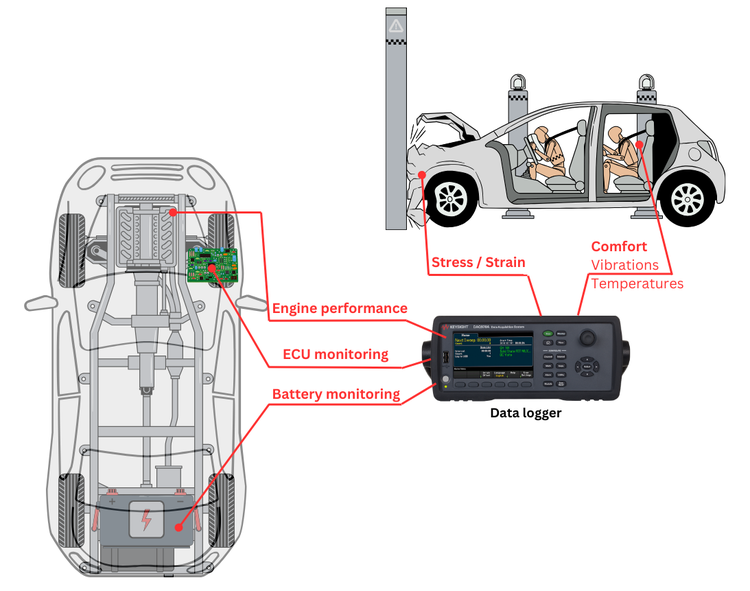
Figure 2. Data loggers in automotive testing
Data loggers are used for testing components and ensuring compliance with automotive standards and regulations. Some specific uses are explained below:
- Monitoring engine performance: Data loggers are used for measuring engine temperatures, electromechanical vibrations, cylinder pressures, and fuel injection timing.
- Measuring component stresses: Data loggers can measure stresses and strains on different components and systems under load, such as chassis, suspensions, engine parts, and body panels.
- Characterizing electrical subsystem: Data loggers are used for measuring voltages, currents, resistances, and electromagnetic interference in electronic control units and electric vehicle (EV) control boards. They are also used for routing test signals in automated production testing.
- Testing batteries: Data loggers are used to monitor charging, discharging, battery voltages, current draw, battery management systems, and battery temperatures in EVs and hybrid EVs (HEVs).
- Analyzing vehicle dynamics: Data loggers are used for nonstationary vibroacoustic data analysis (a type of dynamic data analysis) on vehicles to improve overall noise and vibration characteristics. Data loggers are also essential for thermal profiling and temperature monitoring at various points in a vehicle to optimize cooling and comfort.
Aerospace and defense
Data loggers are extensively used for testing electronic and electromechanical components in aerospace and defense systems. Uses include:
- electromechanical vibration analysis of components
- testing of RF and microwave components used in military radios, radar communications, and satellites
- wind-tunnel testing for measuring pressures, temperatures, and flow velocities
- pyroshock analysis of pyrotechnic devices like explosive bolts and separation nuts used in spacecraft, launch vehicles, and missiles that are subjected to high-frequency, high-amplitude, or transient shock loads
- integration with automated test equipment
- custom switch matrices for signal routing and conditioning
For example, the National Aeronautics and Space Administration (NASA) has used Keysight's data loggers in spacecraft electric propulsionresearch to measure voltages, currents, fluid flow, and power for durability tests spanning hundreds of hours.
Semiconductor engineering
Since integrated circuits have hundreds to thousands of input/output pins and other test points, integrated DAQs as well as standalone data loggers are used for simultaneous measurements during on-wafer testing, post-silicon validation, and package testing.
For example, NASA has tested copper-wire-bonded semiconductorpackaging for space applications using Keysight data loggers to measure component voltages and current draws as well as power supply voltages and component temperatures.
Electronics manufacturing
Data loggers are extensively used for:
- measuring electrical characteristics of printed circuit board assemblies and their components
- measuring power consumptions of subsystems in consumer devices
- characterizing electronic components during burn-in testing where extreme temperature cycling, elevated voltages, power cycling, and vibrations are applied
- temperature profiling during charging and discharging of consumer device batteries
What are the advantages of using data loggers over manual data recording?
Manual data recording involves wiring up instruments like digital multimeters and power analyzers to a DUT to measure various parameters. However, as the number of measurements, instruments, or DUTs increases, this approach becomes increasingly inconvenient, inefficient, and expensive.
Data loggers prevent those problems and bring additional benefits as explained below.
High scalability
Data loggers are designed for simultaneous measurements from hundreds of test points. They delegate the measurements to add-on modules like multiplexers that support hundreds of measurement channels. Many such add-on modules can be added to data loggers to expand the number of channels.
Manually connecting, configuring, and synchronizing dozens of multimeters and other instruments one by one is very time-consuming. While wiring is still required for data loggers, configuration and synchronization can be finished quickly.
High-speed measurements
Data loggers can scan hundreds of channels and capture thousands of readings per second. These rates are on par with high-end benchtop multimeters and specialized instruments.
Powerful test synchronization
Tests that involve a large number of simultaneous measurements must precisely orchestrate external systems (like power supplies), DUTs, and instruments. Switch modules in data loggers allow entire sets of channels to be activated or deactivated. This is useful when different DUTs or subsystems must be activated in specific sequences.
To facilitate such synchronization, modern data loggers support increasingly sophisticated event detection, graphical test sequence diagramming, and instrument programming.
Dynamic data acquisition
Traditional data loggers only support static acquisition where they measure each channel just once per scan.
In contrast, modern data loggers support dynamicdata acquisition where each channel is measured multiple times per scan. This enables the detection of transient events in power and data signals. Dynamic phenomena like vibrations and noise can also be more accurately characterized.
Multiple domain measurements
Data loggers simultaneously support time-domain and frequency-domain analog measurements as well as digital-domain and physical measurements. This enables the all-around characterization of mixed-signal, RF, and electromechanical systems, which is essential for the final qualification and compliance testing stages.
What types of data can a data logger record?
Data loggers can measure a variety of parameters by combining their generic acquisition capabilities with suitable sensors.
Supported electrical measurements include the following:
- Voltages: Voltages of direct current (DC) and alternating current (AC) signals are supported, ranging from millivolts to hundreds of volts.
- Currents: Currents ranging from microamperes to several amperes can be measured.
- Resistances: Both two-wire and four-wire resistance measurement methods are available.
- Frequencies: Data loggers can measure signal frequencies and periods.
- Capacitances: Capacitances can be determined.
- Digital signals: Voltage levels of digital and mixed-signal circuits can be measured.
Data loggers support these physical parameters:
- Temperatures: Temperature monitoring of many test points is essential in battery and engine testing. Sensors like thermocouples, resistance temperature detectors, or thermistors are used for temperature measurements.
- Strains: Data loggers can measure direct and bridge strains.
- Vibrations: Vibrations can be measured by data loggers with dynamic data capabilities.
How do you select the right data logger for a specific application?
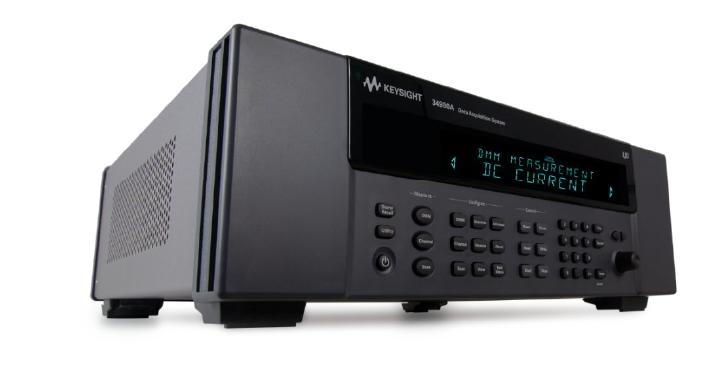
Figure 3. Keysight 34980A DAQ
Some helpful tips for selecting a data logger are listed below:
- Know your application's operating limits: Voltages may range from microvolts to hundreds of volts. Resistances may go as high as thousands of megaohms. Currents can range from nanoamperes to a few amperes. The multiplexer modules available for a data logger must support these wide measurement ranges with high speed and high accuracy.
- Look for dynamic data acquisition: This feature is essential for the detection of transient events and characterization of dynamic phenomena like vibrations.
- Ensure future scalability: During initial design verification stages, you may only need to measure a dozen parameters across a few test points. However, as the product gets closer to full qualification and compliance stages, test points and parameters will explode in number. Make sure that the data logger can be expanded at a low cost to satisfy channel counts and scanning rates over your entire development cycle.
- Evaluate ease of integration: Analyze whether the data logger can be easily integrated into your current test setup. Precise synchronization of test automation with other programmable instruments, DUTs, and power supplies is essential.
- Verify built-in capabilities: Does the data logger have all the built-in signal conditioning you may need? Look for the ability to filter out unwanted signals, amplify small signals, attenuate large signals, and linearize signals. Are the analog-to-digital conversion parameters suited to your project?
How is data from a logger stored, retrieved, and analyzed?
Measured data are first stored with timestamps in the data logger's internal memory. For example, the DAQ970A and DAQ973A can store up to 1 million readings.
The measured data can be retrieved to a connected computer via ethernet, USB, or general-purpose interface bus (GPIB). Standard commands for programmable instruments (SCPI) like "FETCh?" are used to retrieve the data to the computer.
Alternatively, some loggers can store the readings on a universal serial bus (USB) flash drive for expanded capacity. The data can be downloaded as files.
Data loggers with displays and user controls support onboard channel configuration and analyses. Some data loggers support computed or virtual channels that calculate data from multiple channels in real time.
However, most engineers prefer using software like the PathWave BenchVueData Acquisition App from a connected computer for more complex setups and analyses.
What are the emerging trends and technologies in the data logger market?
Going forward, data loggers will be able to measure many more types of phenomena with increased scalability. Some key emerging trends are outlined below:
- Integrated functionality: Data loggers already combine many instrument capabilities into a single unit — like multimeter, switching, digital logic analysis, and signal conditioning. We can expect additional integration to boost testing efficiency and convenience by an order of magnitude. This is particularly relevant to the automotive industry where the scorching pace of innovation in EVs and vehicle-to-everything requires test instruments to improve rapidly. Other fields like radio frequency (RF), mobile, and high-frequency satellites also require more integrated capabilities.
- Dynamic data acquisition: Instead of measuring each channel once per scan, advanced data loggers sample each channel many times in both time and frequency domains. This enables in-depth analysis of transient events as well as highly dynamic phenomena like vibration, shock, and noise.
- Enhanced channel density: There's a strong demand for highly modular designs with pluggable multiplexers, digitizers, and switches to expand channel density and capabilities on demand.
- Increased performance: Future data loggers will have higher channel sampling rates, accuracy, and resolution. Solid-state switches are increasingly preferred due to their higher scanning speeds over mechanical relay or armature switches.
- Higher data storage: Current data loggers can internally store about a million data points. With advances in non-volatile memory and double data rate memory technologies, we can expect far higher storage capacities in the future.
Deploy Keysight data loggers for your future needs
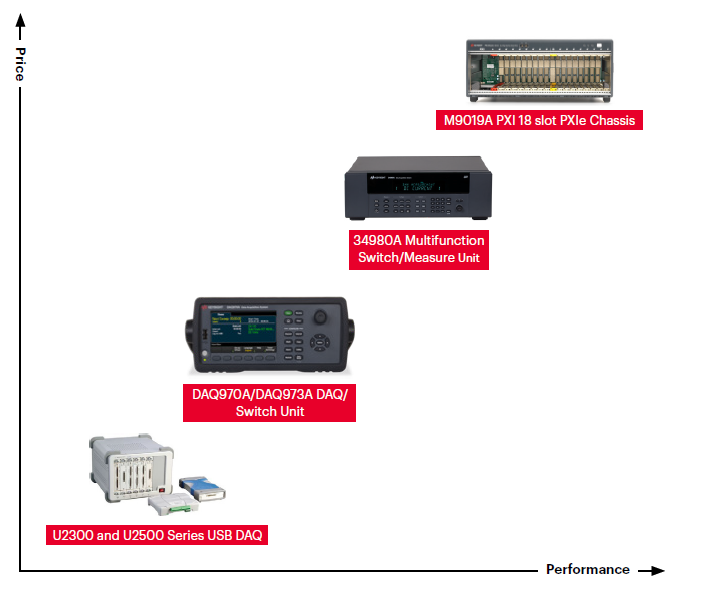
Figure 4. Keysight DAQ products
In this blog post, you obtained an overview of data loggers, their applications, and their capabilities.
Keysight's DAQ systems anddata loggers cater to the special needs of critical industries like automotive, aerospace, defense, and health care.
Contact us for insights and help on data logger instruments and software.