
AI Data Center Infrastructure: Scaling, Power, and Cooling
To increase productivity, enterprises are adopting agentic, multimodal, and generative AI models with integrated capabilities for text, images, video, and speech. However, these powerful AI and machine learning (ML) tools critically depend on AI data center infrastructure.
Unless AI data center infrastructure can scale rapidly, it will become a bottleneck to enterprise AI adoption and the broader rollout of AI services.
Below, we’ll cover AI data center infrastructure, its key components, energy demands, cooling systems, and future outlook.
Key takeaways:
- Rack densities in artificial intelligence (AI) data centers are rapidly approaching the limits of prevalent power delivery and cooling systems.
- Innovations in new power sources and more effective cooling systems will determine whether AI adoption can continue at the same pace.
- Sustainability and regulations are also contributing to advances in AI infrastructure.
What is AI data center infrastructure?
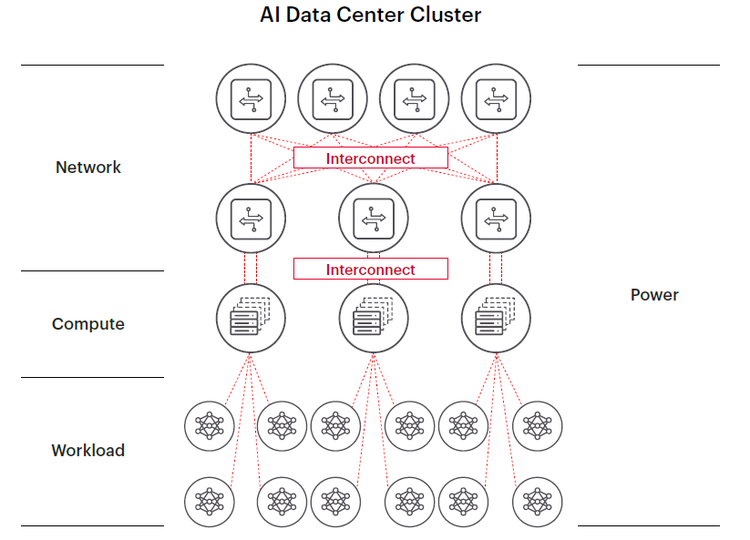
Figure 1. AI data center infrastructure
AI data center infrastructure encompasses the integration of specialized power systems, advanced AI data center cooling systems, high-speed compute nodes, high-bandwidth networking fabrics, high-capacity storage, and purpose-built facility design optimized for all of them.
As AI adoption rapidly rises, AI data centers are turning into industrial-scale AI factories and facing several challenges.
The core challenge of AI data center infrastructure remains scaling up resources to achieve extremely high compute densities that meet the intensive data processing demands of AI algorithms.
However, to better understand AI data centers, we need to examine their key components.
What are the key elements of AI data center infrastructure?
The key elements of AI data center infrastructure include computing resources, storage systems, networking fabric, power delivery, cooling systems, and facility design. Together, these components form the AI data center architecture needed to support high-density AI workloads.
Compute layer
AI compute infrastructure is built from high-density server racks containing CPUs, AI accelerators such as NVIDIA GPUs or Google TPUs, high-bandwidth memory, and high-speed interconnects. At hyperscale, these compute resources are deployed across many clusters, data centers, regions, and availability zones.
Storage systems
The high-volume dataset pipelines for AI training and inference require high-capacity distributed storage consisting of fast, non-volatile memory express (NVMe) devices and NVMe over Fabrics (NVMe-oF). High-throughput parallel file systems are built over this fast storage fabric.
Networking fabric
Data transfer between compute units within a server and across servers has to be low-latency. Interconnect technologies like NVLink and fast networking technologies like InfiniBand, Ethernet, and emerging Ultra Ethernet based architectures enable low-latency, high-throughput data transfers for AI workloads.
Power Delivery
AI clusters require highly efficient power delivery networks capable of supplying large, rapidly changing loads to accelerators and networking equipment. Modern AI infrastructure increasingly adopts high-voltage DC distribution, advanced voltage regulation modules, busbars, and rack-scale power architectures to improve efficiency and support rack densities exceeding 100 kW.
Facility design
Physical layout, power delivery, and cooling systems need to be optimized for the high rack densities needed for AI workloads.
Together, these infrastructure layers determine how efficiently an AI data center can scale. As compute density rises, power delivery and thermal management become the limiting factors, making energy demand and cooling system design central to AI data center infrastructure planning.
What are the energy demands of AI data center infrastructure?
Large AI data centers can require hundreds of megawatts of power, while the largest hyperscale AI campuses are expanding toward gigawatt-scale capacity.
Why does AI data center infrastructure need so much energy?
The high power consumption of AI data centers is primarily due to model training and inference tasks that involve extreme GPU scaling across thousands of GPUs simultaneously. For example, some public estimates suggest that a single frontier-model training run can consume tens of gigawatt-hours of electricity, though exact figures are rarely disclosed.
What are the power density challenges of AI data center infrastructure?
Key power density challenges include high energy demand, grid constraints, thermal management, power delivery issues, and low-power innovations.
- High energy consumption: While many conventional enterprise racks operate below 10 kW, current AI systems can exceed 40 kW per rack, with leading systems exceeding 100 kW and future designs moving towards support for 1MW per rack. AI models require continuous power at high current densities. Some aggressive financial-sector projections estimate AI-specific power demand could grow by orders of magnitude by 2030, while broader energy forecasts still point to very large but more moderate growth in total data center electricity demand.
- Grid and infrastructure constraints: Demand is outpacing traditional infrastructure, prompting operators to explore architectural innovations, such as disaggregated power delivery and AI-aware thermal control.
- Thermal management: The high density of compute racks generates massive heat. Managing this thermal load using effective AI data center cooling is critical to prevent hardware failures and performance degradation.
- Power delivery network issues: As data centers scale, power management issues can impede further growth. Simulating andoptimizing these networks is required to identify the root causes of power waste.
- Low-power innovations: Architectures are driving adoption of lower-power interconnect approaches such as linear pluggable optics (LPO), while placing greater demands on host electrical channels, signal integrity, interoperability, and validation. Such innovations must be rigorously tested for reliability and performance under realistic workloads, using instruments such as Keysight's oscilloscopes, BERTs, network emulators and electronic designautomation software.
What grid, sustainability, and regulation challenges are AI data centers facing?
The rapid growth in AI data centers has placed unprecedented stress on aging electrical grids, increased interest in dedicated power infrastructure, and raised regulatory concerns related to carbon emissions, environmental impact, and noise near residential areas.
Operators are also exploring lower-carbon energy strategies, including renewable generation, nuclear power, battery storage, and on-site microgrids.
Which cooling technologies are used in AI data centers?
Advanced cooling approaches for AI data center infrastructure rely on liquid solutions rather than air, including direct liquid cooling (DLC), direct-to-chip cooling (D2C), immersion cooling, and rear-door heat exchangers. As AI rack densities increase, liquid cooling is becoming increasingly important for efficiently removing heat from the highest-density systems.
What are the limits of air cooling in AI data centers?
Traditional air cooling can support many conventional data center workloads, but it becomes less effective as AI racks reach much higher power densities. Dense GPU servers generate concentrated thermal loads that are difficult to remove with airflow alone, which is why AI data center cooling is increasingly shifting toward liquid-based methods such as direct-to-chip cooling, rear-door heat exchangers, and immersion cooling.
What is direct-to-chip cooling?
D2C is a type of DLC in which coolants absorb heat via copper cold plates mounted directly on the surfaces of the hottest components, like GPUs, interconnects and processors. Water-based coolants, including treated water and water/glycol mixtures, are commonly circulated through the cold plates.
A coolant distribution unit circulates the coolant in a secondary loop while constantly monitoring its temperature. The secondary loop is isolated from, and transfers heat to, the facility's chilled water loop. Other components in each server are cooled through traditional air cooling.
D2C can handle rack densities up to around 120 kilowatts, while future designs are pushing higher. Another benefit is its compatibility with standard 19-inch racks, making it effective for retrofitting existing facilities.
However, a significant challenge is custom-designing the cold plates to be in near-perfect contact with each chip's surface, matching its geometry and unique heating patterns.
What is immersion cooling?
In immersion cooling, the entire server chassis is submerged in a special dielectric fluid that has high thermal conductivity, high heat capacity, and no electrical conductivity.
In single-phase immersion, this fluid remains liquid and is pumped to a heat exchanger. In two-phase immersion, the fluid boils upon contact with hot components, absorbing an enormous quantity of heat, turns to vapor, condenses on cooling coils, and rains back down.
Immersion cooling can support very high rack densities and may be considered where conventional air or direct-to-chip approaches become difficult to scale.
Some common challenges of immersion cooling design:
- Servers and their components must be chemically compatible with the fluid.
- The performance of all components, such as GPUs and networking interconnects, must be testable in an immersion environment.
- Maintenance and servicing are complicated. Servers have to be removed from the fluid, often with mechanical assistance, and undergo drip-dry procedures.
- Some fluorinated two‑phase fluids raise environmental concerns, including regulatory scrutiny related to PFAS.
What are rear-door heat exchangers?
Rear-door heat exchangers use liquid cooling to remove heat from the exhaust air of server racks.
What is hyperscale AI data center infrastructure?
Hyperscale AI infrastructure refers to large-scale data center facilities — and, often, global fleets of those facilities — designed to scale compute, storage, networking, power, and cooling capacity for massive AI training and inference workloads.
Hyperscale AI data center infrastructure differs from regular AI data centers in scalability, and from traditional data centers in the technologies and workloads they support. The differences are outlined in the illustrative, not definitional, table below.
Public-facing AI cloud services to thousands of customers, typically.
Some (e.g., Meta's) are mostly for proprietary AI research, plus a few public-facing AI applications.
Many are for proprietary captive AI use by specific organizations.
Some offer specialized public-facing AI services or AI-driven applications.
Gigawatt-scale "AI factories" designed for continuous, large-scale growth in AI uses year after year.
Frontier models training and inference.
Can accommodate very large corporate customers.
Smaller customers may face various resource restrictions.
Designed with a more limited maximum AI capacity.
Smaller customers often face much more severe resource restrictions.
Uses every type of cooling.
Immersion cooling for some servers.
Mix of D2C cooling, air cooling, and rear-door heat exchangers for others.
DigitalOcean, Amazon,
Google, Microsoft, IBM
Rackspace
Some distinct characteristics of hyperscale AI data centers:
- Scale and reliability: Due to their extreme scales and constant operation without downtime, hardware disruptions and errors are statistically inevitable, requiring robust system-wide fault tolerance and real-time mitigation.
- Stringent power and thermal requirements: Because of their high densities, these facilities face intense power and thermal management challenges, necessitating advanced cooling and power integrity validation to prevent system-wide failures.
- Multi-region AI compute networks: Inference services are often distributed across regions, while training clusters are typically concentrated within a data center or campus to minimize latency.
- Extreme compute density: They can contain tens of thousands of accelerators, with the largest multi-site AI infrastructure programs targeting substantially larger aggregate accelerator fleets.
- High-speed interconnects: They use ultra-fast network links, as high as 1.6 Tb/s, to ensure synchronized, low-latency communication between compute nodes.
- Congestion-managed networking: Because GPUs must work together on the same task, any congestion, packet loss, or latency can lead to idle GPUs, timeouts, or longer job completion times. Technologies such as InfiniBand, RoCEv2, and emerging Ultra Ethernet approaches help support low-latency, high-throughput communication, but they require careful congestion management and validation to avoid packet loss, tail latency, and GPU idle time.
- Unique traffic patterns: They must support hyperscale AI workloads with specific patterns that differ significantly from the diverse traffic of traditional data centers.
How will AI data center infrastructure evolve in the future?

Figure 2. Performance testing using Keysight AI Data Center Builder
In the near future, AI data center infrastructure will have to serve much higher demand for AI services using innovations like edge computing, modular AI-ready data centers, and more sustainable approaches as outlined below:
- Rapid growth in AI compute capacity: Model sizes will keep expanding in architectural complexity and multimodal capabilities. As a result, inference will make up a growing share of compute-intensive workloads, requiring continued expansion of compute capacity. Future AI rack designs are moving from roughly 100 kW-class systems toward several-hundred-kilowatt designs, with megawatt-class racks anticipated on some roadmaps, placing new pressure on power delivery, facility design, and advanced cooling methods such as immersion cooling.
- Testing, emulation, and validation: Data center and infrastructure designs will need to be validated and optimized with dedicated emulation solutions, such as KeysightAI Data Center Builder. With dedicated, AI-native traffic emulation, hyperscalers can make operational improvements, improve scalability, and validate maintenance procedures by recreating real-world workload behaviors, network dynamics, and system-level data center operations.
- Edge AI data centers: Smaller, localized data centers will be deployed near end users to minimize latency for real-time AI decision-making, such as use cases for autonomous vehicles and manufacturing automation.
- Modular AI-native infrastructure: AI-native infrastructure enables rapid scaling of data centers with prefabricated, containerized blocks, complete with integrated liquid cooling, power distribution, and networking.
- Improved sustainability and efficiency: Under global regulatory pressure and sustainability constraints, future data centers might opt to reduce their environmental impacts and implement green compute with high energy efficiency. Operators could consider using cutting-edge techniques like closed-loop liquid cooling architectures that can reduce on-site evaporative water consumption compared with cooling approaches that rely heavily on evaporative heat rejection.
Evolve your AI data center infrastructure with Keysight
AI data centers are rapidly becoming the next generation of critical infrastructure, with their importance growing across federal governments and enterprises alike, from service providers and financial institutions to legal, eCommerce, technology companies, and beyond.
AI data center infrastructure is facilitating a long-term paradigm shift from the cloud computing era into an AI computing era. Keysight solutions enable the smooth implementation, testing, and validation of this critical evolution.
Explore KeysightAI data center solutions to learn how testing, simulation, and validation can support reliable AI data center infrastructure at scale. For guidance on your infrastructure requirements, contact Keysight.