
Top 3 AI Data Center Challenges at 800G / 1.6T — and How to Solve Them
The rise of artificial intelligence (AI) is driving unprecedented growth in data center infrastructure, fueled by the demand for high-throughput compute and ultra-low-latency communication. The industry is rapidly transitioning to 800G and 1.6T Ethernet interconnects to meet these performance requirements, which are now essential for supporting modern AI workloads at scale.
AI’s massive compute demands, paired with expectations for efficiency, speed, and scalability, are pushing traditional architectures to their limits. Meeting these needs requires upgrading server count, network bandwidth, and data speeds at a faster pace. This accelerated upgrade cycle introduces complex engineering challenges, which demands end-to-end optimization across every chip, transceiver, interconnect, and networking equipment to ensure reliable performance.
In response to these challenges, Keysight has developed a comprehensive suite of AI data center test solutions to validate, troubleshoot, and optimize high-speed Ethernet interconnects, ensuring that your infrastructure scales reliably to meet the performance demands of next-generation AI workloads. Read on for three critical challenges every data center architect must solve.
Challenge 1: AI Interconnect Bottlenecks
As AI workloads intensify, data centers are transitioning to higher-speed interconnects such as 800G and 1.6T Ethernet to accommodate the massive data throughput requirements. However, this evolution introduces significant challenges. From pushing the limits of signal integrity to ensuring interoperability at scale, data center architects must navigate a complex landscape of technical challenges to keep pace with AI-driven performance demands.
The higher signaling rates increase sensitivity to noise, jitter, and crosstalk, making physical layer design and validation more complex. Additionally, managing power consumption and thermal output becomes increasingly difficult at these speeds, requiring innovations in cooling, packaging, and materials to maintain reliability and performance under demanding conditions.
Scaling bandwidth
Traditional 400G architectures can no longer meet the throughput demands of AI training, and moving to 224 Gb/s lane rates introduces significant signal integrity issues such as jitter, noise, and channel loss. Overcoming these challenges requires advances in switching silicon, the use of forward error correction (FEC), and high-performance test equipment capable of accurately characterizing these high-speed links.
Interoperability and reliability
Ensuring interoperability and reliability is becoming increasingly complex as hyperscale data centers deploy millions of interconnects. Even a single non-compliant transceiver can cause costly disruptions. The increasing complexity makes thorough conformance and interoperability testing aligned with standards from organizations like Institute of Electrical and Electronics Engineers (IEEE) and Optical Internetworking Forum (OIF) essential to avoid weak links in the network.
Growing complexity
Transceiver designs are driving up test time, cost, and power consumption. Test margins shrink, and validation becomes more resource-intensive as devices scale to 16 or 32 lanes and adopt PAM4 signaling. Addressing these challenges requires more efficient, automated test workflows and support for new optics technologies, such as linear pluggable optics (LPO) and co-packaged (CPO) optics, which improve power efficiency and reduce cost per bit.
The Solution: Advanced Optical Test and Validation Tools
To overcome these interconnect challenges, Keysight offers a 1.6T transceiver test solution that helps overcome the exact challenges you experience in ensuring reliability and compliance, while keeping cost of test under control in complex AI data center environments.

Here's how it addresses each:
- Maximize measurement margin: With industry-leading sensitivity, low jitter, and precision bandwidth, Keysight’s DCA-M sampling oscilloscopes provides unmatched measurement accuracy. The DCA-M offers <15 µW noise and 90 fs intrinsic jitter, giving R&D and manufacturing teams the confidence to meet tight design margins and deliver reliable, high-throughput transceiver validation.
- Minimize setup complexity: Integrated clock recovery supports baud rates up to 120 GBd, eliminating the need to configure and route a separate sub-rate signal for clocking.
- Optimize production test efficiency and throughput: Optical Test Optimization software seamlessly integrates with the hardware to maximize instrument utilization and test efficiency while reducing total cost-of-test and accelerating time to production.
Challenge 2: Architectural Pressure Points
The transition to AI data center architecture redefines the high-speed networking infrastructure requirements.
These environments demand tightly synchronized, low-latency communication across thousands of densely interconnected GPUs, where even minor signal degradation or component variation can create systemic performance bottlenecks.
As operators scale to 1.6T Ethernet and 224 Gb/s per-lane signaling, network architects must account for various interconnect-related constraints across the stack to ensure reliable and deterministic behavior at scale. The following outlines the most critical factors affecting AI data center network efficiency.
Cluster density
AI training workloads depend on highly parallel processing across large GPU clusters, which are interconnected through a dense fabric of high-speed electrical and optical links to form a “backend network”. An AI data center backend network must support high-bandwidth, low-latency east-west traffic between compute nodes, ensuring synchronized communication to prevent GPU idling to operate efficiently at scale.
Highly interconnected systems
The network is only as fast as its slowest component. A single underperforming transceiver, cable, or switch can create a bottleneck that stalls training. AI data center architecture must account for uniform performance across all links, ensuring no single transceiver, cable, or connection becomes a bottleneck. This consistency is critical in parallelized AI workloads, where all nodes must operate at similar speeds to maintain synchronization and throughput.
Tail latency
This approach reduces the delays caused by slow or inconsistent data packets at the end of transmission distributions. The entire network must wait for the slowest node, and the time it takes for the slowest node to complete its processing is called “tail latency.” Even small delays can cascade across AI training nodes, stalling progress and underutilizing GPUs.
System-wide fault tolerance
In modern distributed computing, system-wide fault tolerance plays a critical role in ensuring uninterrupted operations by enabling networks to recover from component failures. This functionality is essential in hyperscale environments, where hardware failures are statistically inevitable and must be isolated and mitigated in real time.
High-speed signal integrity at scale
The move to 224 Gb/s lane rates and 1.6T Ethernet introduces serious signal integrity challenges such as tight jitter, noise, and dispersion budgets. Even minor fluctuations in timing (jitter), voltage (noise), or signal spread (dispersion) can lead to bit errors or eye diagram closure.
The margin for variation shrinks as data rates increase, making it much harder to design and validate transceivers and channels that meet specifications under real-world conditions. These tighter budgets require precise transmitter and receiver tuning, as well as advanced measurement tools.
Limited power and thermal headroom
AI hardware is inherently power-intensive, and including high-speed interconnects further increases the thermal burden on system infrastructure. Architectures must be designed to support lower-power solutions such as linear pluggable optics (LPO), which help reduce energy consumption to address these challenges. These systems must also operate reliably in elevated temperature environments, requiring robust thermal management and resilient hardware design.
Multilayer validation
Multilayer validation presents a significant challenge because ensuring reliable performance in high-speed, AI-driven networks requires more than just verifying the physical layer.
As data rates increase and systems become more complex, faults or inefficiencies can emerge at any layer of the stack, and overlooking these can compromise the entire system. Scalable manufacturing without quality loss
As demand for AI infrastructure grows, network equipment manufacturers are under pressure to scale production for next-generation 1.6T Ethernet networks. However, speed can’t come at the cost of quality. Faulty interconnects or network elements can become major points of failure in high-performance AI workloads.
The Solution: Validating AI Infrastructure at 800G and 1.6 Ethernet Scale
To tackle the complex demands of AI-optimized data centers, Keysight offers an integrated solution — the Keysight Interconnect and Network Performance Tester 1600GE (INPT-1600GE) and the Interconnect Test System (ITS) software. The INPT-1600GE is a 1.6T Ethernet hardware test platform built for generating and analyzing traffic in high-speed networks.
Available in both a portable benchtop form factor and a standard 19-inch rackmount chassis, the INPT-1600GE is engineered to support a variety of lab and production test environments. When paired with ITS software, the platform delivers automated, multilayer workflows for end-to-end Ethernet compliance testing, enabling consistent performance validation from physical to protocol layers.
Watch the product launch webinar on-demand
Challenge 3: Financial Challenges
As AI continues to reshape the data center landscape, organizations face mounting financial pressures alongside technical challenges. Supporting large-scale AI training workloads requires powerful GPUs, high-speed interconnects, and a robust infrastructure that can scale efficiently and reliably.
Rising capital demands
Scaling AI infrastructure requires massive investments across compute, memory, and network layers. According to Forbes, AI global spending on AI infrastructure is projected to reach $423 billion by 2029. Training cutting-edge models like Meta’s Llama 3, which needed over 16,000 GPUs and 700 TB of memory, illustrates the scale and cost of supporting such systems. As AI models grow in size and complexity, so do the financial demands on the supporting data center networks.
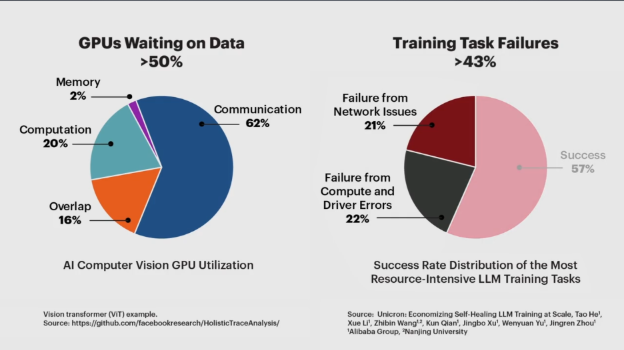
Underutilization of expensive GPU resources
One of the most costly inefficiencies in AI data centers is idle GPU time caused by networking delays or failures. Goldman Sachs projects that leading tech giants, various companies, and utilities will collectively invest around $1 trillion in capital expenditures by 2030. Many AI training task failures stem from network or compute issues. When a single transceiver or cable underperforms, it can stall an entire training run, leaving millions of dollars worth of GPU infrastructure sitting idle. These inefficiencies directly extend job completion times (JCT), delaying outcomes and reducing the return on investment.
Rising costs of high-speed interconnect upgrades
Upgrading from traditional interconnects to 800G or 1.6T Ethernet is not only technically complex but financially demanding. The infrastructure shift requires advanced optical transceivers, switches, and highly specialized testing tools like bit error rate testers (BERTs) and high-bandwidth oscilloscopes. These upgrades are essential to maintain performance under AI workloads, but the expense of deployment and validating them at scale can be significant.
Costly trial-and-error in production environments
Testing new network designs in a live AI cluster carries financial risks. Any errors or inefficiencies discovered in production can reduce available computing resources and impact ongoing training tasks. Replicating full-scale AI environments in a lab is challenging due to space, thermal, and power constraints — raising the likelihood of costly problems surfacing only after deployment. Without accurate emulation, organizations face higher costs from late-stage troubleshooting or downtime.
Balancing training speed and budget
Training large AI models can take weeks or even months, consuming energy and tying up valuable compute infrastructure. Improving interconnect performance and network reliability can shorten training timelines, freeing up resources for other jobs and reducing overall operating costs. Each day of reduced training time can yield substantial financial savings, especially in hyperscale data centers where maximizing utilization and throughput directly impact operational costs.
Scaling manufacturing without compromising quality
Manufacturers of transceivers and interconnect components face pressure to meet growing demand quickly, but rushing production can introduce defects that degrade performance or cause failure. Failures in the field can lead to expensive recalls, reduced trust in hardware, and the cost of diagnosing and replacing faulty units in live systems.
Meet Keysight AI Data Center Test Solutions
Keysight introduces the Keysight Artificial Intelligence (KAI) architecture, a portfolio of end-to-end solutions designed to help customers scale AI processing capacity in data centers by validating AI cluster components using real-world AI workload emulation. Keysight provides multilayer validation — from the physical layer (signal integrity, TDECQ, BER) to protocol-level emulation (Layer 2 / 3 traffic, congestion, FEC tail analysis). This approach ensures every component, link, and system behaves as expected under real-world AI workloads, reducing failures and idle time.
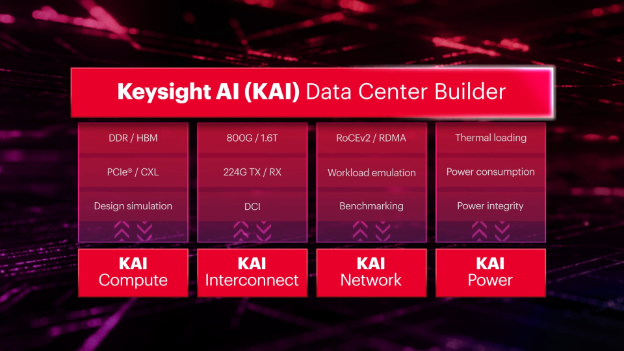
The Keysight AI (KAI) Data Center Builder emulates full-scale AI workloads using realistic traffic patterns in a lab setting, allowing architects to visualize every data flow in their network. This solution enables organizations to validate network configurations, job completion time (JCT), and congestion behavior without occupying production GPUs — reducing bottlenecks and saving time, compute resources, and budget.
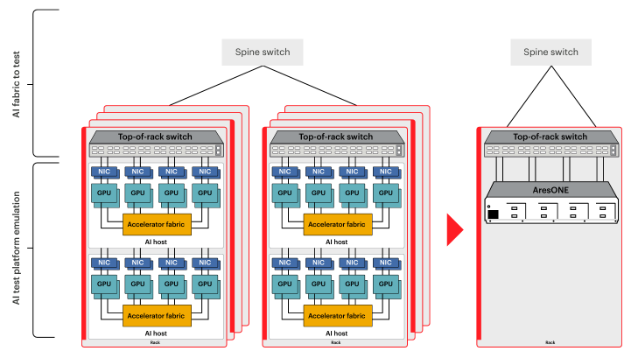
Products like the INPT-1600GE and Interconnect Test System (ITS) software offer advanced tools to test and optimize 1.6TE interconnects , components, and high-speed cables. Keysight’s DCA-M optical sampling oscilloscopes can help scaling 1.6T production with high-throughput optical testing. These tools ensure reliable signal integrity and interoperability before deployment, protecting infrastructure investments.
Boosting AI Capacity in Data Centers
Scaling AI infrastructure comes with high financial and technical stakes. Keysight helps organizations reduce risk, accelerate deployment, and maximize return on AI infrastructure investments through end-to-end validation, advanced traffic emulation, and scalable manufacturing test solutions. By ensuring performance at every layer — from physical to application layers — Keysight enables data center developers and network architects to scale confidently with a robust end-to-end AI infrastructure validation solution.