
Step Into an Exciting Future Powered by 6G and AI
Key takeaways:
- 6G is expected to propel us into 24/7 anywhere-in-the-world connectivity, humongous data rates, and ultra-low latency like we've never experienced before.
- The high performance expected from 6G could open up exciting new applications for artificial intelligence (AI) and machine learning (ML) in various sectors that are bottlenecked by current communication systems.
- 6G and AI could launch entire new industries, like holographic telepresence, fully autonomous factories, immersive gaming, and more, and the time to start preparing for them is now.
Want to start a delivery network for your corner of the world using a swarm of autonomous drones? How about a fully automated factory to manufacture those drones? And after running your drone business for the day, why not relax by stepping into an immersive game where your 3D hologram is one of the characters?
These are the dreams that 6G and AI could turn into real-world businesses in the coming decade. But what exactly makes 6G so special? And what does it have to do with AI anyway?
In this blog post, find out how 6G and AI could open up new synergies in key industries, like automotive, manufacturing, defense, consumer electronics, gaming, and more.
How will 6G performance compare with 5G networks?

Figure 1. 6G vs. 5G performance (Image source: How to Revolutionize 6G Research With AI-Driven Design)
The development of 6G will be guided by how the International Telecommunication Union (ITU) envisions mobile networks and technology trends in 2030 and beyond. Performance standards for 6G have not yet been defined. The Third Generation Partnership Project (3GPP) is expected to define them based on the ITU's vision by around 2028. Some of the envisioned parameters are impressive:
- Peak data rates are anticipated to reach 200 gigabits per second (Gbps) to several terabits per second (Tbps) in the terahertz (THz) bands. Consumers could enjoy 300-500 megabits per second (Mbps) on average.
- Latency is expected to be kept very low — 0.1 milliseconds (ms) for the air interface, one ms end-to-end in industrial environments, and a few ms for cellular vehicle-to-everything (V2X).
- Device densities of 1 million to 100 million devices per square kilometer (km) could be possible.
- Mobility speeds of 500-1,000 km per hour could be achieved, enabling 6G for aircraft, drones, and high-speed trains.
- Precise positioning within 1-10 centimeters (cm) is being envisioned.
- Ubiquitous worldwide connectivity is hoped for through cell-free architectures and non-terrestrial networks (NTNs).
What new AI capabilities will be possible because of 6G's extreme performance?
The network performance of 6G is expected to unlock several new AI-powered use cases, like ubiquitous self-driving, brain-computer interfaces, immersive holographic telepresence, real-time digital twins, and more. Let's explore each of these.
Pervasive edge intelligence and multi-access edge computing (MEC)

Figure 2. What pervasive edge intelligence might look like in 6G, assuming its RAN architecture will be similar to 5G
We first look at the MEC and pervasive edge intelligence because they could dramatically expand and democratize the compute fabric needed for AI.
MEC would involve:
- deploying compute hardware in the mobile towers and base stations of a 6G communication provider's radio access network (RAN)
- utilizing the computing capacity of user devices like smartphones
MEC could potentially enable data serving or server-side processing close to users to achieve sub-millisecond latency in:
- real-time communications
- industrial Internet of Things (IoT)
- V2X
- content delivery networks
- social media and streaming services
Pervasive edge intelligence is possible when some of this edge hardware is AI-capable, like graphics processing units in network elements and neural processing units in user devices. They enable AI approaches like:
- on-device model training and inference
- distributed AI, where data and models are partitioned across a centralized system consisting of AI data centers and edge devices
- federated learning, where edge devices participate in decentralized AI training and inference
- online learning, with AI models updating dynamically whenever network or system conditions change
Autonomous mobility with 6G and AI
Edge AI / ML would be essential for:
- real-time obstacle and collision detection based on cameras, radars, and other sensors
- real-time understanding of local traffic conditions based on V2X data and visuals from nearby vehicles and road cameras
However, a vehicle at 30 miles per hour moves by 11 feet within half a second. A typical car camera feed would require several Mbps to upload to the V2X network within milliseconds. So, for safe self-driving, 6G's MEC, high data rate, sub-millisecond latency, and centimeter positioning are all critical.
Smart city management with 6G and AI
For real-time traffic management, powerful AI would be essential to understand the high-volume data from road cameras and vehicle-to-infrastructure (V2I) sensors. Edge AI and high data rates of 6G could enable such real-time comprehension.
6G and AI for smart factories
AI will be crucial to operate automated guided vehicles (AGVs) and other Industry 4.0 smart equipment.
Industrial 6G could provide the ultra-low latency communications, precise positioning, and edge AI needed for:
- machine remote control
- sensing, transmission, and fusion of data from thousands of wireless industrialIoT devices
Drone surveillance and analytics
Connectivity, compute, and bandwidth bottlenecks restrict the range and use of drones. With 6G's promises of ubiquitous presence, edge AI, precise positioning, and high bandwidths, more capable drones could be built for:
- remote rescue missions that require real-time autonomous decision-making using computer vision
- remote equipment monitoring and visual inspections
- constant perimeter patrolling of industrial facilities for physical security
Drones and balloons could also function as base stations with AI-driven components as part of 6G NTNs.
Private 6G networks
Private 6G is expected to boost secure automation of operations in large facilities like airports, seaports, and mines.
6G and AI for defense
AI could propel drone capabilities with the help of 6G's anticipated higher bandwidth, powerful edge computing, and expanded reach through NTNs.
6G could fulfill the U.S. military's Joint All-Domain Command and Control strategy for secure, resilient, ubiquitous, private mobile networks that can be set up quickly anywhere. 6G and AI are expected to fuse communication and sensing for real-time situational awareness. They could also help train soldiers for combat using immersive technologies.
Immersive holographic telepresence

Holographic telepresence is like science fiction come to reality! It shows realistic 3D avatars of people on special holographic displays for immersive virtual reality (VR), augmented reality (AR), and mixed reality (MR). It's useful for:
- next-generation communications and presentations with accurate 3D versions of participants, including realistic facial expressions and body language
- immersive gaming and e-sports
Using multiple cameras and sensors, edge AI vision models create accurate 3D representations of a person's face and body. This high-volume data would be compressed by autoencoder models and transmitted to AI data centers over 6G and high-speed data center networks. At the other end, the 3D representations would be reconstructed in real time using AI compute in data centers and edge AI.
The high bandwidth and edge AI of 6G could turn out to be crucial for:
- transmitting and compressing the high-volume input and output data
- quickly downloading the powerful AI vision models with billions of parameters
- running these AI models wholly or partially on edge devices, including mobile towers
Brain-computer interfaces
AI models interpret complex neural signals and translate them into commands to remote devices like drones or industrial machinery. The high volume of neural data and complex models would require the high data rates and edge AI promised by 6G.
Swarm intelligence
AI algorithms can coordinate vast swarms of AGVs and drones during industrial, environmental, rescue, and military operations. The high device density and data bandwidth of 6G could be essential for such complex orchestration.
How will 6G networks enhance real-time AI applications like autonomous vehicles and robotics?
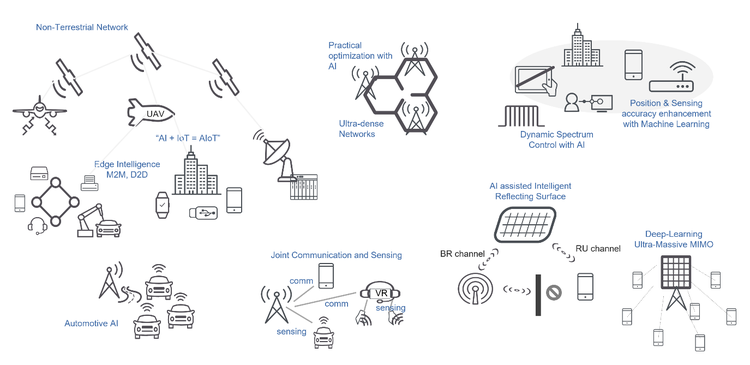
Figure 3. AI integration across 6G networks (Image source: How to Revolutionize 6G Research With AI-Driven Design)
Ultra-low latency (100 microseconds) and high reliability (an air interface error probability as low as 10-5 to 10-7), promised by 6G, would be essential for real-time, mission-critical AI applications in the various sectors outlined below.
Autonomous vehicles
Ultra-low latency will be crucial for the AI-driven control units in self-driving vehicles to make split-second decisions based on real-time data from their own sensors (cameras, radars, and lidars), other vehicles, infrastructure, and pedestrians. Edge AI could process the sensor data locally to prevent collisions and allow for immediate responses to hazards. High reliability and resilience would be needed from 6G for collision avoidance and emergency braking.
Real-time defense using 6G and AI
6G wireless networks and 6G NTNs could potentially be more resilient than vulnerable undersea or underground cables. They could provide secure wireless communication between soldiers and AI-driven autonomous vehicles for fast, accurate targeting, monitoring, and logistical support.
The anticipated use of integrated sensing and communication (ISAC) in 6G could become crucial for protecting national security and public safety from hostile drone attacks.
Industrial robotics with 6G and AI
Edge AI and 6G could enable more intelligent, self-learning robotics in smart factories. Precise localization, reliable communication, ML-based predictive maintenance, and AI-driven quality control could be possible.
How does 6G enable AI at the edge (edge AI)?
First, it is hoped that 6G will solve the network bottlenecks that limit today's edge AI. For use cases where edge AI will be crucial, like immersive telepresence, 6G is expected to provide big fast data pipelines that can send large volumes of input sensor data to the edge AI and transfer out the large volumes of processing results.
It is hoped that 6G would become a seamless ultra-low-latency invisible channel, transferring data so quickly that a user would not perceive the massive amounts of distributed computing going on behind the scenes.
Second, under 6G, its entire communication fabric is expected to become a distributed, intelligent, multi-access edge computing platform. Base stations and user devices could be made capable of running AI models. Split computing would enable the offloading of computations from resource-constrained mobile devices (like AR glasses) to more powerful resources in the network, like MEC servers.
Applications could distribute data and model weights over 6G cloud and edge devices for model training or inference. AI computing would be brought as close as possible to users to support AR/VR, smart cities, industrial automation, and more.
The following applications could be enabled by edge AI:
- AR / VR / MR and extended reality: They would enable high-fidelity holographic telepresence, immersive gaming, and virtual training.
- Smart cities: Edge AI, powered by 6G, could monitor air quality, optimize smart energy grids, and enable autonomous public transport systems.
- Industrial automation: Edge AI could optimize industrial processes through real-time monitoring of machinery, predictive maintenance, and AI-driven quality control.
How can 6G ISAC support next-gen AI models?

Figure 4. A reference 6G digital twin network architecture (Image source: Next-Generation Wireless: A Guide to the Fundamentals of 6G)
The expected ability of 6G to sense location, motion, and context supplies much richer data into AI systems for the use cases outlined below:
- Dynamic communication network management: Using ISAC, AI models could dynamically handle changing network and propagation conditions by modifying resource allocation, antennas, wireless channels, modulation, signal processing, beamforming, handovers, and more.
- Autonomous mobility: ISAC could collect massive amounts of real-time local data for better cooperative perception between vehicles.
- Smart factories: ISAC could enable collaborative robots to adjust their behaviors based on the nature of objects (like fragility). It could also support real-time monitoring of machinery for predictive maintenance and AI-driven quality control.
- Real-time digital twins: ISAC, high bandwidth, and edge AI could enable businesses to create realistic virtual models of critical physical systems and processes. Such digital twins could enable telecom providers, city managers, and airport administrators to experiment on their virtual models without disrupting critical physical systems.
How does 6G improve the performance and scalability of AI models?
Edge computing, ultra-low latency, high throughput, and massive connectivity promised by 6G would facilitate large-scale distributed AI training and inference.
High bandwidth of 6G would enable seamless transfer of high volumes of data, including training and validation datasets, model weights of large complex models, and gradient aggregation parameters.
High device density would enable hundreds of mobile and edge devices to participate in distributed or federated learning and inference to achieve unprecedented scalability.
ISAC could open up the possibility of online learning once massive volumes of fresh, real-time data become available.
What are the major challenges in integrating 6G and AI?
The integration of AI and 6G is expected to involve many challenges, including data privacy, explainability of AI models, resource constraints, and standardization hurdles. Business and technical leaders in this space must plan for the key challenges below.
Ensuring data privacy and security
The unprecedented volume of data and computing in AI-enabled 6G networks would drastically expand the attack surface. Robust AI-aware vulnerability detection, data security, and privacy policies would be crucial.
The goal of semantically understanding 6G traffic could come in tension with data privacy and security concerns. Telecom providers could consider segmenting their networks for different tradeoffs on these aspects, possibly through 6G network slicing.
Aiming for explainability of AI models
As AI would become increasingly autonomous while managing critical 6G networks, engineers and operators would need to implicitly trust its logic. AI-driven decision-making in areas like spectrum usage or energy efficiency would have to be justifiable to communication and environmental regulators.
Managing resource constraints
Sophisticated future AI models could exceed available computing resources every now and then. Organizations must plan for such conditions by using federated learning, computation offloading, and similar measures.
Anticipating standardization hurdles
Achieving global standardization and interoperability across regions, regulatory domains, and network operators could become a major challenge.
Additionally, although 6G is expected to be AI-enabled, the AI ecosystem itself may not be fully standardized. Key aspects — like model weights, data storage layout in memory, or split computing between user devices and networks — could remain open issues. It's currently unknown if 3GPP plans to specify comprehensive standards for all these aspects. Too much discretion for operators may lead to severe interoperability issues in multi-vendor deployments and roaming scenarios.
How does Keysight enable 6G and AI?

Figure 5. Keysight solutions for 6G
Keysight's 6G andAI expertise would enable communication service providers, network vendors, and device manufacturers to stay ahead of the 6G curve and be ready for 6G standards from day one.
6G testing solutions
Keysight has been advancing 6G through:
For RAN and air interface radio frequency (RF) design and validation, Keysight provides these solutions:
- 6G FR3 System Testing software enables end-to-end system testing of FR3 bands using channel emulation.
- UeSIM RAN Testing Toolset can emulate thousands of user devices for RAN testing.
- Channel Studio (RaySim) provides radio wave propagation and AI / ML model training for 6G radio systems and transceivers.
- System Design enables AI / ML network optimizations using RF system models.
- EXata Network Emulation and Modeling helps you design and validate entire 6G and NTN networks using digital twins.
- 6G sub-terahertz testbed enables 6G hardware testing and signal generation.
- 6G Vector Component Analysis solution allows network analysis of 6G bands.
Automotive V2X and C-V2X solutions
Automotive companies and V2X vendors can test their systems using Keysight V2X and C-V2X solutions.
AI data centers and photonic networks
Keysight provides hardware and software to design and test photonics and interconnects for data center optical fiber networks.
Such high-speed 800G/1.6T data centers are likely to become critical backend infrastructure for 6G and AI technologies.
Keysight also enables such data center operators to optimize power consumption for maximum performance and energy efficiency.
Semiconductor design tools for AI chips
It's anticipated that 6G terahertz chips will require new 3D designs like gate-all-around and nanosheets. Keysight provides several electronic design automation tools to design and simulate next-gen AI chips.
Accelerate your 6G and AI systems with Keysight
In this blog post, we looked at how 6G mobile communications could unlock new AI applications in different industries.
Keysight can help you reliably prepare for this exciting future with our hardware and software solutions.
Contact us for expert advice on designing and testing your 6G and AI systems