


Title
Temperature and Altitude
Tech Guide
DO-160 Testing
A Pre-Compliance Guide to Passing Sections 16 and 17

You booked the accredited lab months ago, the unit ships next week, and one voltage spike on the power input could force a re-test you cannot fit into the schedule.
DO-160 testing can feel like a pass-or-slip gate, especially when most accredited lab guidance ends with the same next step: send it in.
This guide takes a more practical angle. You will learn what DO-160 tests, why units fail Sections 16 and 17 at the lab, and how to screen those power-input disturbances on your own bench before formal submission.
As the OEM behind the instruments, the Official Keysight Used Equipment Store helps you compare pre-compliance bench options with a clearer view of calibration, configuration, warranty, and support.
Summary
- DO-160 is the RTCA standard for environmental qualification of airborne equipment. Section 16 (Power Input) and Section 17 (Voltage Spike) cover the power disturbances you can most usefully screen in-house.
- A failed run is where the cost climbs. An accredited re-test cycle commonly runs $20,000 to $50,000, and full testing takes 4 to 12 weeks, so catching a failure on your bench pays for itself.
- The spec that makes in-house capture credible: a 14-bit ADC helps resolve small disturbances on a 28 V rail, and deep memory preserves sample rate across a long interruption and recovery window.
- The instrument is the Keysight InfiniiVision HD3 (HD304MSO), available certified used. Used InfiniiVision MSOX and Infiniium models cover mainstream to higher-channel work.
- Certified used can save 40 to 90% versus new, with up to 5 years warranty options. Keysight Premium Used adds OEM remanufacturing and a final 101-point quality inspection.
What Is DO-160 Testing?
DO-160 testing qualifies airborne equipment against the environmental conditions and test procedures in RTCA DO-160. The standard’s full title is Environmental Conditions and Test Procedures for Airborne Equipment. Published by RTCA, it serves as aviation’s environmental test standard for airborne equipment on fixed-wing aircraft and helicopters. It covers the climatic, dynamic, power, and electromagnetic stresses an aircraft installation can place on a line-replaceable unit. Teams certifying avionics, defense, or advanced air-mobility hardware for flight often run a scoped set of DO-160 tests.
The standard carries regulatory weight. In the United States, the Federal Aviation Administration (FAA) recognizes DO-160 as an acceptable means of environmental qualification for airborne equipment, and it points to revision G for new articles. As of July 2026, DO-160G remains the current published revision, published in 2010 and referenced by FAA Advisory Circular AC 21-16G. DO-160H is in final development, so confirm the applicable revision before starting a new qualification program. RTCA DO-160 testing verifies whether airborne equipment can maintain required performance under defined environmental test conditions.Each section pairs test methods with pass criteria, which makes DO-160 a performance test standard as well as an environmental one.
Treat DO-160 as a test campaign to plan and budget for, not a single test you book and forget.The sections you run, the order you run them, and the failures you catch early all shape the schedule and cost. For an equipment-focused companion, see the Keysight avionics test guide for DO-160 and ARINC 429 and the aerospace and defense used equipment hub.
How Many Sections Does DO-160 Have, and Which Ones Matter Most?
DO-160 has 26 sections plus 3 appendices. The climatic and dynamic sections cover temperature, altitude, humidity and condensation, water and fluids susceptibility, sand and dust, fungus, salt fog, icing conditions, vibration, and shock. Most need an accredited laboratory chamber or shaker. Most DO-160 aerospace testing campaigns run a subset based on the equipment type and its aircraft installation location.
For avionics environmental testing, many electrical risks sit in the power and EMC sections, Sections 16 through 22. Within that group, Sections 16 and 17 stand out for in-house screening because they apply defined disturbances to the power input. You can reproduce many of those conditions on a bench with a supply, a generator, and an oscilloscope.
The table below maps the sections most relevant to electrical design and shows which ones you can realistically screen before the lab.
| Section | Title | What It Stresses | In-House Screenable |
|---|---|---|---|
| 4 | Temperature and Altitude | Climatic envelope | Limited (needs chamber) |
| 8 | Vibration | Mechanical/dynamic | Limited (needs shaker) |
| 16 | Power Input | Voltage range, interrupts, transients, ripple | Yes |
| 17 | Voltage Spike | Fast spikes on the power input | Yes |
| 18 | Audio Frequency Conducted Susceptibility | AF on power leads | Partial |
| 19 | Induced Signal Susceptibility | Coupled interference | Partial |
| 20 | RF Susceptibility | Radiated/conducted RF | Partial (needs RF gear) |
| 21 | Emission of RF Energy | Conducted/radiated emissions | Partial (needs receiver) |
| 22 | Lightning Induced Transient Susceptibility | Indirect lightning | Partial |
Section
Title
What It Stresses
In-House Screenable
4
Title
Climatic envelope
Climatic envelope
Title
Limited (needs chamber)
Limited (needs chamber)
8
Title
Vibration
Vibration
Title
Mechanical/dynamic
Mechanical/dynamic
Title
Limited (needs shaker)
Limited (needs shaker)
16
Title
Power Input
Power Input
Title
Voltage range, interrupts, transients, ripple
Voltage range, interrupts, transients, ripple
Title
Yes
Yes
17
Title
Voltage Spike
Voltage Spike
Title
Fast spikes on the power input
Fast spikes on the power input
Title
Yes
Yes
18
Title
Audio Frequency Conducted Susceptibility
Audio Frequency Conducted Susceptibility
Title
AF on power leads
AF on power leads
Title
Partial
Partial
19
Title
Induced Signal Susceptibility
Induced Signal Susceptibility
Title
Coupled interference
Coupled interference
Title
Partial
Partial
20
Title
RF Susceptibility
RF Susceptibility
Title
Radiated/conducted RF
Radiated/conducted RF
Title
Partial (needs RF gear)
Partial (needs RF gear)
21
Title
Emission of RF Energy
Emission of RF Energy
Title
Conducted/radiated emissions
Conducted/radiated emissions
Title
Partial (needs receiver)
Partial (needs receiver)
22
Title
Lightning Induced Transient Susceptibility
Lightning Induced Transient Susceptibility
Title
Indirect lightning
Indirect lightning
Title
Partial
Partial
For the emissions testing, the matching instrument is a measuring receiver such as the used N9048A/B PXE EMI test receiver. For the terms in this guide, the oscilloscope glossary is a quick reference.
What Do DO-160 Sections 16 and 17 Actually Test?
These two sections are the technical core of an in-house pre-compliance bench, so it is worth knowing what each one applies.
DO-160 Section 16: Power Input
Section 16 verifies whether your equipment can tolerate the required range of aircraft-bus conditions. It applies normal and abnormal voltage, over and undervoltage, momentary power interruptions, voltage transients, and ripple, plus frequency variation on AC buses. Standard buses include 14 Vdc, 28 Vdc, and 270 Vdc, plus 115 or 230 Vrms at 400 Hz.
The measurement challenge is dynamic range. A power interruption and ride-through event can play out over a long window, while the disturbance you need to measure may be small. You need to see both the long event and the fine detail in the same capture.
DO-160 Section 17: Voltage Spike
Section 17 confirms the unit can withstand fast voltage spikes on its power inputs without damage or upset. The spike is roughly 10 microseconds long and is applied through a 50-ohm source impedance. Category A applies a 600-volt spike. Category B applies twice the AC RMS or DC line voltage, or 200 volts, whichever is less.
There is a useful cross-standard connection. Section 17 is analogous to the MIL-STD-461 CS106 voltage-spike method: the two address similar voltage-spike susceptibility risks, and some bench equipment can be reusable across both if it supports each standard's waveform, impedance, and calibration requirements. Verify each setup separately.
The exact Section 16 and 17 levels come from the standard and depend on the equipment category and installation. For Section 17, the voltage spike is roughly 10 microseconds long and applied through a 50-ohm source. Category A uses a 600-volt spike, while Category B uses twice the AC RMS or DC line voltage, or 200 volts, whichever is less.
| Test | Category A | Category B | What to Watch |
|---|---|---|---|
| Voltage spike (Sec 17) | 600 V, 10 µs, 50 Ω | 2x line or 200 V (lesser) | Reset, latch-up, recovery |
| Power interruption (Sec 16) | Defined drop and duration | Defined drop and duration | Rail droop, ride-through |
| Voltage transient (Sec 16) | Over and undervoltage steps | Over and undervoltage steps | Overshoot, recovery time |
| Ripple (Sec 16) | Bus-dependent | Bus-dependent | Amplitude on the rail |
Test
Category A
Category B
What to Watch
Voltage spike (Sec 17)
Title
600 V, 10 µs, 50 Ω
600 V, 10 µs, 50 Ω
Title
2x line or 200 V (lesser)
2x line or 200 V (lesser)
Title
Reset, latch-up, recovery
Reset, latch-up, recovery
Power interruption (Sec 16)
Title
Defined drop and duration
Defined drop and duration
Title
Defined drop and duration
Defined drop and duration
Title
Rail droop, ride-through
Rail droop, ride-through
Voltage transient (Sec 16)
Title
Over and undervoltage steps
Over and undervoltage steps
Title
Over and undervoltage steps
Over and undervoltage steps
Title
Overshoot, recovery time
Overshoot, recovery time
Ripple (Sec 16)
Title
Bus-dependent
Bus-dependent
Title
Bus-dependent
Bus-dependent
Title
Amplitude on the rail
Amplitude on the rail
DO-160 categories are section-specific, so do not infer the required Section 17 category from a category used in another section. Verify the exact test requirements for your installation, including category, test levels, and waveform, in the standard before you build the bench. See the accredited-lab summaries of DO-160 Section 16 and Section 17 for a second reference.
You bring the unit, we will help you spec the bench to screen Sections 16 and 17. Browse the certified used inventory and request a quote.
Why Do Units Fail DO-160 at the Lab, and What Does It Cost?
Qualification failures can happen, and the larger cost often comes from the re-test, not the initial test. Industry data commonly attributed to an Intertek study indicates that roughly 50% of products fail EMI/EMC testing on the initial attempt, with a further 5 to 7% failing the re-test. Each failed cycle can force redesign, re-booking, and re-testing.
The numbers can add up fast. An accredited re-test cycle commonly runs $20,000 to $50,000, and full DO-160 testing takes 4 to 12 weeks (Compliance Engineering, citing Intertek). A failure is rarely one charge. It can include the re-test fee, debug time, and the schedule hit of re-booking the lab.
The delay itself carries a measurable cost. A Keysight-commissioned survey of 305 test engineers, published in Avoid Costly Delays with Priority Access to Expert Resources, found that more than 90% of companies reported revenue loss because of preventable equipment-related delays, and 53% reported $100,000 or more of waste per day while waiting to resolve a critical issue. Electronic Specifier reported the same survey findings independently.
Every Section 16 or 17 issue you catch on your bench is one less failure to discover at the lab. For the broader economics, see Keysight's fundamentals of EMC pre-compliance.
How Do You Screen DO-160 Sections 16 and 17 In-House Before the Lab?
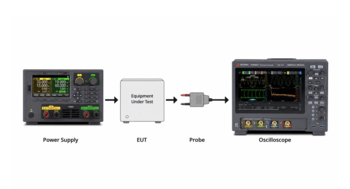
In-house pre-compliance screening is a bench rehearsal for the lab’s power-input and voltage-spike tests.You power the unit, apply the disturbance, and capture what happens at the power input before formal submission.The formal test conducted under the program's approved qualification and certification process still follows, but you enter it with fewer unknowns.
The bench rehearsal follows four steps:
- Power the unit from a programmable supply or apply the spike with a generator that reproduces the Section 16 or 17 disturbance.
- Probe the power input with an isolated or differential probe rated for the bus voltage and the expected spike level.
- Capture the event on a high-resolution oscilloscope with deep memory.
- Review the response for rail droop during an interruption, ripple amplitude against the limit, and whether the unit resets, latches, or recovers after a spike.
These are the signatures that often lead to lab failures, and they are easier to see on a bench oscilloscope with enough resolution and memory.
Correlate power and bus behavior where you can. Capture a Section 16 or 17 power event alongside ARINC 429 or MIL-STD-1553 bus traffic on one instrument, because intermittent avionics faults can appear when a power event overlaps with a bus transaction. A multi-channel mixed-signal oscilloscope lets you see both at once.
Keep the evidence traceable. Use calibrated instruments and export the waveform records so the data can support the qualification package.To set up probing and capture, see how to select oscilloscope probes, oscilloscope triggering to isolate a rare spike, and current probes for inrush.
You do not have to build this bench from a blank sheet. Tell us your DO-160 sections, your bus voltages, and your timeline, and we will spec a pre-compliance setup from certified used
What Instrument Specs Make In-House Transient Capture Credible?
Your bench is only as trustworthy as the instrument's resolution, noise floor, and memory. Get these right, and your screen is more credible. Get them wrong, and you may miss the issue the lab will later catch.
Start with vertical resolution. A 14-bit ADC offers 64 times the quantization resolution of a conventional 8-bit oscilloscope, which matters when a small disturbance rides on a 28 V rail. Usable resolution also depends on the noise floor, which is why Effective Number of Bits matters more than headline bit depth. Keysight's InfiniiVision HD3 pairs a 14-bit ADC with a 50 microvolt RMS noise floor and deep memory to deliver 4 times the resolution and half the noise floor of general-purpose oscilloscopes (Keysight Application Note 5991-4088; InfiniiVision HD3, 2024).
Memory depth comes next. Deep memory preserves sample rate over long interruption and recovery windows and keeps detailed pre-trigger and post-trigger context around short transients. Channel count follows: a 4-analog-plus-16-digital mixed-signal oscilloscope correlates multiple rails and buses at once.
The buying rule is simple. Match the instrument specs to the DO-160 condition, not to the brochure. The table below maps each spec to the requirement it serves.
| Spec | What It Controls | Why It Matters for DO-160 16/17 |
|---|---|---|
| 14-bit ADC | Vertical resolution | Helps resolve small ripple or droop on a 28 V rail |
| Low noise floor (ENOB) | Real measurement accuracy | Keeps small disturbances out of the noise |
| Deep memory | Capture time at full rate | Holds a long interrupt and a fast spike together |
| 4 analog + 16 digital | Simultaneous views | Correlates rails with ARINC 429 / MIL-STD-1553 |
| Isolated/differential probe | Isolated high-voltage capture | Captures a 600 V spike when its differential, common-mode, and transient ratings cover the setup. |
Spec
What It Controls
Why It Matters for DO-160 16/17
14-bit ADC
Title
Vertical resolution
Vertical resolution
Title
Helps resolve small ripple or droop on a 28 V rail
Helps resolve small ripple or droop on a 28 V rail
Low noise floor (ENOB)
Title
Real measurement accuracy
Real measurement accuracy
Title
Keeps small disturbances out of the noise
Keeps small disturbances out of the noise
Deep memory
Title
Capture time at full rate
Capture time at full rate
Title
Holds a long interrupt and a fast spike together
Holds a long interrupt and a fast spike together
4 analog + 16 digital
Title
Simultaneous views
Simultaneous views
Title
Correlates rails with ARINC 429 / MIL-STD-1553
Correlates rails with ARINC 429 / MIL-STD-1553
Isolated/differential probe
Title
Isolated high-voltage capture
Isolated high-voltage capture
Title
Captures a 600 V spike when its differential, common-mode, and transient ratings cover the setup.
Captures a 600 V spike when its differential, common-mode, and transient ratings cover the setup.
For the fundamentals, see the oscilloscope performance basics and the signal integrity glossary entry, or start at the oscilloscope basics hub.
Which Keysight Oscilloscope Fits DO-160 Pre-Compliance?
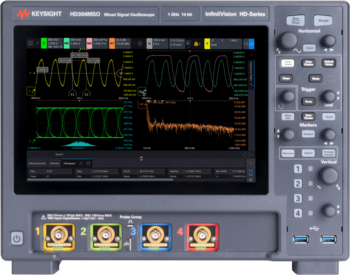
For DO-160 Section 16 and 17 screening, the recommended instrument is the Keysight InfiniiVision HD3 (HD304MSO). Its native 14-bit ADC resolves 16,384 vertical levels, its low-noise front end reaches a 50 µVRMS noise floor, and up to 100 Mpts of memory preserves sample rate across a long interruption and recovery window. The HD3 offers 4 analog plus 16 digital channels and spans 200 MHz to 1 GHz bandwidth. With the right decode option, it can correlate ARINC 429 or MIL-STD-1553 traffic alongside the power rails.
Think of the lineup as a value-to-capability ladder. Used InfiniiVision MSOX models cover mainstream multi-bus screening at a lower price than new. Higher-channel Infiniium MXR and MSOS models suit power-plus-bus work that needs more channels or bandwidth. Buying certified used or OEM-remanufactured can put that capability on your bench at a lower price than new.
Check live stock and pricing by tier: the Keysight InfiniiVision HD3 (HD304MSO) for 14-bit Section 16/17 capture, the InfiniiVision MSOX4154A for mainstream multi-bus screening, and the Infiniium MXR608A for 8-channel power-plus-bus work.
Three things decide whether a given HD3 listing will actually screen your sections, so confirm them on the product page before you order:
- Memory depth, because a Section 16 interruption and recovery window has to fit in one acquisition at a sample rate that still resolves fast detail. Confirm the memory option on the listing rather than assuming the platform maximum.
- The aerospace decode package (HD300AERA), if you intend to correlate ARINC 429 or MIL-STD-1553 traffic with the power rails. It is a licensed option, so check whether it is already enabled.
- Calibration status and included probes, since your Section 16 and 17 records have to be traceable, and the isolated or differential probe rated for your bus and spike level may not be part of the listing.
| Class | Example Used Models | Channels | Suits |
|---|---|---|---|
| Essential | InfiniiVision MSOX 2000/3000T X-Series, InfiniiVision HD3 (HD304MSO) | 2 to 4 analog + 8 to 16 digital | Mainstream screening; the HD3 adds 14-bit resolution for Section 16/17 capture |
| Advanced | InfiniiVision MSOX 4000 X-Series | 4 analog + 16 digital | Multi-bus debug, faster edges |
| Expert | Infiniium MXR-Series, and the prior-generation MSOS-series in used inventory | Up to 8 analog, or 4 analog + 8 digital | Higher bandwidth, deeper analysis |
Class
Example Used Models
Channels
Suits
Essential
Title
InfiniiVision MSOX 2000/3000T X-Series, InfiniiVision HD3 (HD304MSO)
InfiniiVision MSOX 2000/3000T X-Series, InfiniiVision HD3 (HD304MSO)
Title
2 to 4 analog + 8 to 16 digital
2 to 4 analog + 8 to 16 digital
Title
Mainstream screening; the HD3 adds 14-bit resolution for Section 16/17 capture
Mainstream screening; the HD3 adds 14-bit resolution for Section 16/17 capture
Advanced
Title
InfiniiVision MSOX 4000 X-Series
InfiniiVision MSOX 4000 X-Series
Title
4 analog + 16 digital
4 analog + 16 digital
Title
Multi-bus debug, faster edges
Multi-bus debug, faster edges
Expert
Title
Infiniium MXR-Series, and the prior-generation MSOS-series in used inventory
Infiniium MXR-Series, and the prior-generation MSOS-series in used inventory
Title
Up to 8 analog, or 4 analog + 8 digital
Up to 8 analog, or 4 analog + 8 digital
Title
Higher bandwidth, deeper analysis
Higher bandwidth, deeper analysis
What If the Configuration You Want Is Not in Stock?
Used inventory rotates, so a nearby configuration can often be brought up to the requirement. Availability changes as instruments are purchased and new units are listed. If the exact model or bandwidth is unavailable, check whether a close configuration supports what your Section 16 and 17 screening actually needs:
- Bandwidth on many InfiniiVision models can be upgraded after purchase, within the limits of the specific platform. For Section 16 and 17 work, vertical resolution and memory depth do more for the measurement than headline bandwidth, so a lower-bandwidth unit is often still the right instrument.
- Serial decode, including the aerospace package that covers ARINC 429 and MIL-STD-1553, is usually a software license, so it can often be added after purchase rather than deciding which unit you buy.
- Some DSOX models can be upgraded with mixed-signal capability through a software license plus the matching digital-channel probe kit, so a DSOX listing can be a practical alternative when the MSOX configuration you wanted is unavailable.
Supported options vary by model, current configuration, bandwidth, and platform, and the required license or probe kit may be priced separately from the listed instrument. Check the model-specific details, including the installed options and the supported upgrade ceiling, rather than relying on a series name alone. Confirm the upgrade path on the product page before you order, create an account for stock alerts, or tell us your DO-160 sections and bus voltages and we will match an available instrument when you request a quote.
Should You Buy a Used Oscilloscope for a DO-160 Bench?
It is reasonable to question a used instrument purchase, so let’s answer the concern directly. The doubt is usually about reliability, calibration, and support, not price. The price case is strong: certified used instruments can save 40 to 90% versus new, with up to 5 years warranty options.
The ownership math is where it gets clear. One avoided re-test cycle, at $20,000 to $50,000, can offset much of the cost of a certified used screening oscilloscope. After that, the bench can be reused across future qualification programs, so the savings can compound.
There is a sustainability case too. The UN Global E-waste Monitor 2024 reports a record 62 million tonnes of e-waste in 2022, with only 22.3% formally collected and recycled. Extending the working life of capable instruments through the refurbished market helps keep usable hardware out of the waste stream. That is a procurement target many teams now track.
| Dimension | Certified Used | New |
|---|---|---|
| Acquisition cost | 40 to 90% lower | Full list price |
| Warranty | Up to 5 years warranty options | Standard warranty |
| Quality | Inspected and tested by the OEM; Keysight Premium Used adds full remanufacturing and a final 101-point inspection. | Factory new |
| Support | KeysightCare access | KeysightCare access |
| Lead time | Often shorter (in stock) | Can be longer |
Dimension
Certified Used
New
Acquisition cost
Title
40 to 90% lower
40 to 90% lower
Title
Full list price
Full list price
Warranty
Title
Up to 5 years warranty options
Up to 5 years warranty options
Title
Standard warranty
Standard warranty
Quality
Title
Inspected and tested by the OEM; Keysight Premium Used adds full remanufacturing and a final 101-point inspection.
Inspected and tested by the OEM; Keysight Premium Used adds full remanufacturing and a final 101-point inspection.
Title
Factory new
Factory new
Support
Title
KeysightCare access
KeysightCare access
Title
KeysightCare access
KeysightCare access
Lead time
Title
Often shorter (in stock)
Often shorter (in stock)
Title
Can be longer
Can be longer
Before you compare on price alone, read why a low-priced scope can cost more.
What Does “Certified Used” Include?
Not all used is equal, and the source matters. Every instrument sold through the Official Keysight Used Equipment Store is inspected and tested by the OEM before it is listed, with calibration as stated on each unit and a fresh Keysight calibration option where offered. Up to 5 years of warranty options and KeysightCare technical support are available as options, and OEM software and hardware customization can be arranged so the unit matches your application.
Keysight Premium Used is the higher tier. Those instruments are OEM-remanufactured and tested to the same quality requirements as new, with current firmware, software, accessories, and warranty coverage, and each one passes a final 101-point quality inspection covering function, performance, and condition. The difference from broker refurbishment is the OEM behind the work.
Traceability matters for qualification evidence. A credible certified-used instrument is tested and calibrated so your measurements can link back through a documented chain. For the full picture, see the used oscilloscope buying guide and the 15 features to check before buying.
How Does Buying Direct From the OEM Remove the Risk?
Buying direct from the manufacturer changes the risk profile. You get OEM calibration and customization, warranty options, and a support team you can reach, instead of relying on a broker’s description. For procurement, that means a known supplier path, clearer lifecycle and end-of-support information, and in-stock equipment that may ship faster than a new-build order.
That addresses the main used-equipment concern. Used test equipment bought direct from the OEM keeps the savings while reducing the risks engineers and procurement teams often associate with used equipment: unclear condition, uncertain options, and limited support.
Browse the certified used inventory and request a quote.
Conclusion and Next Steps
Plan your DO-160 effort in four steps: scope the sections you actually need, screen Sections 16 and 17 in-house, size the instrument to the transient, and compare used versus new based on total cost. The capability you put in place now is reusable at every qualification push, so it pays off across the whole budget cycle, not just this program.
If you are scoping for a later purchase, create a complimentary Used Equipment Portal account to save favorites and get stock alerts. If you are ready now, browse the certified used inventory and request a quote.
Select up to 3 instruments to compare
Select another instrument to compare
![]()
Starting at
Select another instrument to compare
![]()
Starting at
Select another instrument to compare
![]()
Starting at
Whenever You’re Ready, Here Are
5 Ways We Can Help You
1
2
Call tech support US: +1 800 829-4444
Press #, then 2. Hours: 7am – 5pm MT, Mon– Fri
3
Contact our sales support team
4
Create an account to get price alerts and access to exclusive waitlists
5
Talk to your account manager about your specific needs
Frequently Asked Questions
DO-160 testing qualifies airborne equipment against RTCA DO-160 environmental conditions, covering climatic, dynamic, power, and EMC stresses. The FAA recognizes it as an acceptable means of environmental qualification. As of July 2026, DO-160G remains the current published revision, and DO-160H is in final development, so confirm the applicable revision before starting a new qualification program.
DO-160 has 26 sections plus 3 appendices. Most programs run a scoped subset. Sections 16 and 17 cover power input and voltage spike, which are the power input disturbances you can most usefully screen in-house before the lab.
Section 16 verifies whether your unit can tolerate required aircraft-bus conditions: normal and abnormal voltage, overvoltage and undervoltage, momentary interruptions, transients, and ripple on buses such as 28 Vdc, 270 Vdc, and 115 Vrms at 400 Hz.
Section 17 checks whether the unit can withstand fast spikes on its power inputs.The spike is roughly 10 microseconds through a 50-ohm source. Category A is 600 volts. Category B is twice the AC RMS or DC line voltage, or 200 volts, whichever is less.
Costs vary by section scope and lab, but the re-test is often the expensive part. An accredited re-test cycle commonly runs $20,000 to $50,000. Screening Sections 16 and 17 in-house before submission helps reduce the risk of that repeat charge.
Full DO-160 testing commonly takes 4 to 12 weeks depending on the section scope and lab queue. A re-test after a failure can add another booking and weeks of delay. Pre-compliance screening helps reduce that schedule risk.
Yes. You rehearse the lab's power-input and spike tests on a bench: power the unit, probe the power input with an isolated or differential probe, and capture the transient on a high-resolution oscilloscope before formal submission. The formal test under the program's approved qualification and certification process still follows.
In-house Section 16/17 screening may use a programmable supply, a spike generator, an isolated or differential high-voltage probe, and a high-resolution oscilloscope with deep memory, such as the Keysight InfiniiVision HD3. The formal, calibrated test setup comes from the program's approved test organization.
Used inventory rotates as instruments are purchased and new units are listed. Bandwidth, decode licenses, and mixed-signal capability can often be added after purchase within the limits of the specific platform, so a close configuration may still meet the need. Set a stock alert or request a quote, and we will match an available instrument.
Section 17 and MIL-STD-461 CS106 are analogous voltage-spike methods that address similar susceptibility risks. Some bench equipment can serve both if it supports each standard's waveform, impedance, and calibration requirements, so verify each setup separately before reusing it across avionics and military power-qualification work.
DO-160 and MIL-STD-810 both define environmental test methods, but for different fleets. DO-160 supports environmental qualification for airborne equipment under RTCA and FAA recognition, while MIL-STD-810 defines environmental test methods used for United States military hardware.Defense avionics programs often test to both.
Certified used instruments are tested before sale, with calibration as stated on each listing, and Keysight Premium Used instruments also pass a final 101-point quality inspection. KeysightCare support is available as an option. Confirm the exact calibration status and included accessories on the listing before you order so your measurement evidence stays traceable.
Categories define test severity by installation environment. For Section 17 voltage spike, Category A applies a 600-volt spike, while Category B applies twice the line voltage or 200 volts, whichever is less. Your equipment’s aircraft installation location helps determine the category.