
Methods of Reflective Telescope Design - Part 3: Surface shape trades for pupil aberration control
In previous posts, we described a set of operating conditions:
- 500 mm entrance pupil diameter, with accessible entrance pupil in front of the imager (although the methods discussed in this article also apply when the entrance pupil is at the primary mirror).
- Field of view 4°x4°
- F/4.0 at the FPA
- Broad band infrared spectral band.
- At least mostly accessible field stop, for out-of-field stray light control.
- Accessible exit pupil (cold stop) at a high-quality image of the entrance pupil.
- Unobscured pupil, for maximum collection area and MTF performance.
We indicated why a reimaging reflective design with 3-5 mirrors is likely the best solution, and how using four or more mirrors, versus three mirrors, provided leverage to control pupil aberration in addition to wavefront error.
In this article, we will explore the results of using freeform mirror shapes as an alternative to rotationally symmetric aspheres. The specific performance metric to be optimized, in addition to wavefront error, is pupil aberration (the image of the entrance pupil at the cold stop). This will be illustrated with the 4-mirror configuration, Example 11 of the review article “Unobscured mirror designs” (Proceedings of the IODC, 2002; pdf copy available from Keysight).
Pupil aberration control
In a system with ideal pupil imaging, every ray through a given point on the entrance pupil will trace to the same point at the exit pupil. In an unobscured infrared system with a cold stop that is sized to prevent the FPA from viewing outside the entrance pupil, we care only about the pupil image quality at the perimeter of the entrance pupil. Degraded pupil imaging internal to the entrance pupil does not affect the stray light suppression in an unobscured system. (For a centrally obscured system, however, the pupil image must also be controlled at the obscured inner diameter of the pupil). See Figure 1 for a conceptual illustration of the unobscured pupil imaging condition.
To optimize the system for minimum pupil aberration at the perimeter of the entrance pupil, the simplest method is to target the X and Y coordinates of the marginal rays at the cold stop surface, from each field angle in the field of view, to be the same as the X and Y coordinates of the marginal rays from some reference field angle, typically on axis. If full control is achieved, the circular entrance pupil maps to a circular or elliptical image, with no marginal ray mismatch at the perimeter of the pupil image.
Using freeform surface shapes, such as Zernike polynomials, on the mirrors provides additional degrees of freedom that permit the design to have better control of pupil aberration in addition to control of wavefront aberration. To illustrate this, the folded 4-mirror imager was optimized with 8th order rotationally symmetric aspheres (ASP surface type in CODE V) on all four mirrors, and another case with 8th order Standard Zernike aspheres (SPS ZRN surface type) on all four mirrors. Figure 2 shows a layout of each version of the design.
Figure 3 shows the beam print of the image of the 500 mm diameter circular entrance pupil at the exit pupil plane, for both optimized designs. The figure is the overlay of beams from 25 different field angles across the 4°x4° total field of view. Ideally, all beams would exactly overlay, similar to the condition shown in Figure 1. Due to pupil aberration, overlay is imperfect for different field angles, requiring the limiting aperture at the cold stop to be undersized (losing light) to prevent the FPA from seeing outside the entrance pupil. As shown, the rotationally symmetric mirrors produce pupil blur of about 6% of the pupil diameter. In the design with the Zernike aspheres, the pupil blur is about 2%, a 3x reduction. In the Zernike asphere design, less undersizing of the cold stop aperture is needed, resulting in greater light collection.
In addition to controlling pupil aberration, the Zernike aspheres provide better control of wavefront error, as shown in Figure 4. Compared with the rotationally symmetric aspheres, the Zernike aspheres improve the RMS WFE by 27% at the worst-case field angle.
Freeform surfaces can also provide similar superiority over rotationally symmetric aspheres for controlling image distortion. In practice, there is usually a tradeoff between wavefront error and pupil aberration (and any other performance parameters such as image distortion). Improving one tends to degrade the others, for a given imager configuration, surface shape type, and envelope limitation. The designer adjusts the weighting on each type of aberration to get the best balance between them.

Figure 1. Conceptual illustration of ideal pupil imaging of perimeter of entrance pupil.
Marginal rays from all field angles through the upper edge of the entrance pupil trace to the same point on the exit pupil, and likewise for the lower, left, and right marginal rays.

Left: rotationally symmetric aspheres. Right: Zernike aspheres (both 8th order)

Figure 3. Beam print at exit pupil surface from a circular entrance pupil, from 25 field angles across the 4°x4° field of view.
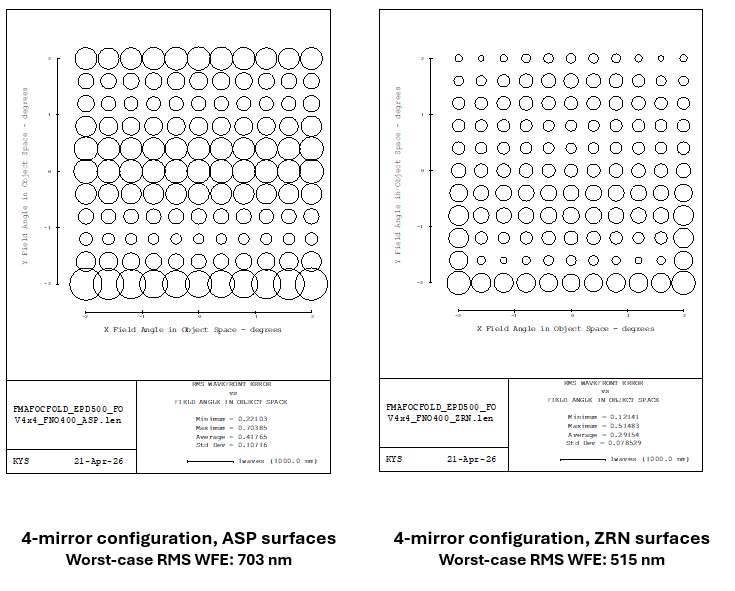
Diameter of circles indicate magnitude of RMS WFE at different field angles.
Get a recap on the previous posts:
Related Posts