
Methods of Reflective Telescope – Part 2: Design Configuration Trades
In a previous post, we described a set of operating conditions,
- 500 mm entrance pupil diameter, with accessible entrance pupil in front of the imager (although the methods discussed in this article also apply when the entrance pupil is at the primary mirror).
- Field of view 4°x4°
- F/4.0 at the FPA
- Broad band infrared spectral band.
- At least mostly accessible field stop, for out-of-field stray light control.
- Accessible exit pupil (cold stop) at a high-quality image of the entrance pupil.
- Unobscured pupil, for maximum collection area and MTF performance.
We indicated why a reimaging reflective design with 3-5 mirrors is likely the best solution. In this article, we begin to review the steps to determine which configuration is the best. Common trade parameters are the number of mirrors, and the complexity of the surface shape. Due to space limits, we will consider only design trades with mirror number. All mirror surfaces are 10th order rotationally symmetric polynomial (ASP type, in CODE V). In a future article, we will explore the results of using freeform mirror shapes instead of ASP.
Design configuration trade considerations
Assume that the performance metrics of interest are the wavefront error, and the quality of the pupil imaging between the entrance and exit pupils (exit pupil is at the cold stop). In attempting to meet performance, mass, and packaging goals, minimizing the number mirrors usually is the goal for lower cost, mass, tolerance stack up, and transmission. In some problems, it is not clear in advance how many mirrors are needed, so designs with different numbers of mirrors will be developed. My approach is to try to solve the problem with 3 mirrors; if that does not succeed, try 4 mirrors; etc.
Pupil aberration control can be the decisive factor in selecting the configuration in systems where that performance parameter is critical. This will be illustrated with 3- and 4-mirror configurations.
Design examples
The example configurations in this article are publicly known and generic, e.g. the 3- and 4-mirror configurations of Examples 5 and 11 of the review article “Unobscured mirror designs” (Proceedings of the IODC, 2002; pdf copy available from Keysight). Figure 1 shows layouts of the two configurations at the same scale.
The 3-mirror imager is a compact configuration that is widely used, but is limited in its ability to control pupil aberration. The 4-mirror imager is unavoidably less compact, but has the potential to control wavefront error, and, especially, pupil aberration, to lower levels.
Figure 2 shows the maps of RMS wavefront error (WFE) across the 4°x4° FOV for the two designs. The two designs provide comparable performance over the inner area of the FOV, but the 3-mirror loses the ability to control the full field. However, depending on how the wavefront performance requirement is defined (e.g. less than a particular value across 80% of the FOV area), the 3-mirror design might be acceptable and not be ruled out on the basis of WFE.
Figure 3 shows, for the two designs, beam prints at the exit pupil (projection of the circular entrance pupil onto the exit pupil). The 4-mirror design, with mirrors on both sides of the internal field stop, has more leverage to control the pupil aberration. In this example, it is at least a factor of 3 better than in the 3-mirror design. This is where the 4-mirror configuration stands out as the preferred solution. If the entrance pupil diameter aperture is fixed, then to avoid stray light from reaching the FPA from non-mirror surfaces, the cold stop aperture in the 3-mirror design would need to be downsized to the common transmitted area across all field angles, reducing the net collection area.
Starting points and optimization methods
Keysight’s Imaging Optical Design group has a library of hundreds of reflective designs from over 40 different configurations. Typically, one of these library items, with similar F/# and field of view to a new design requirement, is selected as a starting point.
The CODE V macro language provides tools for effectively controlling pupil aberration via user-defined constraints during optimization. Discussion of these tools is beyond the scope of this article, but information is available in CODE V training materials.

Figure 1. 3-mirror and 4-mirror configurations, layouts on the same scale.

Figure 2. Maps of RMS WFE across 4°x4° FOV, plotted at same scale. (In these plots, the horizontal and vertical axes indicate the X and Y field angles. The diameters of the small circles indicate the magnitude of the RMS WFE at the indicated location in the FOV).
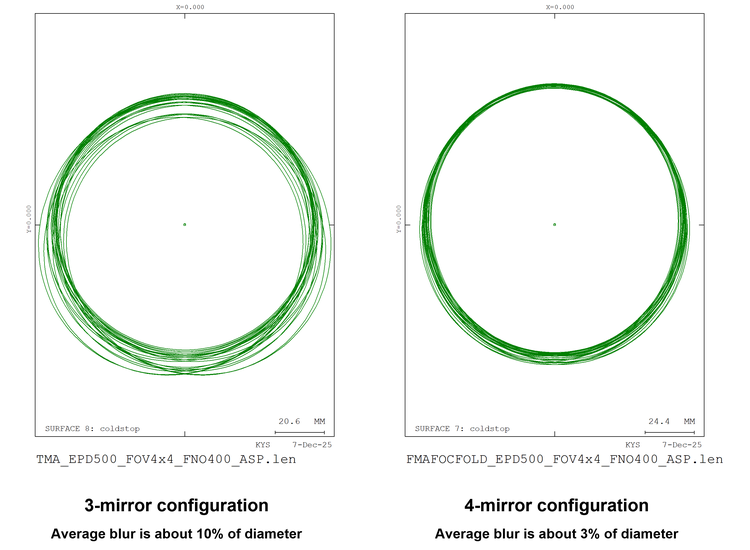
Figure 3. Beam print at exit pupil surface from a circular entrance pupil.