
How to Become an Optical Engineer
Education, Career Paths, and Industry Insights
In Part 1 of this series, we explored what optical engineers do and the wide range of systems they design.
But how do engineers actually enter the field?
Unlike some disciplines, there is no single path into optical engineering. Many professionals arrive through adjacent fields, practical experience, or a growing interest in working with light.
To understand how careers in optics develop, we spoke with optical engineers Eric Herman and Jeff Hoffman at Keysight Optical Design Engineering.
There Is No Single Path
One of the most consistent themes is that optical engineers rarely follow a straight path.
Herman describes his experience: “I didn’t originally plan to go into optics… I kind of had no idea what I wanted to do.”
His entry into the field began through a community college program focused on lasers and fiber optics, which eventually led to hands-on work and further study.
“The trajectory of my career is ways that I never would have thought.”
This kind of nonlinear path is common across the field.

Common Educational Backgrounds
While some universities offer dedicated optics programs, most engineers enter the field from related disciplines.
Herman explains, “Most people come from physics or electrical engineering because there are relatively few optics-specific programs.”
Hoffman reinforces this: “Optical engineers come from diverse backgrounds… including physics, electrical engineering, mechanical engineering, materials science, and others.”
Students may:
- pursue an optics-specific degree
- specialize within another engineering or science program
- transition into optics during graduate study
What to Study Plus Skills and Experience That Matter
There are key areas of study to build a strong foundation for optical engineering. They include:
- geometrical and physical optics
- imaging and illumination design
- lasers and photonics
- optical materials and coatings
- detectors and radiometry

Hoffman notes that a broad education helps. “Optical engineering draws from multiple disciplines, so a wide technical foundation is valuable.”
Key topics include geometrical optics, physical optics, imaging systems, lasers, and optical materials. To get started in the field, most roles require:
- a degree in optics, physics, or electrical engineering
- familiarity with optical design or simulation tools
- laboratory or hands-on experience
- programming or modeling skills
Internships and research experience are particularly important for building practical knowledge.
Hoffman also highlights the importance of:
- communication
- collaboration
- attention to detail
Entry Paths: Technician vs Engineer
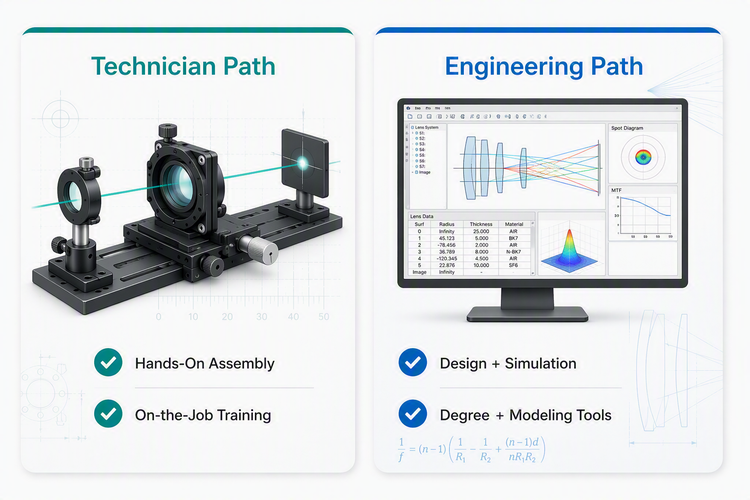
There are multiple ways to enter the field. Some engineers begin in technician roles, gaining hands-on experience before transitioning into design or analysis roles.
As Herman explains:
- some roles involve assembling optical components
- skills can be developed through on-the-job training
- deeper theoretical understanding comes over time
This flexibility makes the field accessible from different starting points.
Early roles vary widely depending on the company and application.
Herman notes that many engineers learn on the job: “Engineers often don’t start as experts in a specific area—they build knowledge as they work on real systems.”
Work can include:
- design and simulation
- testing and validation
- supporting hardware development
- collaborating across teams
Work Environment
Workload and stress levels vary depending on the type of work.
From a first-hand perspective:
- Typical weeks may be around 40 hours
- Demanding projects can require longer hours
- Hardware testing phases may be more intense
Despite this variability, Hoffman notes that many roles provide balance:
“The stress level… is very reasonable… and I do generally have time… for family and hobbies.”
Getting a Job at Large Tech Companies
Many students are interested in working at major technology companies. These roles are competitive and depend heavily on the specific team and application area.
Opportunities often exist in:
- imaging systems
- display technologies
- emerging fields like AR/VR
Strong candidates typically combine:
- solid technical background
- relevant project experience
- ability to learn and adapt

Final Thoughts
One of the most important things to understand about optical engineering is that it is not a rigid career path. As Herman puts it: “I never would have thought I’d end up where I am—but it’s been very rewarding.”
The field attracts people with different backgrounds and experiences, united by a shared interest in solving problems involving light.
Conclusion
Optical engineering remains a critical and growing field, with opportunities across industries and applications.
For students and early-career engineers, the key takeaway is clear: You don’t need a perfectly planned path, you need a strong foundation, curiosity, and a willingness to learn.
Related Content
Related Posts