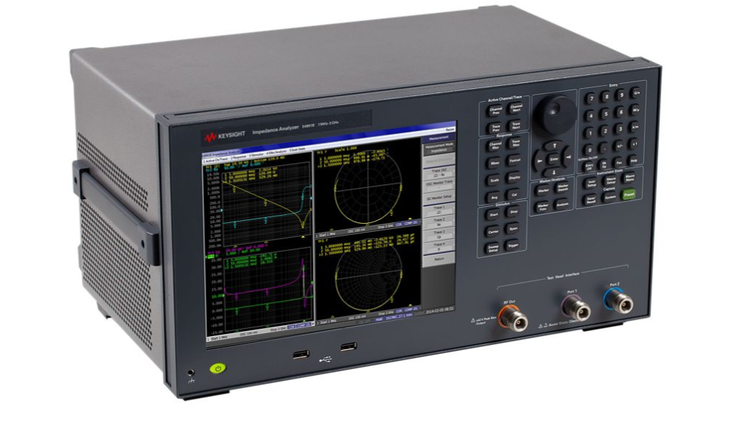
Why Your Circuit Designers and Test Engineers Need Impedance Analyzers
Key takeaways:
- Impedance and related parameters like permittivity are frequency-dependent dynamic characteristics.
- They are also sensitive to voltage and current levels as well as environmental factors like temperature, humidity, and electromagnetic fields.
- Impedance analyzers help engineers understand component parameters by accurately characterizing this highly dynamic quantity.
All engineers know resistance is usually bad news. It generates heat. It reduces efficiency. It wears out components and cuts operational lifetimes.
However, resistance is not the only kind of opposition to the current. When more complex waveforms are involved (like in radio applications), the inductors and capacitors contribute a different kind of opposition that is highly dynamic and complicated.
Impedance analyzers are the instruments of choice to understand this overall opposition to current flow. In this article, find out what impedance analyzers do, where they are used, how they work, and how to use them.
What is an impedance analyzer?
An impedance analyzer is an electronic test instrument that measures the characteristic complex impedance curves of a component, circuit, or material when subject to a range of alternating current (AC) signals.
Impedance, measured in Ohms (Ω), consists of two types of oppositions to the flow of alternating current: resistance and reactance.
Reactance is the opposition due to the inductances and capacitances of a material, component, or circuit. While resistance is not frequency-dependent, inductance, capacitance, and therefore reactance all vary with the frequency.
Because of this, the impedance is effectively a dynamic characteristic because its reactance varies with the signal frequency.

Figure 1. Impedance is a complex quantity of resistance and reactance
The term "complex impedance" is used because it's mathematically convenient to represent it by a vector in a two-dimensional complex plane with a real axis (the resistance) and an imaginary axis (the reactance). The magnitude of this vector is the total impedance, while the direction tells us about the phase difference between voltage and current.
What are some applications of impedance analyzers in electronics and materials testing?
Impedance analysis is useful in multiple industries where the characterization of components, materials, and circuits under AC waveforms is essential. Various uses of impedance analyzers are outlined below.
Electronics
Analog circuits, like voltage-controlled oscillators, amplifiers, filters, and power supplies, and their components, like resonators and inductors, involve phenomena where impedance parameters like the resonant frequency and quality factor are sensitive to signal levels and frequencies.
Understanding their dynamic behaviors using analyzers with wide impedance ranges is crucial for optimum operational design and efficiency.
Telecommunications
Analyzers help achieve optimum impedancematching in antennas and transmission lines for signal transmission with maximum power transfer and minimal noise.
Additionally, cellular network components are optimized based on impedance measurements.
Power systems
Impedance analyzers are used to characterize devices like transformers and generators to minimize power losses. They are also used in renewable energy devices like solar inverters to optimize conversion efficiency and power quality.
Aerospace
Impedance analyzers are used to test and optimize communication links and navigation systems in aircraft and spacecraft.
Automotive
Impedance behaviors of batteries, battery management systems, and electronic control units are characterized for improving reliability, safety, and efficiency.
Material science
Impedance analyzers are widely used to study the electrical properties of conductive and semiconductive materials.
How does an impedance analyzer differ from an LCR meter?
Like impedance analyzers, inductance-capacitance-resistance meters (LCR meters) can also measure complex impedance. But their capabilities and usage are different, as listed below:
- Measurement display: The biggest difference is that LCR meters show instantaneous impedance values, while impedance analyzers display impedance curves across a range of frequencies. The latter's graphical presentation provides more detailed information about the behavior of the device under test (DUT). This is analogous to the difference between a multimeter and an oscilloscope.
- Signal frequency: An LCR meter measures at a fixed frequency. An impedance analyzer sweeps a frequency range.
- Frequency range: LCR meters typically work with only lower frequency levels. Impedance analyzers support very high frequency ranges.
- Capabilities: LCR meters are low-cost easy-to-use solutions for basic fixed-frequency impedance measurements. Impedance analyzers are more sophisticated instruments that support a variety of impedance parameters, resonance analysis, and equivalent circuit modeling.
How do impedance analyzers work?
There are multiple techniques to measure unknown impedances, each with various pros and cons. The measurement hardware in impedance analyzers is designed to implement one of these techniques. The methods are outlined below.
Bridge method
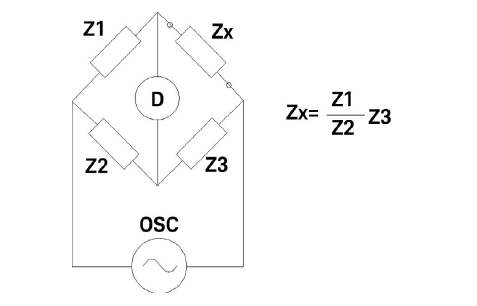
Figure 2. Bridge circuit method (D is the instrument and Zx is the unknown impedance)
This traditional technique uses a simple bridge circuit to compare the unknown impedance with a known reference.
It's simple and effective for low-frequency measurements. However, it does not support high frequencies and very low impedance values.
Current-voltage (IV) method

Figure 3. Circuit for current-voltage measurement method
A known voltage is applied to the circuit or component. The resulting current is then measured to calculate impedance.
This method is simple and versatile. However, the phase relationship between voltage and current must be correctly accounted for.
Radio frequency (RF) IV method
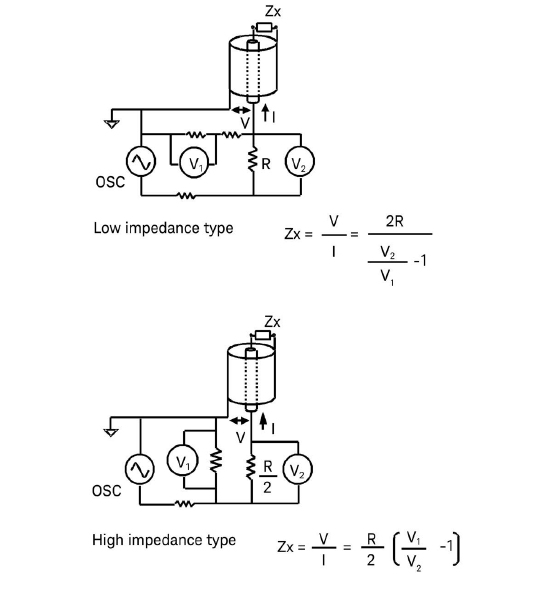
Figure 4. Circuits for RF IV method
This technique extends the IV method to work accurately at the higher frequencies prevalent in RF circuits. It involves more sophisticated designs to accurately measure phase differences at these high frequencies.
Auto-balancing bridge method
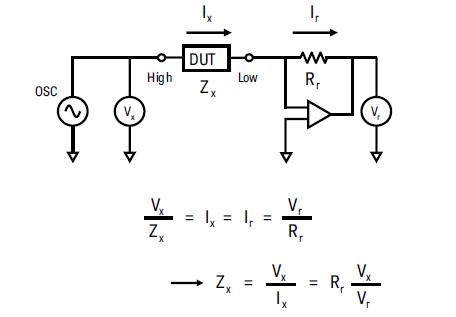
Figure 5. Auto-balancing bridge method
This method uses a feedback mechanism to automatically and dynamically balance the bridge circuit while the frequency is changing. It supports a very wide range of frequencies and impedances with high accuracy. However, its hardware design is more complex.
How do you use an impedance analyzer to measure the impedance of electronic components?

Figure 6. Impedance analyzer test setup
The typical configuration for impedance analysis of individual electronic components includes:
- Impedance analyzer: The instrument's leads are connected to a test fixture that's suitable for the properties of the specific type of the DUT.
- Test fixture: The text fixture is carefully designed to hold the DUT but without modifying or interfering with its impedance characteristics.
- Cable and adapter: A cable and adapter may be used to make the instrument's leads and test fixture's connectors electrically compatible. For example, Bayonet Neill–Concelman (BNC) type connectors are available.
- DUT: This is the component under test that's inserted into a test fixture that is suited to its specific behaviors.
How can an impedance analyzer be used to measure complex impedance in circuits?
For circuit designs, printed circuit boards (PCBs), and PCB assemblies (PCBAs) that operate exactly to specifications, the impedance characteristics of their circuit blocks and materials must be understood accurately.
These characteristics depend on the signal frequency, signal voltage, temperature, humidity, and similar operational factors. So, impedance analyzers are used as described below:
- Characterize circuit blocks: Each major circuit block's impedance behavior when integrated is modeled based on measurements from impedance analyzers. The input and output impedances of each circuit block (like an amplifier subsystem or a filter subsystem) must be modeled based on measurements.
- Measure parasitics: The parasitic capacitances and inductances of PCBs and components under actual operating conditions must be modeled based on measurements. These are particularly crucial in sensitive RF circuits.
- Measure PCB material properties: The permittivities of the materials used in the PCB and substrates are critical parameters that affect circuit performance and electromagnetic interference. These must be measured under actual operating conditions using impedance analyzers.
How do impedance analyzers contribute to the characterization of materials and sensors?
Device manufacturers must know the behaviors of the materials used in their wafers, semiconductors, and PCBs under actual operating conditions.
Impedance analyzers support relevant measurements like:
- permittivity of thin sheet materials at high impedances
- permeability measurements of magnetic materials at low impedances
- capacitance of the oxide layer and the density of substrate impurities during the fabrication of metal oxide semiconductors based on measured I-V characteristics
- characteristics of on-wafer components like capacitors, inductors, and micro-electromechanical system sensors
What frequency ranges are typically supported by impedance analyzers?
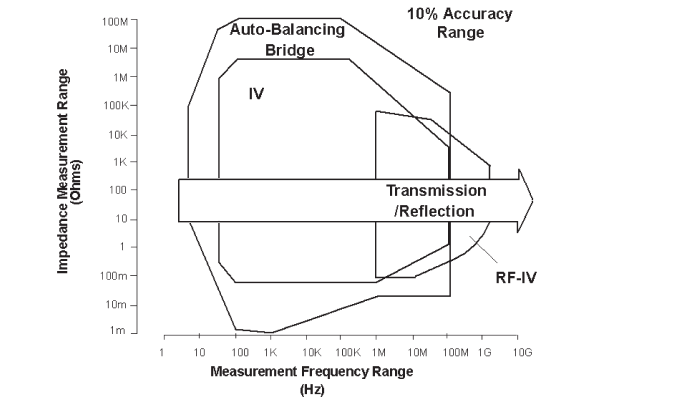
Figure 7. Impedance and frequency measurement ranges of different designs for ±10% accuracy
The measurement method used by a particular analyzer decides its supported frequency and impedance ranges as shown above and described below:
- Auto-balancing bridges: This design offers exceptional accuracy over the widest impedance range and the second widest frequency ranges. It can measure milliohms (mΩ) to 100 megaohms (MΩ) while sweeping from a few Hertz (Hz) up to 110 megahertz (MHz). However, its impedance range starts to narrow toward higher frequencies, and its impedance range starts to lower to 1 MΩ as frequency goes above 100 kilohertz (kHz).
- IV method: IV-type analyzers are as accurate but over a smaller range. They can measure 100 mΩ to 5 MΩ while sweeping from 40 Hz to 100 MHz.
- RF-IV method: This type of analyzer can measure 100 mΩ up to 100,000 MΩ while sweeping from 1 MHz to 3 gigahertz (GHz).
- Transmission reflection technique: This type of analyzer has the widest frequency range of 5 Hz to 110 GHz but its accuracy is limited to the impedance range of 50-75 Ω.
What factors should you consider when selecting an impedance analyzer for a specific application?
When selecting a suitable impedance analyzer, consider the following aspects.
- Measurement method: Select the measurement method based on the expected measurement ranges for impedance and frequency.
- Voltage level control: Remember that a capacitor's dielectric constant, and so its capacitance, depends on the AC voltage level. Similarly, the electromagnetic hysteresis of an inductor's material depends on the AC current level. So, a good analyzer must have voltage level monitoring capabilities at a minimum. Automatic level control capability to maintain a constant voltage would be even better.
- Measurement accuracy: Different analyzers and their designs have different accuracy profiles. Decide the analyzer based on the required accuracy.
- Required impedance parameters: Select the instrument based on the parameters you want to measure, like permittivity, permeability, quality factor (Q), or dissipation factor (D).
How do temperature and environmental conditions affect impedance measurements using an analyzer?
It's critical to remember that impedance is highly dynamic. Environmental conditions like temperature, humidity, and electromagnetic interference (EMI) can drastically affect measurements, as described below:
- Temperature: Most resistors, inductors, and capacitors are temperature-dependent. Their temperature coefficients are critical factors in impedance behavior. Ensure a stable temperature, preferably in a controlled laboratory setting. If working in the field, minimize exposure to sudden temperature changes.
- Humidity: High humidity can result in condensation, which affects the electrical properties of components and circuits. Ensure a low-humidity environment using dehumidifiers.
- Electromagnetic interference: EMI can affect impedance measurements, particularly in sensitive devices like semiconductors or high-frequency applications. Measure in a shielded environment to prevent the effects of external electromagnetic fields.
Keysight impedance analyzers
Keysight's suite of high-accuracy impedance analyzers consists of three instruments with the following key features:
- E4990A impedance analyzer: The E4990A has an auto-balancing bridge design that can measure 25 mΩ to 40 MΩ by sweeping from 20 Hz up to 120 MHz.
- E4991B impedance analyzer: The E4991B is an RF IV type analyzer that supports 120 mΩ to 52 kΩ with a sweep range of 1 MHz to 3 GHz, suitable for most RF applications.
- E5061B ENA vector network analyzer: The E5061B is a full-fledged vector network analyzer with network analysis, impedance analysis, and gain/phase analysis features for high-accuracy RF applications. Its 3L5/005 solution option adds an impedance analysis function with 5 Hz to 3 GHz range. It also supports direct current (DC) applications through a DC bias source of 40 VDC.
All these instruments support data export interfaces like the general purpose interface bus (GPIB), local area network (LAN), and universal serial bus (USB).
Overcome impedance with Keysight instruments
In this article, you learned about the uses of impedance analyzers and their key aspects.
Keysight'simpedance analyzers provide highly accurate impedance characterization for multiple industries and applications, from semiconductors to the largest power systems.
Contact us for insights and advice on selecting the right impedance analyzer for your lab or field tests.