
FR3 – The Next 6G Testing Battleground
Choices Made Today Will Decide Who's Ready for 6G
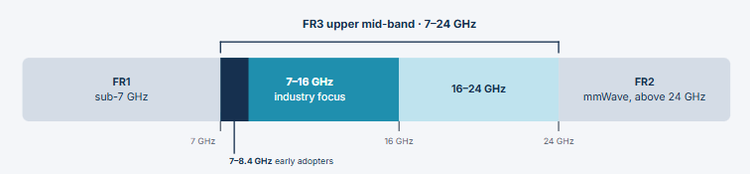
The 7–24 GHz FR3 upper mid-band is where many of 6G’s hardest RF problems will be solved first. Industry attention centers on 7–16 GHz, and most early adopters are starting at 7–8.4 GHz. FR3 is also where the 3rd Generation Partnership Project (3GPP) has focused dedicated work: Release 19 study item RP-234018, initiated at the RAN plenary in December 2023 and concluded in June 2025, enhanced the 3GPP channel models to close the modeling gaps for 7–24 GHz New Radio. Those models are now a foundation for 6G, but the 6G specifications built on them are still being written. If you’re building or buying FR3 test infrastructure now, you’re investing ahead of a finished standard, which makes your test platform’s underlying architecture more important, not less.
What FR3 actually demands
FR3 isn't just "5G, but higher frequency." It's where extreme MIMO (xMIMO) starts to become real: base station arrays are being studied with more than 4,000 antenna elements, up to 64 co-existing MIMO layers, and pencil beams narrow enough to be measured in single digits of degrees (think 3-4°). Designing and validating that kind of system means the channel model has to capture accurate intra- and inter-cluster angular characteristics, and the test platform has to keep up with dynamic beam management and precoding as devices move between line-of-sight, non-line-of-sight, and blockage conditions.

That translates into concrete test requirements at 7–16 GHz: phase- and time-coherent multichannel emulation, both semi-deterministic and fully deterministic channel models, tightly calibrated phase and amplitude accuracy, and the ability to evaluate physical-layer metrics like beamforming gain, beamwidth, and sidelobe levels all the way up to the application layer. These requirements leave little room for error.
Two ways to get to FR3
Broadly, there are two architectural paths a channel emulator can take to cover the FR3 range.
Native coverage. The RF hardware is built to operate across the target frequency range directly, out of the box, with a single calibrated signal chain from the platform to the device or antenna under test.
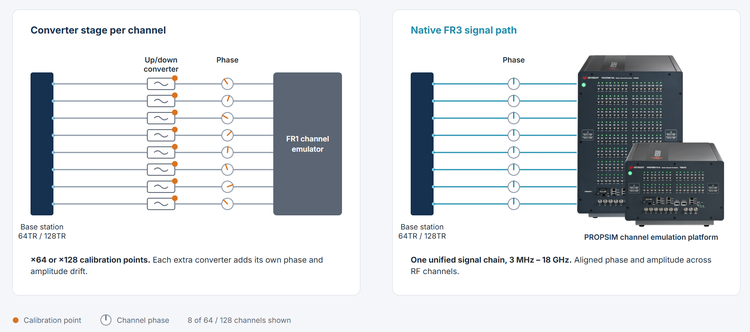
External conversion. An existing lower-frequency RF chassis is paired with a separate up/down-converter module that shifts the signal into the FR3 range. This is a legitimate engineering path, and it's the approach taken by one recently announced channel emulation platform, which pairs a converter module with an existing chassis to reach into the upper mid-band.
Each approach involves tradeoffs. Every additional RF stage in a signal chain can add phase noise, cabling, and calibration steps that need to be verified as configurations change. For a use case that already demands phase- and time-coherent multichannel emulation as a baseline requirement, added conversion stages can affect the performance metrics that matter most, such as phase coherence, amplitude accuracy, and dynamic range. Useful questions to ask include how many RF stages sit between the platform and the device under test, and how calibration is maintained when you scale to a full massive-MIMO channel count.
Where native coverage matters most
At massive-MIMO scale, the conversion-stage question compounds. Testing a 64TR or 128TR base station configuration means synchronizing that many RF chains with consistent phase and amplitude behavior — something that gets progressively harder to guarantee once each channel is running through its own converter stage rather than a single native signal path.
Keysight's PROPSIM channel emulation platform covers FR1 and FR3 natively, from 3 MHz to 18 GHz out of the box. For users already running PROPSIM F8800B or F8820B platforms, the upgrade path to FR3 is a channel-unit addition or swap within the same architecture, preserving a single, unified signal chain. With external Remote Radio Heads (RRHs), PROPSIM frequency coverage can be extended to FR2 (mmWave) and other higher-frequency bands..
The evaluation question
FR3 is genuinely new ground for the whole industry, and with 6G specifications still in progress, no vendor's approach is backed by a finished standard yet. What you can evaluate today is architecture: how many RF stages sit in the signal path, how phase and amplitude calibration holds up as channel count scales toward massive MIMO, and what the upgrade path looks like as 6G specifications built on the Release 19 channel models mature. Moreover, leveraging a real-time channel emulator with native 6G band support that has been part of qualified setups for many years addressing multiple industry application gives you the certainty that your testing future is on the right path.
Learn more: Keysight PROPSIM Channel Emulation Solutions | 6G FR3 Channel Emulation and ISAC Application Note | Unlocking the Potential of 6G FR3 | How to Perform 6G FR3 System Test | 6G Testing Help Center