
Verify Your Healthcare IT Systems With Automated EMR Testing
Key takeaways:
- Unlike normal enterprise software, healthcare software must be extensively and regularly tested by client organizations to ensure patient safety at all times.
- Manual testing by overworked staff is a common problem, and it can seriously harm the level of patient care.
- Non-invasive test automation approaches that use artificial intelligence (AI) take 43% less time to create tests, run 57% faster, and save millions of dollars worth of manual effort.
The number of people suffering from lifestyle disorders is rising around the world. Many societies are rapidly aging. Health insurance procedures are becoming more complicated.
In this challenging environment, electronic medical record (EMR) and electronic health record (EHR) software are the anchors that streamline all healthcare organizations.
In this article, understand why it's critical for healthcare organizations to test their EMR and EHR software. Learn about the challenges they face. Find out how non-invasive test automation, combined with artificial intelligence, is addressing the challenges of EMR testing.
What is EMR testing?

Figure 1. Keysight Eggplant dashboard
EMR testing involves verifying all aspects of EMR and EHR software systems with a vision of achieving the highest quality of care for patients. EMR testing includes:
- qualifying the accuracy of all patient information management functions through functional testing and regression testing
- achieving excellent user experiences for all end users through usability testing
- verifying availability and operational correctness under heavy daily usage through reliability testing
- ensuring patient safety, privacy, data confidentiality, and integrity through in-depth security testing
- avoiding workflow disruptions and frustrating delays for healthcare professionals through performance testing
- maintaining strict compliance with all relevant healthcare regulations and industry standards
It also involves integration testing of an EMR system's interoperability with other healthcare software like clinical decision support systems and health information exchanges.
Most importantly, extensive EMR system testing is done not only by the software vendors but also separately by clients like hospitals. To understand why, you must know how these healthcare systems are typically used.
In the rest of this article, we will use the terms EMR and EHR interchangeably. Technically, EHRs capture a more comprehensive medical history of a patient. They include clinical data from EMRs of multiple care providers as well as data from non-clinical health settings like assisted living, pharmacies, insurance, and more.
How are EMR systems used in healthcare? EHR and EMR Integrations | EHR Workflow Diagram EMR System Flow Chart
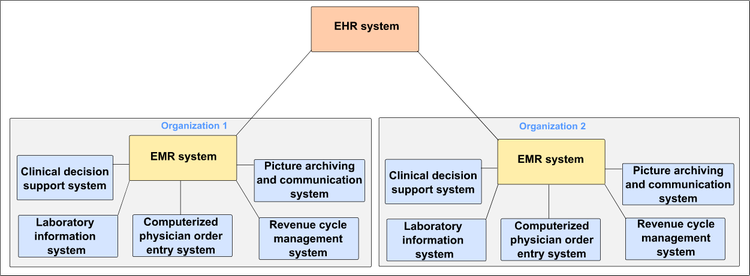
Figure 2. EHR and EMR integrations
An EMR/EHR system is at the heart of the various health information technology (IT) systems deployed in hospitals, research universities, laboratories, and other healthcare organizations. Below, we outline some key characteristics of its use and deployment.
Healthcare software integrations
An EMR system is at the heart of the ecosystem of health information systems. It's integrated with other health IT systems like:
- clinical decision support systems to aid healthcare providers with clinical pathways, diagnoses, and evidence-based decision-making tools
- computerized physician order entry systems to record patient orders like prescriptions, lab tests, and imaging requests
- picture archiving and communication systems (PACS) to store radiology results
- laboratory information systems to manage lab results and tests
- revenue cycle management (RCM) systems to manage health insurance claims and reimbursements
Such integrations enable clinicians and administrators to directly access all data via a single EMR system.
In addition to their inherent complexity, all these systems are often designed like walled gardens with interoperability as an afterthought. For clients, the integration of so many complex silos from different vendors often means higher chances of data inconsistencies.
Extensive client-side customizations
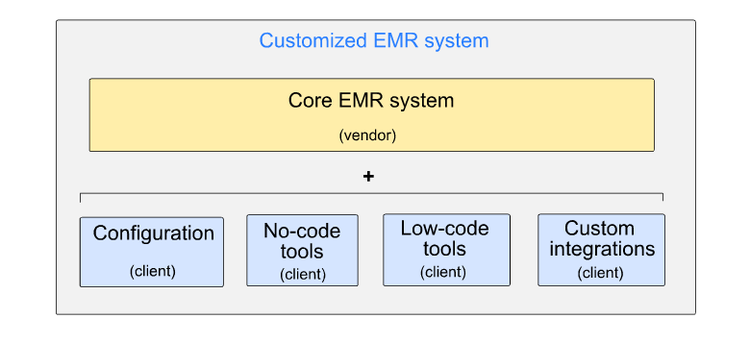
Figure 3. Customized EMR systems by clients
Every hospital, academic medical center, specialty care center, and primary care clinic tends to customize its systems to adapt to its preferred:
- healthcare workflows
- clinical pathways and other medical recommendations
- documentation templates suitable for its medical specializations and patient care settings
- custom report formats
- administrative and approval workflows
- business and accounting practices
These customizations are implemented through:
- configuration flags set by the client without any custom coding
- no-code and low-code addons with graphical user interfaces (GUIs) provided
- feature-rich modules with custom code that talk to the EMR platform's object layer and application programming interface (API)
The testing and maintenance of such customizations are usually the client organization's responsibilities, not the vendor's. Vendors frequently release feature updates and security patches. Clients are then forced to spend a couple of weeks re-qualifying all their customizations — sometimes even updating or re-implementing them — every few months.
Such deployment practices as well as healthcare industry norms make client-side EMR testing critical, as you shall see next.
Why is it crucial for healthcare organizations to conduct client-side EMR testing?
Unlike enterprise IT, in industries like healthcare, client-side software testing must be comprehensive for these reasons:
- Safety-critical nature: The human costs of healthcare software failures can be extremely high. Ensuing legal and reputational costs are not trivial either.
- Complex integrations: The individual complexities of each software as well as interoperability problems increase the chances of data inconsistencies.
- Customizations: The extent of customizations in the industry means every EMR software deployment is unique. Clients have no choice but to test it themselves.
- Frequent updates and patches: Frequent software patches and updates from vendors increase the risk of compromised patient safety.
What regulations and standards must EMR systems comply with?
Healthcare is heavily regulated by local governments around the world. Additionally, interoperability initiatives have resulted in various data exchange standards. Clients of EMR systems expect them to comply with all applicable regulations and standards.
Important healthcare regulations, standards, and policies are outlined below.
Health Insurance Portability and Accountability Act (HIPAA)
In the United States (U.S.),HIPAA imposes stringent requirements on EMR systems. It requires:
- protection of privacy and security of patient health records
- secure authentication and authorization
- reliable data security and encryption
- capturing detailed audit trails for all actions
- interoperability with other healthcare systems
Health Information Technology for Economic and Clinical Health (HITECH) Act
The U.S. HITECH Act placed obligations on business associates like EHR vendors to protect patient data, ensure patient privacy, and report data breaches.
General Data Protection Regulation (GDPR)
Under the European Union's GDPR and EHR exchange format regulation, healthcare organizations and their health IT vendors must:
- provide control over their personal data to patients
- get consent of patients before processing their personal data for research
- maintain data security and patient privacy during data transfers between institutions and across national borders
Medicare and Medicaid
In the U.S., EHR and RCM systems must facilitate health insurance policies like Medicare and Medicaid sponsored by the federal and state governments.
Interoperability standards
The fasthealthcareinteroperability resources (FHIR) standard from Health Level 7 (HL7) is a comprehensive specification for healthcare data exchange.
The Office of the National Coordinator (ONC) for Health Information Technology under the U.S. Department of Health and Human Services (HHS) has adopted FHIR as part of its nationwide framework forhealthinformation sharing.
EHR implementations must comply with FHIR and other local interoperability standards to facilitate interoperability, privacy, and security.
What are the key challenges in EMR software testing?
Some common pain points that healthcare organizations have reported while testing EMR software are listed below:
- Frequent updates: Updates for commercial EMR systems are released quite frequently, every couple of months or even weeks. This forces clients into a continuous testing mode, always checking if new features or changes introduce new issues or disrupt their clinical workflows.
- Forced to test manually: Many healthcare organizations are caught between a rock and a hard place. Re-testing EMR software after every patch is essential, but popular test automation tools break with UI changes and don't offer the needed depth of testing. Manual testing is often the only remaining option for most organizations.
- Challenging integration complexities: For workflows that involve multiple systems, checking for functional correctness, interoperability issues, and data inconsistencies can be very challenging. Manual data entry and data reconciliation due to integration faults are common.
- Customization problems: After every update of the core software, customizations must be re-verified for functionality, security, usability, and performance.
- Doubts over patient safety: Are software patches and customizations silently introducing medical errors? The above pain points result in such doubts.
- No object layer access: Access to the EMR software's object layer can facilitate test automation. However, no vendor exposes it to clients. Only select APIs and extension endpoints are available, which may be unsuitable for test automation.
- Overworked medical staff forced to test: Healthcare staff shortages have been a persistent problem and are expected to remain one in the future. In addition to their primary medical duties, these already overworked staff are also asked to test EMR software functionality and usability. That potentially compromises the quality of patient care.
- Deployment complexities: The use of multiple end-user devices and virtual desktops like Citrix complicate EMR testing. For example, automated testing of software on a virtual desktop using popular test tools can be clumsy.
Is there an effective solution for all these challenges? Yes, there is! It's called non-invasive test automation. The following section explains this approach in detail.
What is non-invasive test automation for EMR systems?
It is a methodology that automates testing without access to a software's source code or object layer and without the installation of any test agents on the software's application servers.
This is achieved by using and observing the software in the same way that end users do and testing it at the user interface level. AI, computer vision, and image recognition are extensively used.
This approach, used by Keysight Eggplant test automation software, is ideal for client-side EMR software testing.
What non-invasive test automation features does Keysight Eggplant provide?

Figure 4. An Eggplant SenseTalk script
Keysight Eggplant implements non-invasivetest automation through the features below:
- User-friendly testing for non-technical personnel: Eggplant provides no-code tools that enable any non-technical member to create test cases. For more complex scenarios, it also provides a low-code solution using an intuitive scripting language called SenseTalk.
- Intelligent computer vision: Unlike other test automation tools like Selenium, Eggplant tests are not coupled deeply to a software's UI model. Instead, it mimics how end users see a software's UI. Image recognition and optical character recognition are used to identify UI elements and detect changes in them.
- Platform agnostic testing: Eggplant automated tests can operate across multiple platforms, operating systems (OS), device types, and web browsers. It also supports virtual desktop environments like Citrix.
- Model-based testing: Eggplant's AI engine infers a comprehensive usage model of any software by observing how end users navigate and interact with it. It can then do automated exploratory testing of all possible workflows and actions. These automated test plans can be rerun after every software update or patch.
How does Keysight Eggplant solve EMR testing challenges?

Figure 5. Eggplant UI model
Let's see how Eggplantautomation forhealthcare addresses the EMR testing challenges we listed earlier:
- Efficient frequent retesting: Eggplant test plans can be automatically rerun after every software update, customization, or patch. Unlike other tools, Eggplant tests are not brittle against UI changes.
- Eliminate manual testing: Free your overworked medical personnel from testing software. Eggplant learns their usage patterns in real time and automatically tests all UI navigation paths and actions comprehensively within a few seconds.
- Test integrations and customizations: Eggplant also handles navigation workflows that involve multiple systems and their interoperability. Eggplant does not need access to the software source code or object layer.
- Ensure patient safety: Patient safety outcomes like the correctness of clinical pathways and order sets can be verified using image recognition and SenseTalk scripting.
- Ensure regulatory compliance: Fine-grained regulatory requirements related to patient consent, privacy, data security, and other aspects can be verified using simple SenseTalk scripts.
- Test all platforms: The same Eggplant test plan can be applied to all browsers, platforms, OSs, devices, mobile apps, and virtual desktop solutions.
- Reliable performance and scalability testing: Ensure that EMR software scalability and performance are not adversely impacted by capturing timing and load testing metrics using Eggplant Performance. Eggplant can mimic large-scale patient data creation and simulate real-world load scenarios.
- Automate administrative workflows: Eggplant's engine can also be used for robotic process automation (RPA). Automate both trivial and exhaustive tasks to reduce the administrative burden on your healthcare staff, allowing them to focus on patient care.
Streamline your EMR testing with Keysight Eggplant
You’ve discovered how Eggplant addresses the serious challenges that healthcare organizations face from their EMR software and other health IT systems. Now, contact us for recommendations and demos of Eggplant effortlessly testing such complex systems.