
AI Data Center Fundamentals: What It Is and How It Works
Almost every time you ask your favorite artificial intelligence (AI) chatbot a question, the request is processed by a specialized computing environment built for high-volume AI workloads.
It consists of thousands of servers, each with powerful purpose-built chips that perform massive numbers of parallel calculations. Helping those chips are several high-performance storage, memory, and networking technologies that make up an AI data center.
Below, we cover the technologies that power AI data centers, how they handle training and inference workloads, and why they've become the backbone of modern AI.
Key takeaways:
- Artificial intelligence (AI) data centers require high-performance technologies across AI infrastructure — compute, memory, storage, network, and software.
- AI data center workloads have unique demands that traditional enterprise data centers are often not optimized to meet.
- AI data centers are crucial for future AI advances and enterprise AI adoption.
What is an AI data center?
An AI data center is a specialized computing facility designed to handle the enormous computational needs of AI workloads with low latency. It facilitates the full AI lifecycle of data ingestion, model training, fine-tuning, and real-time inference.
Unlike traditional data centers, AI data center infrastructure is more purpose-built and optimized for much higher performance.
For example, when you ask a chatbot a question or ask an AI service to fine-tune a large language model (LLM) on your custom data, that request is processed end-to-end by an AI data center.
What technologies are used in AI data centers?

Figure 1. AI data center
AI data center hardware relies on five specialized technologies to minimize latency across every layer of the stack:
- AI accelerators
- high-performance memory
- high-speed local and distributed storage
- high-bandwidth networking
- orchestration software and AI software frameworks
What are AI accelerators?
AI accelerators are specialized modules that can execute the mathematical and matrix operations of AI models at very high speeds. AI accelerators can deliver dramatically higher throughput than general-purpose CPUs for the highly parallel matrix and tensor operations common in AI workloads.
AI accelerators are the primary processors in AI data center servers. They’re supported by traditional CPUs, which handle system-level tasks, managing resource allocation, and orchestrating data pipelines. AI accelerators are typically deployed as PCIe cards, SXM/OAM-style modules, rack-scale systems, or specialized wafer-scale systems — consisting of:
- specialized processors such as GPUs, TPUs, and other AI accelerators, optimized for highly parallel mathematical operations
- high-speed onboard memory for caching model parameters, KV cache used by attention mechanisms during inference, and input data needed at each step of an AI model's algorithm
- interconnect technologies, including NVLink and UALink, for scale-up / super-fast inter-accelerator communication within racks, and Ethernet and Ultra Ethernet for scale-out data center fabrics
Examples of popular AI accelerators include:
Which high-performance memories are used in AI data centers?
Memory technologies preferred in AI data centers include:
- high-bandwidth memory (HBM)
- compute express link (CXL)
- on-chip static random access memory (SRAM)
- graphics double data rate (GDDR)
AI accelerators run at such high speeds that traditional memory becomes a bottleneck. Keeping the compute cores constantly fed with data is a significant challenge. The above technologies alleviate this memory wall in different ways.
HBM3E provides extremely high memory bandwidth, with implementations reaching approximately 1.2 TB/s per stack. An accelerator typically combines multiple HBM stacks to achieve several terabytes per second of aggregate memory bandwidth.
CXL enables CPU‑side memory pooling and expansion, improving memory capacity for inference‑heavy or heterogeneous workloads.
What storage technologies are used in AI data centers?
AI data centers prefer high-speed non-volatile memory express (NVMe) solid-state drives and storage architectures built upon NVMe-over-fabrics (NVMe-oF), GPUDirect Storage, and parallel file systems.
Both the capacity and speed of AI data center storage are critical. It must store large training and inference datasets as well as potentially numerous model checkpoints and associated training state. It must also fetch all this data at high speeds to avoid bottlenecking the ultra-fast AI accelerators.
NVMe-oF extends NVMe storage access across a high-performance network, enabling compute nodes to access shared or disaggregated NVMe storage with high bandwidth and low latency.
GPUDirect Storage enables direct DMA transfers between storage and GPU memory, avoiding the traditional CPU-memory bounce buffer and reducing CPU overhead.
Scale-out parallel file systems and object stores provide data management for these storage technologies.
Which networking technologies are used in AI data centers?

Figure 2. AI data center networking
AI data centers rely on high-performance networking technologies including InfiniBand and Ethernet-based fabrics.
InfiniBand is a networking technology designed explicitly for high-performance computing and AI. It's an alternative to Ethernet-based fabrics and relies on tightly integrated, purpose-specific hardware.
Modern AI Ethernet fabrics commonly support RDMA using RoCEv2 (RDMA over converged Ethernet). RoCEv2 brings the benefits of RDMA to standard Ethernet networks by enabling RDMA over routable IP networks. It is commonly deployed with lossless or loss-managed Ethernet techniques such as Priority Flow Control (PFC), Explicit Congestion Notification (ECN), and Data Center Quantized Congestion Notification (DCQCN).
High-bandwidth Ethernet, scaling up toward 800G, 1.6T, and beyond using optical fiber, is an essential backbone of AI data center networking.
Which software is used in AI data centers?
AI data centers rely on software for cluster orchestration, distributed model inference, model serving, and distributed model training.
These software stacks orchestrate the hardware resources and software components needed for model training and inference. They operate across multiple layers, from foundational communication libraries up to high-level workload orchestrators.
Cluster orchestration software manages containers, container resources (compute, memory, storage, and network), task scheduling, and fault tolerance. Popular solutions include Kubernetes, Anyscale Ray, Slurm, and their cloud-based versions.
Distributed model inference and serving stacks offer AI models and their inference capabilities through application programming interfaces. Hyperscalers and AI service providers, such as Google Cloud, OpenAI, Microsoft, and Anthropic, use proprietary inference engines to handle their hyperscale workloads. Other service providers may use open-source inference engines like vLLM.
Distributed model training stacks are needed to orchestrate training of large models, which requires high computational power and is very data-intensive. These stacks reduce training times by distributing tasks using frameworks such as DeepSpeed, PyTorch Distributed, and the NVIDIA Collective Communications Library.
How do AI data centers work?
The technologies in AI data centers interact differently depending on the training or inference stage of an AI workload lifecycle, as explained below.
How do AI data centers work during model training?
During AI training or fine-tuning, all the layers of AI infrastructure — compute, storage, interconnects, memory, and networks — face intense loads for extended periods.
The steps and loads are outlined below:
- Training data ingestion: The training data (text, images, video, or audio) is accumulated and stored in the data center's file system. Frontier-scale training datasets can contain trillions or tens of trillions of tokens and require hundreds of terabytes or more of storage, depending on the data type and representation.
- Raw model loading: The initial model contains several layers, such as attention and linear layers, each with millions to billions of initialized parameters, depending on model size. Training is done by reading the training data (which is grouped into batches, typically represented as tensors) and passing them through the model's layers.
- Distributed pipeline parallelism: During training, the model's layers are split sequentially, and sets of consecutive layers are allocated to different servers. The model's layers are divided into sequential stages, with different groups of accelerators responsible for different portions of the model. Data from one server is passed to another server over the networking fabric.
- Distributed tensor parallelism: Tensor parallelism splits individual model layers across multiple AI accelerators, distributing their tensor computations and memory requirements across GPUs.
- Tensor operations: Each layer has some characteristic mathematical operation, like matrix multiplication or exponentiation, that is applied to the batch data and layer parameters. The AI accelerator chip translates this math operation to its internal instruction set and executes it at high speeds.
- Gradient synchronization and collective communication: In distributed training, accelerators must frequently exchange gradients, activations, and model state using collective communication operations such as AllReduce, ReduceScatter, and AllGather. These operations can generate substantial east-west network traffic and make network bandwidth, latency, congestion, and reliability critical to overall training efficiency.
- Memory management: Model parameters, activations, gradients, and optimizer states consume substantial accelerator memory. Techniques such as sharding, activation recomputation, and memory offload are used to manage these requirements.
- Loss calculation and backpropagation: After a batch has been processed through all layers of the model, the output of the final layer is compared with the expected result to compute the loss. This loss is then propagated backward through each layer, allowing the parameters to be updated to minimize the loss in the next round.
- Model checkpointing: The above process is repeated over multiple iterations. A checkpoint is saved periodically after iterations (such as after a certain number of update steps, at epoch boundaries, or when a metric improves), with parameters from all the layers stored in the distributed file system. Large models with hundreds of billions of parameters may require a few terabytes of data per checkpoint. Model training continues over many steps or epochs and is typically stopped according to a training plan, validation metrics, compute budget, or convergence criteria.
- Trained model: The final saved checkpoint represents the trained model. It's ready for serving and inference workloads.
How do AI data centers work during model inference?
Compared with training, an individual inference request typically performs less computation because it runs a forward pass through an already-trained model. But production inference can place enormous pressure on AI data centers. At scale, serving thousands or millions of concurrent users requires careful management of GPU memory, KV cache, batching, network traffic, tail latency, and cost per token. The steps during model inference are as follows:
- Model loading: The saved checkpoint of a trained model is loaded into the compute cluster. Sets of layers are allocated to different servers (pipeline parallelism). Within each server, larger layers are split across multiple AI accelerators (horizontal sharding).
- Model replicas: Since the inference engine must serve thousands or even millions of users, the same model is loaded across multiple groups of compute nodes.
- Request routing: When a prompt or other input data is received from a user for inference, the serving engine assigns it to one of the model replicas based on metrics such as current load and routes the request to that replica.
- Inference: The input data is received by the assigned replica and passed through each of its layers. The tensor operation specific to a layer is executed by the AI accelerators assigned to that layer. The results of a layer are passed on to the next layer. If the same server processes the layers, the results are passed through the interconnects. If the layers are on different servers, the results are passed through the data center network.
- Inference results: The final results of each inference are sent to the requesting user or client application. In some use cases, they may also be stored in the storage layer as request history or for logging.
How is an AI data center different from a traditional data center?
An AI data center differs from a traditional enterprise data center in its architecture, workload, power, and cooling.
How is AI data center architecture different from an enterprise data center?
AI data center architectures use different compute, network, interconnect, storage, and memory technologies than traditional data centers.
NVIDIA GPUs
Google TPUs
Amazon Trainium
Cerebras Wafer Scale Engine
Intel Xeon
AMD EPYC
HBM
CXL
How do AI workloads differ from typical enterprise workloads?
AI workloads include training, fine-tuning, inference, embedding generation, retrieval, data preprocessing, evaluation, and monitoring.
Large-scale AI training and inference can require hundreds or thousands of accelerators operating in parallel:
- large language model training
- neural network backpropagation
- generative AI inference for text, images, and videos
- deep learning model training or inference
In contrast, enterprise workload tasks span many task types:
- web hosting
- database queries
- email routing
- enterprise system workflows
An enterprise data center may host millions of discrete, independent, diverse tasks.
How are power consumption and cooling different in AI data centers?
An AI data center has much higher power consumption and cooling requirements due to AI accelerator chips. As a result, AI data center energy efficiency has become a core design priority, driving investment in liquid systems, power delivery architecture, and chip-level thermal management.
Direct liquid cooling circulates coolant through cold plates attached to high-power components such as GPUs and CPUs.
Traditional air conditioning
Raised floor cooling
Why are AI data centers essential for modern AI?
AI data centers are essential prerequisites to maintain the current trajectories of generative AI, AI agents, and enterprise ML adoption. Without continued advances in AI data-center infrastructure, the cost, performance, scalability, and latency requirements of increasingly capable AI workloads would become increasingly difficult to meet.
What role do AI data centers play in generative AI and LLMs?
The scalability and performance ofAI data centers are essential for training better LLMs and more powerful multimodal AI models.
Research has demonstrated predictable relationships between model size, training data, compute, and model performance. AI data-center infrastructure provides the compute, memory, storage, and networking required to scale these resources efficiently.
Training large-scale foundation models involves orchestrating thousands of GPUs or TPUs operating continuously for weeks to months. AI data centers are designed to sustain this level of synchronized computation without systemic failures or downtime, through resilient RDMA fabrics, distributed NVMe storage, and deterministic job schedulers.
Why are AI data centers critical for enterprise AI adoption?
AI data centers are critical to enterprises. To support large numbers of concurrent users, AI infrastructure must provide scalable inference with high concurrency, low latency, stable tail latency, and high throughput.
Enterprise adoption is crucial for better AI-powered business automation, more insightful analytics, machine learning, and generative AI workflows in critical sectors like:
- finance
- healthcare
- defense
- aerospace
- automotive
AI data centers are the robust infrastructure backbones needed to effectively and profitably commercialize AI applications.
What scaling challenges come next for AI data centers?
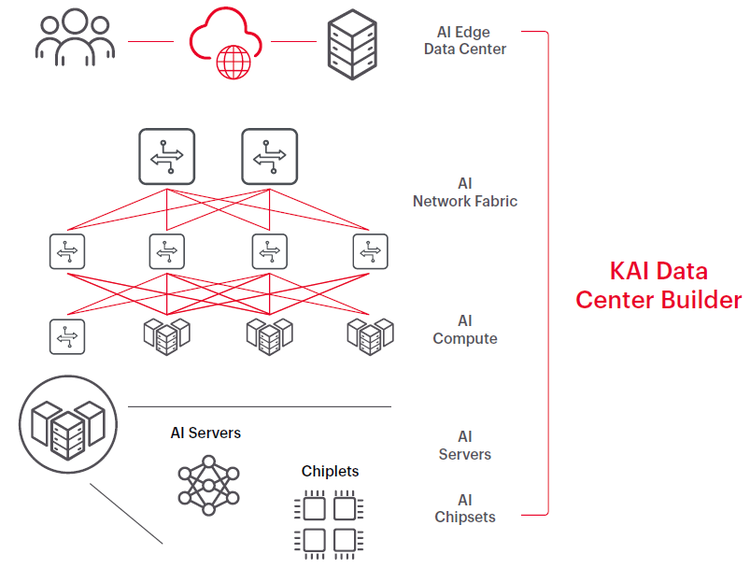
Figure 3. AI infrastructure hierarchy from chiplets to the network’s edge
AI data centers are crucial for ensuring future advances in AI capabilities and hardware. The adoption of advanced AI across enterprises and research environments depends on further optimizing these facilities for peak performance.
However, scaling up poses many challenges for AI data center design and testing. Energy grids have to scale up to supply power. High energy consumption, cooling demand, energy efficiency, sustainability, renewable energy sources, and environmental impact remain significant challenges. More powerful AI chips and interconnects are also needed.
Read more about these challenges of designing and testing AI data center infrastructure.
Rely on Keysight for AI data center validation
This article introduced AI data center technologies and how they work during typical AI tasks. Keysight products help engineers design, test, and validate every hardware and software layer of the next-generation AI data center.
Contact us for insights into AI data center design and testing.
Related Posts
AI data center hardware relies on five specialized technologies to minimize latency across every layer of the stack:
- AI accelerators
- high-performance memory
- high-speed local and distributed storage
- high-bandwidth networking
- orchestration software and AI software frameworks
AI data centers prefer high-speed non-volatile memory express (NVMe) solid-state drives and storage architectures built upon NVMe-over-fabrics (NVMe-oF), GPUDirect Storage, and parallel file systems.
Both the capacity and speed of AI data center storage are critical. It must store large training and inference datasets as well as potentially numerous model checkpoints and associated training state. It must also fetch all this data at high speeds to avoid bottlenecking the ultra-fast AI accelerators.
AI data centers rely on remote direct memory access (RDMA) technologies such as InfiniBand, RDMA over converged Ethernet (RoCEv2), and high-bandwidth Ethernet.
InfiniBand is a specialized networking technology designed explicitly for high-performance computing and AI. It's an alternative to Ethernet-based fabrics and relies on tightly integrated, purpose-specific hardware.
RoCEv2 brings the benefits of RDMA to standard Ethernet networks by enabling RDMA over routable IP networks. It is commonly deployed with lossless or loss-managed Ethernet techniques such as Priority Flow Control (PFC), Explicit Congestion Notification (ECN), and Data Center Quantized Congestion Notification (DCQCN).
High-bandwidth Ethernet, scaling up toward 800G, 1.6T, and beyond using optical fiber, is an essential backbone of AI data center networking.
AI data centers rely on software for cluster orchestration, distributed model inference, model serving, and distributed model training.
These software stacks orchestrate the hardware resources and software components needed for model training and inference. They operate across multiple layers, from foundational communication libraries up to high-level workload orchestrators.
The scalability and performance ofAI data centers are essential for training better LLMs and more powerful multimodal AI models.
Research has demonstrated predictable relationships between model size, training data, compute, and model performance. AI data-center infrastructure provides the compute, memory, storage, and networking required to scale these resources efficiently.
AI data centers are crucial for ensuring future advances in AI capabilities and hardware. The adoption of advanced AI across enterprises and research environments depends on further optimizing these facilities for peak performance.
However, scaling up poses many challenges for AI data center design and testing. Energy grids have to scale up to supply power. High energy consumption, cooling demand, energy efficiency, sustainability, renewable energy sources, and environmental impact remain significant challenges. More powerful AI chips and interconnects are also needed.