
6G and AI: Using AI for 6G Design and Validation
Key takeaways: Telecom companies are hoping for quick 6G standardization followed by a rapid increase in 6G enterprise and retail customers, with AI being a key enabler:
- Artificial intelligence (AI) and machine learning (ML) are expected to become essential and critical components of the 6G standards, scheduled for release in 2028 or 2029.
- Engineers in 6G and AI could take products to market quickly by understanding the potential benefits of AI / ML for 6G design validation.
The 6G era is poised to be fundamentally different — potentially the first "AI-native" iteration of wireless telecom networks. With extensive use of AI expected in 6G, engineers face an unprecedented challenge: How do you validate a system that is more dynamic, intelligent, and faster than anything before it?
This blog gives insights into 6G design validation using AI for engineers working in communication service providers, mobile network operators, communication technology vendors, and device manufacturers.
We explain the new applications that 6G and AI could unlock, the AI techniques you're likely to run into, and how you could use them for designing and testing 6G networks.
What are the key use cases that 6G and AI will enable together?

Figure 1. 6G conservative and ambitious goals versus 5G goals (Image source: How to Revolutionize 6G Research With AI-Driven Design)
The two engines of 6G and AI are projected to power exciting new use cases like real-time digital twins, smart factories, highly autonomous mobility, holographic communication, and pervasive edge intelligence.
These are among the major innovations that the International Telecommunication Union (ITU) and the Third Generation Partnership Project (3GPP) envision from 6G and AI. Let's examine these key use cases for AI in 6G and 6G for AI in 2030 and beyond.
Real-time digital twins using 6G and AI
With promises of ubiquitous deployment, high data rates, and ultra-low latency, 6G and AI could create precise real-time representations of the physical world as digital twins.
Digital twins will be powerful tools for modeling, monitoring, managing, analyzing, and simulating all kinds of physical assets, resources, environments, and situations in real time.
Digital twin networks could serve as replicas of physical networks, enabling real-time optimization and control of 6G wireless communication networks. Proposed 6G capabilities like integrated sensing and communication (ISAC) could efficiently synchronize these digital and physical worlds.
Smart factories through 6G and AI
6G and AI have the potential to support advanced industrial applications ("industrial 6G") through reliable low-latency connections for ubiquitous real-time data collecting, sharing, and decision-making. They could enable full automation, control, and operation, leveraging connectivity to intelligent devices, industrial Internet of Things (IoT), and robots. Private 6G networks may effectively streamline operations at airports and seaports.
Autonomous mobility via 6G and AI
6G and AI are set to enhance autonomous mobility, including self-driving vehicles and autonomous transport based on cellular vehicle-to-everything (C-V2X) technologies. This involves AI-assisted automated driving, real-time 3D-mapping, and high-precision positioning.
Holographic communication over 6G
6G and AI data centers could enable immersive multimedia experiences, like holographic telepresence and remote multi-sensory interactions. Semantic communication, where AI will try to understand users' actual current needs and adapt to them, could help meet the demands of data-hungry applications like holographic communication and extended reality, transmitting only the essential semantics of messages.
Pervasive edge AI over 6G technologies
The convergence of communication and computing, particularly through edge computing and edge intelligence, is likely to distribute AI capabilities throughout the 6G network, close to the data source. This has the potential to enable real-time distributed learning, joint inference, and collaboration between intelligent robots and devices, leading to ubiquitous intelligence.
How will AI optimize 6G network design and operation?
In this section, we look more specifically at how AI is being considered for the design and testing of 6G networks.
At a high level, 6G communications will likely involve:
- physical components, like the base stations, PHY transceivers, network switches, and user equipment (UE, like smartphones or fixed wireless modems)
- logical subsystems, like the radio access network (RAN), core network, networkfunctions, and protocol stacks
Some of these are expected to be designed, optimized, and tested using design-time AI models before deployment. Others are expected to use runtime AI models during their operations to dynamically adapt to local traffic, geographical, and weather conditions.
Let's look at which aspects of 6G radio and network functions are likely to be enhanced by the integration of AI techniques in their designs.
AI-native air interface
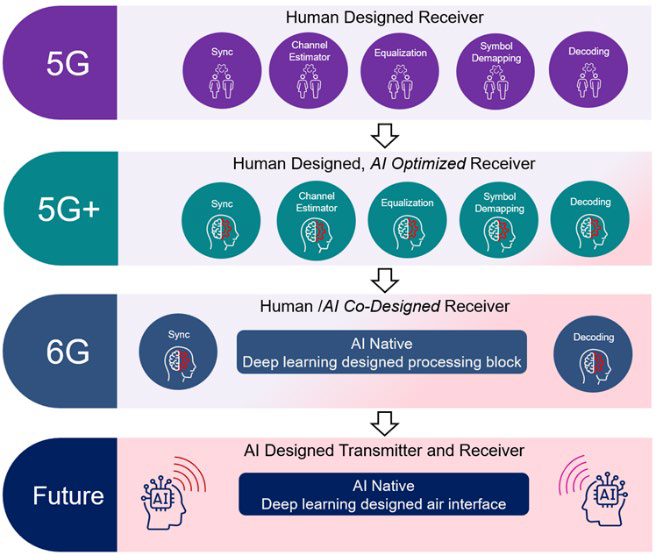
Figure 2. How AI may change the air interface design (Image source: The Integration of AI and 6G)
In the UE-to-RAN air interface, AI models could enhance core radio functions like symbol detection, channel estimation, channel state information (CSI) estimation, beam selection, modulation, and antenna selection.

Figure 3. The three key phases toward a 6G AI-Native Air interface (Image source: The Integration of AI and 6G)
Some of these AI models may run on the UEs, some on the base stations, and some on both.
AI-assisted beamforming

Figure 4. Channel estimation with supervised learning (Image source: How to Revolutionize 6G Research With AI-Driven Design)
AI is envisioned to:
- assist in ultra-massive multiple-input multiple-output (UM-MIMO) using more precise CSI
- predict optimal transmit beams
- reduce beam-pairing complexity
- assist reconfigurable intelligent surfaces (RIS) for environmental optimization
AI-optimized RAN
It's hoped that AI will become instrumental in end-to-end network optimization and dynamically adapting the entire RAN through self-monitoring, self-organization, self-optimization, and self-healing.
Automated network management
AI holds the potential to automate network operation and maintenance as well as enable automated management services like predictive maintenance, intelligent data perception, on-demand capability addition, traffic prediction, and energy management.
Real-time dynamic allocation and scheduling of wireless resources like bandwidth and power for load balancing could be automatically handled by AI. AI-based mobility management could proactively manage handoffs and reduce signaling overhead.
Additionally, analysis of vast network data by AI promises precise threat intelligence, real-time monitoring, prediction, and active defense against network faults and security risks.
What AI techniques are most effective for validating 6G system-level performance?

Figure 5. 6G AI-based model validation (Image source: The Integration of AI and 6G)
AI is a wide field with many techniques, like deep learning, reinforcement learning, generative models, and machine learning. Let's look at how these different AI algorithms and architectures could be used for 6G design, validation, andnetwork performance testing.
Reinforcement learning (RL)

Figure 6. CSI feedback compression (Image source: How to Revolutionize 6G Research With AI-Driven Design)
RL has the potential to be at the forefront of AI for 6G self-optimization, network design, and testing because it is good at replicating human decision-making, testing on a massive scale, and enabling the recent rise of largereasoning models.
RL and deep RL could be used for the following use cases:
- RAN optimization: RL is already being used for intent-based RAN optimization in 5G, enabling autonomous decision-making in dynamic network environments, particularly for mobility management, interference mitigation, and energy-efficient scheduling. RL can control and optimize complex workflows.
- Enhanced beamforming: Deep RL could be used for beam prediction in the spatial and temporal domains.
- Functional testing: Autonomous agents, trained using RL, could test 6G hardware and software systems, looking for bugs as their rewards. Each agent will be a deep neural network trained using proximal policy optimization or direct preference optimization to do sequences of network actions and favor those sequences that are likely to maximize their rewards (the number of bugs found).
- Performance testing: In a 6G system, performance will be an emergent property of hundreds of interacting network parameters. Manually finding the combinations that lead to poor performance will be nearly impossible. An RL agent could automatically explore these combinations and identify configurations that result in performance bottlenecks.
Deep neural networks (DNNs)
DNNs could be used for the following:
- Channel estimation: DNNs and other deep learning architectures like Convolutional Neural Networks (CNNs) could estimate channel conditions, which will be crucial for overall system performance, especially in complex, high-noise environments.
- CSI compression: CNN-based autoencoders are poised to become the most commonly used architecture for CSI compression.
Transformer networks
Transformer-based autoencoders (like Transnet) have been tested for compressing CSI feedback from UEs to a 5G base station and could be used for 6G too.
Graph neural networks (GNNs)
GNNs are used to model the relational structure of network elements. They could learn spatial and topological patterns for tasks like mobility management, interference mitigation, and resource allocation.
They may also be used as physics-informed models for channel estimation reconstruction.
Generative adversarial networks (GANs)
GANs will probably be used to learn and create realistic wireless channel data. They could also be used for denoising and anomaly detection.
Large reasoning and action models
These models are created from pre-trained large language models or large concept models by using RL to fine-tune them for reasoning and acting. They are the foundations of agentic AI. AgenticAI for 6G is still a very new research topic. Agentic AI's ability for complex orchestration of smaller AI models, hardware, databases, and tools could make it suitable for testing 6G networks.
How is synthetic data generated by AI used in 6G testing and validation?

Figure 7. Using AI models in System Design (Image source: The Integration of AI and 6G)
A key benefit of AI will be its ability to synthesize test scenarios and data that simulates realistic 6G environments in lockstep with the 6G standards as they emerge and evolve in the coming years. Such synthesis could enhance designs and reduce development risks from day one.
The use of AI in network operations will lead to non-determinism and an explosion of possible outcomes that challenge testability and repeatability.
Design and test engineers will have to worry about how they can test all possible scenarios and edge cases. Physical deployments would not be possible until customer trials start. Even physical prototypes will be initially impossible and become expensive later on.
This is why AI-powered simulations and AI-generated realistic data are projected to become critical for 6G companies. AI could generate any type of large, realistic data needed to train and test the sophisticated AI/ML algorithms of 6G. The key technologies and techniques involved are outlined below:
- Digital twins: A digital twin is an accurate and detailed proxy for a real-world implementation, capable of emulating entire networks and individual components. These virtual representations will be key to simulating ultra-dense 6G environments. They could support integrated modeling of network environments and users to test complex RAN optimization problems.
- Generative AI models: GANs could become crucial for testing 6G wireless channels. A GAN could be trained on data from real-world 5G networks augmented with 6G-specific parameters calculated using known analytical models. The generator network would learn to synthesize realistic 6G data and simulate virtual channels for realistic environments, even accounting for geography. Later, measured data from 6G hardware prototypes could be included to enhance their realism.
- Specialized testbeds: Synthetic data is vital for studying new 6G sub-terahertz bands (100-300 GHz) because physical measurements are not practical. AI-generated scenarios based on data from sub-terahertz testbeds could recreate the complex impairments and nonlinearities expected at these frequencies.
- Simulation tools: Sophisticated visual tools like Keysight Channel Studio (RaySim) could simulate signal propagation and generate channel data in a specific environment, like a selected city area. It could model detailed characteristics like delay spread and user mobility, mimicking real-world conditions needed for training components like 6G neural receivers.
- Systems modeling platforms: An end-to-end system design platform like Keysight's System Design will have the ability to generate high-quality 6G data for neural network training. It would combine system design budgets, 3GPP-compliant channel models (like clustereddelay line models), measured data, and noise to produce diverse samples with varying noise and channel configurations.
Can AI validate hardware and chip-level designs for 6G communication systems?

Figure 8. Wireless channel estimation (Image source: The Integration of AI and 6G)
AI techniques like anomaly detection and intelligent test automation could help you design and validate all the advanced chips and components that will go into 6G hardware for capabilities like sub-terahertz (THz)frequency bands and UM-MIMO.
Below, we speculate on how 6G and AI could be used for chip and hardware design.
Data-driven AI modeling
The behaviors of 6G technology enablers like UM-MIMO, reconfigurableintelligent surfaces, and sub-terahertz frequency bands will be too complex to fully characterize using analytical methods. Instead, neural networks could create accurate, data-driven, nonlinear AI models.
AI models in electronic design automation (EDA)
EDA tools like Advanced Design System and Device Modeling could seamlessly integrate AI models for designing the high-frequency gallium nitride (GaN) radio frequency integrated circuits that'll probably be needed in 6G. These tools could run artificial neural network models as part of circuit simulations and device modeling.
Validation of AI-enabled components

Figure 9. 6G AI neural receiver design and validation setup (Image source: The Integration of AI and 6G)
Validating the AI-native physical layer blocks (like neural receivers) will be paramount. Only AI-driven testing and automation could effectively tackle the black box nature and non-determinism of AI models.
AI-driven simulations
AI-driven simulation tools like Keysight RaySim could synthesize high-quality, site-specific channel data that — combined with deterministic, stochastic, and measured data — to create highly realistic environments for validating THz and MIMO designs.
Optimized beamforming and CSI
AI models could potentially enhance beamforming by improving spectral efficiency. A problem with many antennas is the huge CSI feedback overhead. AI models like autoencoders could compress CSI feedback by as much as 25% without degrading efficiency and reliability.
Hardware-in-the-loop validation
AI channel estimation models have the potential to handle multidimensionality and noise levels more robustly than traditional methods. They could be used by system design software and tested in hardware-in-the-loop setups (with channel emulators, signal generators, and digitizers) to assess effectiveness based on metrics like block error rate and signal-to-noise ratio.
Anomaly detection
Anomaly detection could be applied to data generated by AI simulations and models to identify unusual behaviors or deviations that may point to design flaws or operational issues.
What are the challenges and limitations of using AI in 6G design validation?
Could AI and its results be trusted? Without careful design, every AI model is prone to out-of-distribution errors, data scarcity, poor model interpretability, overfitting, and hallucinations. A better question that your 6G and AI engineers must keep asking is, “How can we make our AI models, as well as AI-generated tests and data, more accurate and more trustworthy?”
For that, follow the recommendations below.
- Design for seamless integration: AI-based solutions must seamlessly integrate and agree with existing wireless principles built upon decades of tried-and-tested signal processing and communication theories. For example, a fullyAI-designed physical layer that can dynamically change the waveform based on ambient conditions poses challenges for traditional measurement and design techniques like digital predistortion and amplifier design.
- Address data scarcity upfront: Real-world wireless data is often sparse. 6G ecosystems will probably be particularly challenging to characterize. Address this by augmenting data from 5G-Advanced networks with data calculated by 6G-specific analytical models. However, plan for extensive manual pre-processing because preparing realistic channel data to train models will not be trivial.
- Aim for model interpretability: To balance the opacity of powerful black-box techniques like deep neural networks, combine them with models that are more interpretable — like decision trees and random forests — through approaches like mixture-of-experts, ensembling, and explainable AI.
- Use physics-informed models: By bounding AI results with data from physics-informed models, engineers will be able to ensure that AI models operate within physical reality, making them robust and trustworthy. For example, reinforcement learning, which could be used for intent-based RAN optimization, can produce different results for the same input, generate out-of-bounds parameters, or fail to constrain to physical reality.
- Prevent overfitting: Sparse data and poor data diversity can lead to overfitting. For example, data generated under severe fading channel conditions is known to result in overfitting. Follow data augmentation and cross-validation best practices to counteract overfitting.
- Plan hardware-in-the-loop testing: Synthetically generated channels can be loaded into channel emulators likePROPSIMto test AI/ML algorithms in base stations and UEs. This will enable model advancements based on real failures and impairments.
- Avoid negative side effects: AI integration should not lead to excessive energy usage, unmanageable training data, or security risks. AI will greatly expand the threat surface, but since AI itself is quite new, cybersecurity risks are not well understood. This means 6G and AI integrations must be carefully designed for resilience and quick recovery from cyber attacks.
Keysight empowers your 6G and AI engineers
In this blog, we gave an overview of how AIcouldbe used for the design and testing of future 6G networks.
At Keysight, we can empower your 6G engineers and provide rock-solid assistance throughout your development cycles, thanks to our pioneering 6G research, AI expertise, and development of 6G-ready test and measurement solutions.
Contact us for expert insights on 6G standards, AI in 6G, and 6G for AI.