














- Overview
- All Models
- Support
Peak and average power for high-power measurements
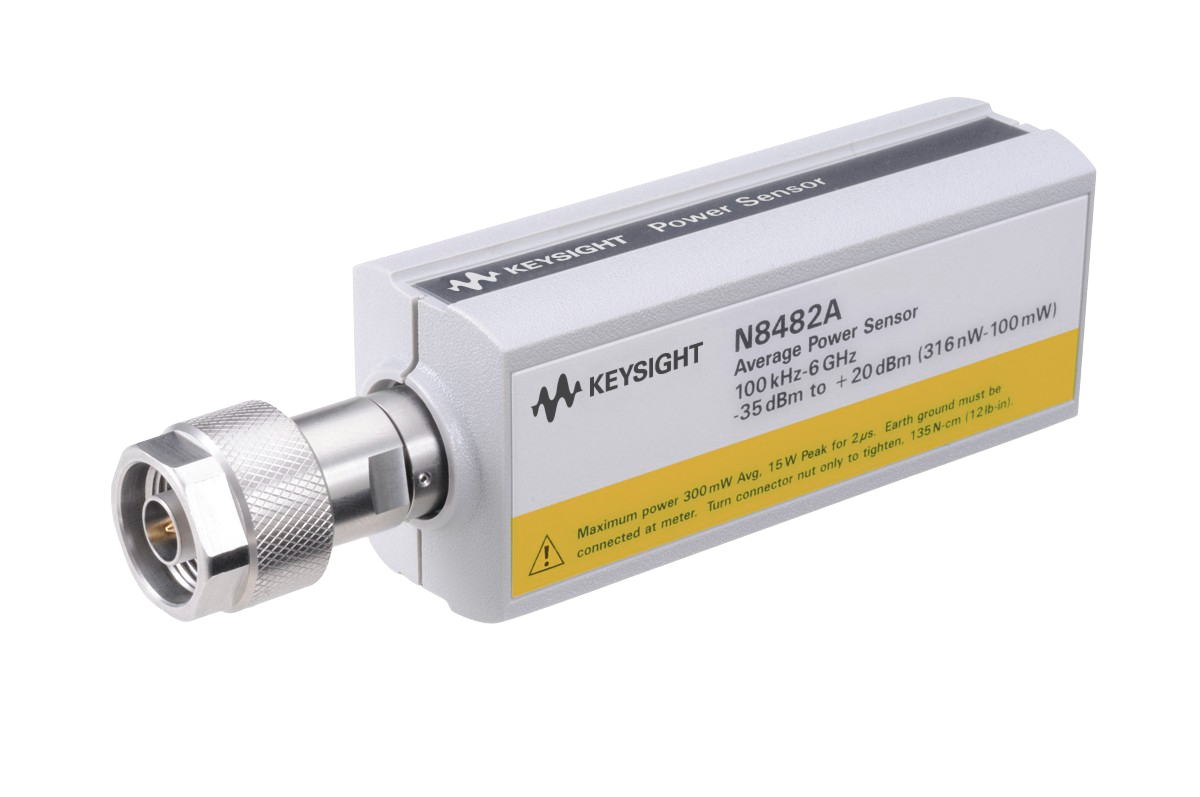
Keysight thermocouple power sensors deliver precise, reliable power measurements, even in demanding high-power RF and microwave environments. With high power linearity, measurements remain consistent and accurate, even at elevated power levels. Designed to handle high power levels, the sensors are particularly well-suited for applications involving complex, high-power RF signals, where maintaining accurate readings over time can be challenging. With excellent calibration traceability to national standards, these sensors provide confidence in measurement accuracy and ensure compliance in industries such as telecommunications and aerospace. High-power handling and outstanding stability make thermocouple power sensors ideal for long-term, high-power applications that require reliable, robust performance.
High power linearity
Provides power linearity of less than 1%, ensuring consistent and accurate power measurements even at high power levels.
Power handling
Supports direct measurement of high-power signals without requiring external attenuators, eliminating extra test setup.
Calibration and traceability
Includes detailed calibration data, traceable to national standards, for verified performance in regulated workflows.
High repeatability
Offers highly accurate power repeatability, ensuring consistent results across multiple measurements.
-
Frequency range
100 kHz to 6 GHz, 10 MHz to 18 GHz, 50 MHz to 50 GHz, 10 MHz to 67 GHz
-
Power range
-35 to +20 dBm, -15 to +35 dBm, -5 to +44 dBm, -35 dBm (316.23 nW) to +20 dBm (100 mW), -15 dBm (31.6 uW) to +35 dBm (3 W)
-
Connector type
Type-N, 2.4 mm, 1.85 mm
-
Measurement type
Average/CW only
-
Maximum power
20 dBm (100 mW) to 44 dBm (25 W)
Most popular configurations
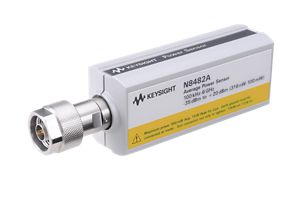
Thermocouple Power Sensors
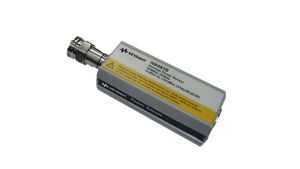

Thermocouple Power Sensors
Thermocouple Power Sensors
- Explore Our Extensive Power Meter and Power Sensor Catalog
- Buying Guide for Power Meters and Power Sensors
- 7 Practices to Prevent Damaging Power Sensors
Services and support
Innovate at speed with curated support plans and prioritized response and turn-around times.
Get predictable, lease-based subscriptions and full lifecycle management solutions—so you reach your business goals faster.
Experience elevated service as a KeysightCare subscriber to get committed technical response and more.
Ensure your test system performs to specification and meets local and global standards.
Make measurements quickly with in-house, instructor-led training, and eLearning.
Download Keysight software or update your software to the newest version.
Frequently asked questions
A thermocouple power sensor measures RF or microwave power by detecting the heat generated when the signal is absorbed by a matched load and converting that thermal energy into a DC voltage using a thermocouple junction of two dissimilar metals that produces voltage in response to temperature differences.
This thermal detection method makes thermocouple sensors inherently modulation-independent, meaning they respond purely to the total energy of the signal, not its shape or timing. As a result, they provide true average power measurements that remain accurate regardless of waveform complexity, burstiness, duty cycle, or crest factor. They do not require correction algorithms to compensate for modulation type or envelope characteristics.
Because of this, thermocouple sensors are ideal for applications that demand precise, waveform-agnostic power measurements, including those involving multi-tone signals, pulsed waveforms, or signals with high harmonic content. Their stability and accuracy also make them well-suited for calibration labs, reference measurements, and linearity testing of other sensors or instruments.
Thermocouple power sensors operate by converting RF and microwave signals into heat, which is then measured by a thermocouple. The thermocouple generates a voltage proportional to the temperature change, providing an accurate average power measurement.
RF Absorption and Heating
The RF signal is terminated in a resistive load that absorbs the signal’s energy and converts it into heat.
Thermal-to-Electrical Conversion
A thermocouple, a junction of two dissimilar metals, is mounted near the termination. As the termination heats up, the thermocouple generates a DC voltage proportional to the temperature rise.
Power Measurement
The resulting voltage is calibrated to represent the true average power of the RF signal. Because the measurement is based on heating, it is independent of waveform shape, such as continuous wave, modulated, or pulsed.
Thermal Compensation and Filtering
To maintain accuracy, the sensor compensates for ambient temperature and stabilizes the output using internal filtering. The response time is slower than diode sensors due to thermal inertia.
Use a thermocouple sensor when:
Modulation independence is critical
Thermocouple sensors give accurate average power readings even for signals with unknown, complex, or high crest factor modulation.
Traceable accuracy is required
They are often used in calibration labs and reference measurements because their thermal detection method closely aligns with physical power standards.
You need consistent results across diverse signal types
For pulsed, multi-tone, or heavily modulated signals, thermocouple sensors provide more reliable readings without relying on correction algorithms.
Avoid thermocouple sensors when speed is necessary; they have slower response times and narrower dynamic range compared to diode sensors, making them less suited for fast-paced production or real-time applications.