


Title
Drawn directly on a CRT
Oscilloscope Glossary
What Is a Digital Oscilloscope?

A digital oscilloscope measures voltage signals and displays how they change over time. It converts those signals into digital data, allowing you to measure, zoom in on, and save waveforms for later analysis.
Choosing the right oscilloscope also affects measurement accuracy. For example, a sine wave measured at the bandwidth limit of a measurement system can appear about 30% lower in amplitude than it actually is. Understanding specifications such as bandwidth and sample rate can help you avoid inaccurate readings.
Overview
- Digital storage: Captured waveforms can be saved, reviewed and analyzed after a measurement.
- Three stages do the work: signal capture (probe, sampling, analog-to-digital conversion), data processing and display.
- Four specifications matter most when you choose one: bandwidth, sample rate, channel count and memory depth.
- Frequency-response measurements: Digital oscilloscopes primarily measure signals in the time domain. For calibrated measurements of how a component responds across frequency, a network analyzer is more suitable. One example is the discontinued Keysight E5071C, available used with configurations supporting frequencies up to 20 GHz.
Understanding Digital Oscilloscopes
The main difference between an analog oscilloscope and a digital storage oscilloscope (DSO) is how they capture and display signals. A conventional analog oscilloscope draws the signal directly on a cathode ray tube (CRT), while a digital oscilloscope samples the signal, digitizes it and stores it in memory for later analysis. Digital models have largely replaced conventional analog oscilloscopes.
| Analog Oscilloscope | Digital Oscilloscope | |
|---|---|---|
| Signal path | Drawn directly on a CRT | Sampled, digitized and stored |
| Storing a waveform | No memory; the trace fades | Held in memory for later analysis |
| Measurements | Read from the screen | Calculated from the stored data |
Analog Oscilloscope
Digital Oscilloscope
Signal path
Title
Sampled, digitized and stored
Storing a waveform
Title
No memory; the trace fades
Title
Held in memory for later analysis
Measurements
Title
Read from the screen
Title
Calculated from the stored data
Key Features
Digital oscilloscopes offer these features:
- Measurements: Voltage, frequency and phase, calculated from the stored samples.
- Waveform analysis: Mathematical functions, including fast Fourier transform (FFT) analysis, help examine waveforms and identify their frequency components.
- Connectivity: LAN connectivity is standard on some Keysight InfiniiVision X-Series oscilloscopes and optional on others. The Keysight InfiniiVision fact sheet identifies the configurations.
How Does a Digital Oscilloscope Work?
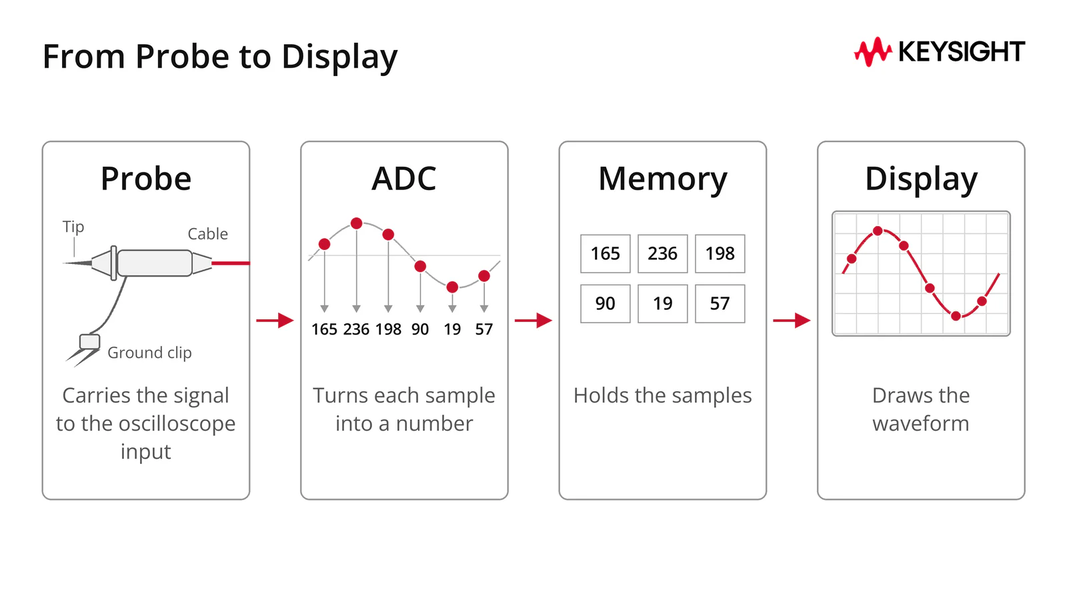
A digital oscilloscope works in three stages: it captures the signal, processes the data and displays the result.
Signal Capture
- Probe connection: You connect the probe to the point of interest in your circuit. The probe carries the signal to the oscilloscope input. Every probe has its own bandwidth limit, and the probe and oscilloscope together set the bandwidth of the measurement system (Keysight application note 5988-5021EN).
- Signal sampling: The oscilloscope measures the signal at fixed intervals set by its sample rate. To avoid aliasing when sampling a band-limited signal directly, the sample rate must be more than twice its highest frequency component, according to the Nyquist criterion.
- Analog-to-digital conversion (ADC): The ADC turns each sample into a number. An n-bit ADC provides 2ⁿ possible quantization levels: an 8-bit ADC provides 256 levels, while a 12-bit ADC provides 4,096. More levels allow finer vertical detail. For example, if an 8-bit ADC's full-scale input range is 800 mV, each quantization step represents 3.125 mV.
- Noise sets the real resolution: Keysight's application note 5991-4088 says vertical accuracy depends on both the number of ADC bits and the front-end noise floor. Effective number of bits (ENOB) describes an oscilloscope's effective resolution after accounting for noise and distortion. Keysight's ENOB guide discusses measurement methods based on IEEE Std 1057-2017.
- Triggering: A trigger tells the oscilloscope when to capture or display a waveform based on a specified condition, helping stabilize repeating signals on screen.
Data Processing
After capture, the oscilloscope processes the digitized data.
- Waveform reconstruction: The oscilloscope uses interpolation to rebuild the waveform between stored sample points, creating a continuous-looking display of the sampled signal.
- Measurement and statistics: The oscilloscope can report parameters such as frequency, period and rise time, and show statistics over many acquisitions.
Display
The display shows the processed waveform and doubles as the control surface.
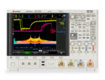
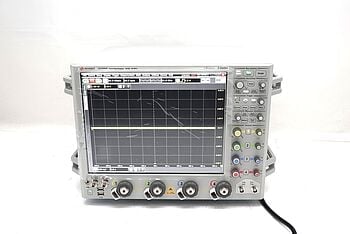
- Visual representation: The screen displays the waveform. Keysight InfiniiVision 6000 X-Series oscilloscopes use color grading to show how frequently different waveform patterns occur, adding another dimension to the display, as described in the data sheet.
- User interface: You adjust the time base and voltage scale and set up measurements from the same screen.
What Are Digital Oscilloscopes Used For?
Engineers and technicians use digital oscilloscopes to measure and troubleshoot changing electrical signals across a range of applications.
- Research and development: Prototype testing and signal integrity analysis, which matters for high-speed digital designs.
- Manufacturing: Finding the cause of a failure on the production line, which can reduce downtime.
- Repair and maintenance: Tracing a fault through a circuit by probing it stage by stage.
- Education: Showing students electronic signals, circuit design and signal processing on a live instrument.
How Do You Choose a Digital Oscilloscope?
Define what you need to measure now and later, then compare these four specifications before any others.
1. Bandwidth
Bandwidth describes the range of signal frequencies an oscilloscope can measure before attenuation becomes significant. Insufficient bandwidth can reduce measured amplitude and distort signal edges and waveform shape.
- Match your signal: A common rule of thumb is to choose an oscilloscope with bandwidth about 5 times the highest frequency component you need to measure. Keysight's application note 5988-5021EN explains why a margin matters: at the measurement system's bandwidth limit (the -3 dB point), a sine wave's measured amplitude can be about 30% low. For accurate sine-wave amplitude measurements, the note recommends a bandwidth at least 3 times the signal frequency. For digital signals, bandwidth requirements depend heavily on edge speed rather than just the clock frequency.
- Use rise time: For an oscilloscope with a Gaussian frequency response, rise time is approximately 0.35 divided by bandwidth. This means 0.35 divided by the fastest rise time you need to measure gives a minimum bandwidth estimate, not the recommended target. For more accurate rise-time measurements, Keysight's application note 5988-5021EN recommends bandwidth 3 or 5 times the estimated edge frequency, calculated as 0.5 divided by rise time.
2. Sample Rate
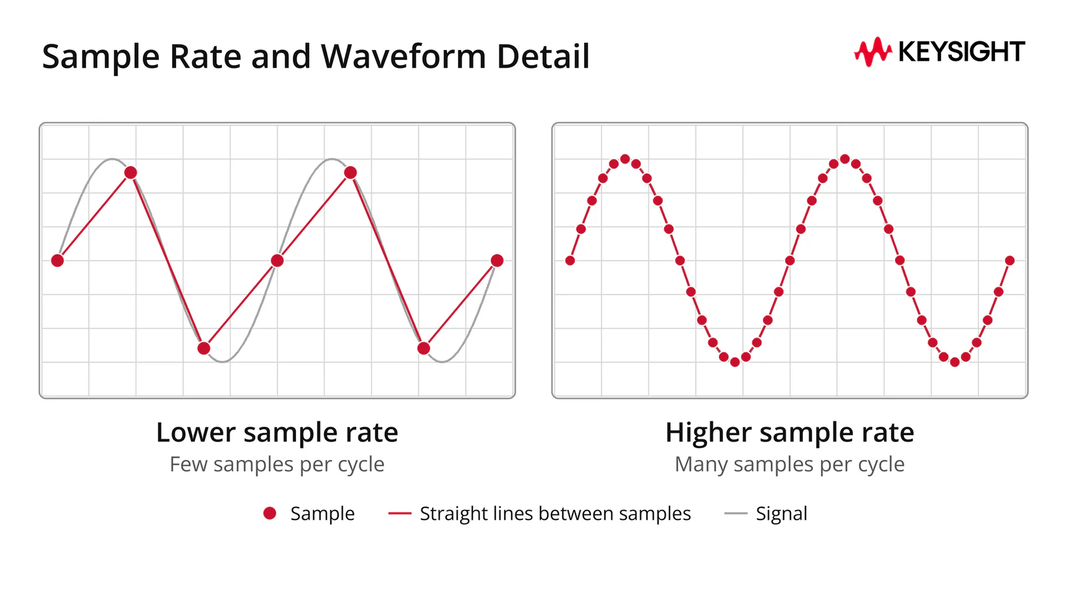
Sample rate is how many samples per second the oscilloscope takes. It affects how well the display reproduces the signal.
- Higher sample rates capture more detail: More samples per cycle help reproduce waveform features and capture short events.
- Rule of thumb: Keysight's guide to six performance characteristics suggests a sample rate above 250% of the bandwidth, ideally 300% or more.
3. Channel Count
Channels are the independent inputs. Keysight's InfiniiVision X-Series oscilloscopes have two or four analog channels.
- Mixed-signal analysis: A mixed-signal oscilloscope (MSO) adds digital channels alongside the analog inputs. InfiniiVision X-Series models with mixed-signal capabilities offer 8 or 16 digital channels, depending on the model.
4. Memory Depth
Memory depth is how many samples the oscilloscope can hold. The time it can capture equals memory depth divided by sample rate.
- Longer captures: Deeper memory lets you record a longer stretch at a high sample rate.
- Trade-off: Very deep memory can slow waveform processing and screen updates, so consider the balance between capture length and responsiveness.
| Specification | What It Determines |
|---|---|
| Bandwidth | The signal frequencies you can show without heavy attenuation |
| Sample Rate | How much detail the waveform carries |
| Channel Count | How many signals you can view together |
| Memory Depth | How long a capture lasts at a given sample rate |
Specification
What It Determines
Bandwidth
Title
The signal frequencies you can show without heavy attenuation
Sample Rate
Title
How much detail the waveform carries
Channel Count
Title
How many signals you can view together
Memory Depth
Title
How long a capture lasts at a given sample rate
Beyond the Four Specifications
Two more points affect what you see in practice.
- Update rate: After each acquisition, the oscilloscope needs time to process and display the waveform. During this interval, it may not capture new events, so a higher waveform update rate can improve the chances of detecting rare glitches. Across the InfiniiVision X-Series, the fact sheet lists waveform update rates from 50,000 to 1,300,000 waveforms per second.
- Probes and measurement category: The probe is part of the measurement system, so its bandwidth and voltage ratings must suit both the signal and the oscilloscope. When a probe and its accessories have different measurement category or voltage ratings, the lowest applicable rating limits the combination (Keysight passive probe guide). Check these ratings before measuring mains voltage or other high-energy circuits.
Browse Used Oscilloscopes
Below are used oscilloscopes from the Official Keysight Used Equipment Store.
What Does a Digital Oscilloscope Not Show?
Some InfiniiVision X-Series oscilloscopes support frequency-response measurements, including Bode plots (fact sheet). However, for calibrated measurements of how components such as cables, filters, and amplifiers transmit and reflect signals across frequency, a network analyzer is generally the more suitable instrument. A vector network analyzer (VNA) measures magnitude and phase, allowing engineers to evaluate characteristics such as gain, loss, reflection, and isolation.
The discontinued Keysight E5071C is one example available used, with configurations supporting frequencies up to 20 GHz. Its frequency range depends on the installed option. According to the data sheet, available configurations start at 9 kHz, 100 kHz, or 300 kHz, while the 20 GHz configurations start at 300 kHz. The E5071C's last order date was May 31, 2021, and Keysight recommends the E5080B for new purchases.
Putting a Digital Oscilloscope to Work
Choosing the right digital oscilloscope comes down to matching its bandwidth, sample rate, channel count and memory depth to your measurement needs.
If you're comparing options, the used oscilloscope buying guide can help you identify the features you need. You can also explore available oscilloscopes through the Official Keysight Used Equipment Store.
Frequently Asked Questions
A conventional analog oscilloscope displays signals directly on a cathode ray tube (CRT), with measurements typically read from the screen. A digital oscilloscope converts signals into digital data, allowing it to store waveforms and calculate measurements automatically (Keysight oscilloscope basics).
A common rule of thumb is to choose an oscilloscope with bandwidth about 5 times the highest frequency component you need to measure. For sine waves, Keysight's application note 5988-5021EN recommends at least 3 times the signal frequency for accurate amplitude measurements. For digital signals, bandwidth requirements depend on rise time, with faster edges requiring higher bandwidth.
A mixed-signal oscilloscope (MSO) combines a digital oscilloscope with a logic analyzer, so it can display and analyze analog and digital signals at the same time on one timeline (Keysight MSO entry).
Whenever You’re Ready, Here Are
5 Ways We Can Help You
1
Browse our used oscilloscopes
2
Call tech support US: +1 800 829-4444
Press #, then 2. Hours: 7am – 5pm MT, Mon– Fri
3
Contact our sales support team
4
Create an account to get price alerts and access to exclusive waitlists
5
Talk to your account manager about your specific needs
Sources
- Keysight Used Equipment Store, Basic Types of Oscilloscopes: analog and digital oscilloscopes, sampling and storage.
- Keysight Used Equipment Store, 6 Performance Characteristics to Look for in an Oscilloscope: bandwidth, channels, sample rate and memory depth.
- Keysight Used Equipment Store, What Is Oscilloscope Bandwidth?: bandwidth ratio and the rise-time relationship.
- Keysight Used Equipment Store, What Is a Network Analyzer?: vector network analyzers, gain, loss and isolation.
- Keysight Technologies, E5071C ENA Vector Network Analyzer data sheet (5989-5479EN): option start frequencies, discontinuance notice and E5080B recommendation.
- Keysight Technologies, InfiniiVision 6000 X-Series data sheet (5991-4087EN): color grade display on the 6000 X-Series.
- Keysight Technologies, InfiniiVision product fact sheet (5992-0192EN): LAN module, channel counts and frequency response by model.
- Open University, Quantisation: n-bit converters and 2 to the power n levels.
- Wikipedia, Nyquist-Shannon sampling theorem: sampling above twice the signal bandwidth.
- Keysight Technologies, Why Is Oscilloscope Vertical Accuracy Important? (5991-4088): ADC bits, front-end noise and ENOB.
- Keysight Used Equipment Store, 14-Bit Oscilloscope Buying Guide: ENOB and IEEE Std 1057-2017.UNITAR and ITU, Global E-waste Monitor 2024.
- Keysight Technologies, Optimizing Oscilloscope Measurement Accuracy on High-Performance Systems with Keysight Active Probes (application note 5988-5021EN): bandwidth, amplitude error and rise
- Keysight Technologies, N2894-60002 Passive Probe User's Guide: measurement categories of probe and accessory.
- Keysight Used Equipment Store, What Is a Mixed-Signal Oscilloscope?: MSO definition.