
What is the WirelessPro 3GPP AI Simulation Platform?
Discover how the WirelessPro 3GPP AI simulation platform accelerates time-to-insight, aligning with the rapid 5G/6G development roadmaps.
Key takeaways:
- 5G-Advanced and 6G extensively utilize artificial intelligence (AI) and machine learning (ML) to optimize various aspects of mobile networks.
- Understanding the AI/ML use cases of the Third Generation Partnership Project (3GPP) is essential for engineers.
- WirelessPro enables 5G/6G communication system engineers and researchers to explore 3GPP AI use cases ahead of time, being ready for future releases from day one.
The complex 5G/6G standards being released will put enormous time-to-market pressures on telecom engineers and researchers for the next five years. However, no engineer would want to compromise on design correctness and capabilities due to a lack of time.
Keysight WirelessPro resolves this tension by providing competent research, prototyping, and simulation tools that accelerate comprehensive experimentation on 5G, 5G-Advanced, and 6G designs.
This blog post introduces the Keysight WirelessPro 3GPP AI simulation platform to communication system engineers and researchers responsible for designing, simulating, and validating 5G/6G systems in telecom companies, research institutions, chipset manufacturers, and network equipment vendors.
What 5G network challenges is 3GPP trying to address?
The 3GPP, in its 5G-Advanced (Release 18) and future releases, seeks to address challenges like:
- extensive use ofAI/ML for self-optimizing networks (SON), including network automation of next-generation radio access network (NG-RAN), 5G core, and other 5G system components
- more accurate and faster channel estimation
- better prediction and compression of channel state information (CSI)
- reduced beamforming latencies
- lowered interruption time for seamless mobility
- more accurate positioning down to <10 centimeter (cm) accuracy
- better network energy savings in the NG-RAN
Why is 6G wireless simulation critical?
The visionfor 6G includes complex system requirements like:
- AI-native network with AI models actively optimizing the air interface and the core network
- extremely high device densities
- very high data rates with very low latencies
- complex ultra-massive multiple input multiple output (UM-MIMO)
- seamless mobility even at high speeds
- centimeter-level positioning accuracy
However, real-world wireless data collection is impractical until the first customer pilots — and even then, it will be expensive and time-consuming.
This is why accurate standard-compliant simulations are critical. They enable research, prototyping, synthetic data generation, and development of functional and performant 6G systems from day one.
What are some key 3GPP AI use cases?
Let's understand some key AI use cases of 5G-Advanced and 6G in more depth:
- channel estimation
- CSI prediction
- CSI feedback compression
- beam management
- mobility
- positioning
Channel estimation (CE)
For reliable communication, receivers on both ends must be able to decode the received data accurately. This is the primary goal of channel estimation.
The 5G base station (5G Node B or gNodeB or gNB) performs physical uplink shared channel (PUSCH) estimation to characterize the channel between itself and the user equipment (UE). The UE does physical downlink shared channel (PDSCH) estimation to characterize the channel from its end.
The characterization is based on pilot reference signals (RS), such as demodulation RS or sounding RS (SRS). Traditional CE applies rigid formulas like least squares or linear minimum mean square error to these signals.
However, in 5G-Advanced and 6G, high device density and dense urban environments with lots of buildings and obstacles result in severe multi-path distortions. Also, high-speed gNodeBs or UEs in drones, airplanes, and satellites must manage significant Doppler shifts. In such scenarios, the channels become highly dynamic and nonlinear.

Figure 1. Channel estimation using AI
The solution? Instead of rigid formulas, use AI for highly dynamic and adaptive CE.
Deep neural networks learn predictive patterns from a channel's key features like temporal dependencies, spatial complexity, frequency selectivity, and sparsity. Traditional estimators provide baseline estimates, which are combined with ideal channel responses (labeled data) in a supervised learning setup for the AI model. Once trained, the model does inference to estimate the full channel.
CSI prediction

Figure 2. CSI exchange between UE and gNodeB
CSI includes crucial information about channel fading, scattering, diffraction, interference, noise, and more. For determining the CSI, a UE calculates information like channel quality indicator, precoding matrix indicator, and rank indicator using the CSI reference signal (CSI-RS). Based on CSI feedback from the UE, a gNodeB adapts its modulation, coding, and beamforming to current channel conditions.
However, in scenarios like fast-moving UEs, the CSI gets outdated fast. Such channel aging severely reduces network performance and efficiency in UM-MIMO systems like 5G/6G.

Figure 3. Time-domain CSI prediction to mitigate channel aging
To mitigate channel aging, ML models are used for time-domain CSI prediction. By predicting how the channel will evolve, the CSI can be kept effectively fresh even in dynamic conditions.
CSI feedback compression
CSI is critical for many advanced features in 5G/6G that boost spectral efficiency and throughput.
As the number of antennas increases (as in UM-MIMO), the volume of CSI information becomes enormous. In the future, 6G will have hundreds or thousands of antennas. This isn't good because of:
- significant feedback overhead
- use of valuable wireless resources
- increased latency

Figure 4. CSI feedback compression using AI
In 5G-Advanced, 3GPP wants AI models that intelligently compress theCSI feedback. Unlike traditional data compression methods, these AI models leverage CSI semantics to compress raw channel data or the precoding matrix more efficiently. An encoder model on the UE compresses the high-dimensional CSI data into a compact representation. On the gNB, a complementary decoder model reconstructs the complete CSI data with minimal loss.
Training methodologies for such two-sided models, like joint training or separated training, are a key focus area for the 3GPP. Given the diversity of network operators, equipment, and UEs, ensuring model interoperability is another focus area.
Beam management

Figure 5. Beam selection steps
Beamforming is critical for UM-MIMO. However, currently, finding the best transmit-receive beam pair takes a lot of time and signals.
That's why 5G-Advanced and 6G will use AI for smarter beam selection, less searching, better connections, and faster speeds.

Figure 6. Spatial beam predictions using AI

Figure 7. Temporal beam predictions using AI
AI models will find the optimal beams faster using spatial predictions (based on nearby signal measurements) and temporal predictions (based on past beam selections).
Mobility

Figure 8. Traditional handovers in mobile networks
In traditional handovers, disconnecting from the previous tower and connecting to the new one results in a service interruption of 50-90 milliseconds.
5G-Advanced seeks to improve on this using L1/L2-triggered mobility (LTM) to reduce interruptions to 20-30 milliseconds, potentially even lower.

Figure 9. Timing of traditional handover vs. LTM
LTM benefits applications where every millisecond counts, like immersive extended reality and real-time gaming.

Figure 10. LTM
LTM involves preparing a UE in advance to contact the next candidate base station in its trajectory.
Positioning
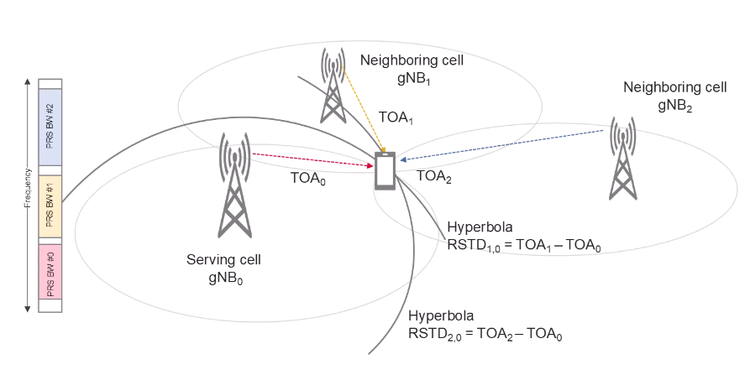
Figure 11. Traditional positioning
Positioning accuracy in 5G New Radio (NR) is only about 3-10 meters. It relies on the time difference of arrival and multilateration using position RS and sounding RS from multiple transmission and reception points (TRPs). Accuracy degrades in poor line-of-sight (LOS) conditions and dense urban multipath environments where signals bounce around. This method can't achieve the accuracy expected by 5G-Advanced (<10 cm), let alone 6G (one cm).
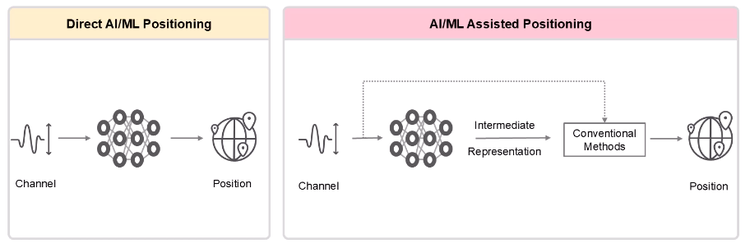
Figure 12. AI for positioning
To improve accuracy, AI is used for positioning as follows:
- Direct positioning: An AI model directly determines the UE's location based on fingerprints of the radio environment, such as channel impulse response or power delay profile.
- AI/ML-assisted positioning: AI generates intermediate metrics like probability of LOS, angle of arrival estimation, or time-of-arrival that are fed into traditional positioning algorithms to improve them.
- Deployment is flexible: The AI model can run on the UE, the gNodeB, or the location management function of the mobile network.
What is the WirelessPro 3GPP AI Simulation Platform?

Figure 13. WirelessPro capabilities
WirelessPro 2026 is a cutting-edge software framework with Python and C++ components for simulating various aspects of 5G NR, 5G-Advanced, and future 6G cellular networks. Tailored for researchers, engineers, and developers, WirelessPro empowers wireless communication system engineers to model, simulate, and analyze various aspects of 5G NR, 5G-Advanced, and future 6G with unparalleled ease and accuracy.
It supports 3GPP-compliant simulations of:
- physical layer signal processing
- channel modeling
- AI/ML-based channel estimation, positioning, and mobility use cases
The current version of WirelessPro is aligned with the 3GPP Release 18 version of March 2025.
What makes WirelessPro different from other simulation tools?


Figure 14. WirelessPro benefits
WirelessPro's unique features are outlined below:
- Standards compliance: WirelessPro releases will always be aligned with the latest 3GPP releases. The current version is already aligned with Release 18. Future releases will comply with 3GPP standards for 5G-Advanced and 6G for reliable results, giving you confidence in the accuracy of your simulations.
- Link-level and system-level simulation support: WirelessPro supports both link-level simulations (like channel estimation) and system-level simulations (like event-driven mobility simulations).
- AI/ML integration: The benefit of using WirelessPro AI models is that wireless concepts are already integrated with them, enabling you to express 5G/6G experiments and simulations using domain-specific concepts.
- Channel modeling: Enable realistic channel modeling, including site-specific and non-terrestrial scenarios.
How does WirelessPro facilitate 3GPP simulation use cases?
WirelessPro’s simulation capabilities span a variety of use cases, including:
- channel estimation
- CSI prediction
- CSI feedback compression
- beam selection
- high-speed mobility
- positioning
- AI/ML workflows
- channel modeling
- site-specific channel modeling
- non-terrestrial network (NTN) channel modeling
- channel coding techniques
Let’s take a closer look at how WirelessPro facilitates each one.
Supercharges channel estimation

Figure 15. WirelessPro components for CE
WirelessPro includes a reference convolutional neural network (CNN) model for PUSCH estimation and simulations based on spatial and frequency features. Scripts and tutorials for training and inference are also included.

Figure 16. Synthetic data generation for training a CE AI model
WirelessPro also generates large amounts of synthetic data required for training such AI models. It configures 3GPP-standardized channel models with diverse signal parameters to generate realistic datasets for urban and rural environments, different antenna configurations, and more.
Predicts CSI accurately

Figure 17. WirelessPro components for CSI prediction
WirelessPro provides a CNN with long short-term memory (LSTM) for CSI prediction and simulation. The CNN uses spatial features while the LSTM uses temporal features to predict the CSI accurately.
Optimizes CSI feedback compression
CSI is inherently correlated across multiple dimensions as follows:
- Spatial: Channel conditions often vary smoothly across closely spaced antennas.
- Temporal: Channel conditions change relatively slowly over short periods.
- Frequency: Channel conditions are correlated across adjacent subcarriers.
WirelessPro provides a PyTorch-based reference transformer network implementation for CSI compression. Transformers are not doing just dumb data compression but semantically aware domain-specific compression.
For low-latency CSI encoding and decoding, WirelessPro implements optimizations like quantization and pruning.
WirelessPro supports different training approaches like:
- Joint training: Both UE-side and network-side models are trained together as a single entity.
- Separate training: UE-side CSI compression and network-side CSI reconstruction are trained independently at their respective ends.
Implements smarter beam selection

Figure 18. WirelessPro components for beam management
For beam selection and simulations, WirelessPro includes a reference deep neural network (DNN) that predicts using spatial features and an LSTM that predicts using temporal features.

Figure 19. Beam selection using AI
WirelessPro enables you to:
- assess beamforming performance under real-world propagation conditions
- train and validate intelligent beam selection and adaptation algorithms
- identify optimal antenna configurations and beam patterns that maximize efficiency
- analyze how beamforming affects interference in dense networks
- generate and measure beams based on the CSI-RS signal
Simulates high-speed mobility

Figure 20. Simulate moving UEs and L1 measurements
WirelessPro supports LTM system-level simulation by supporting custom 5G network layouts, base station placement, UE distribution, and UE trajectories.
Achieves super-accurate positioning

Figure 21. WirelessPro for positioning
WirelessPro implements a reference residual network (ResNet) CNN that can be trained on 3GPP channel models to learn complex relationships between radio signals and physical locations for simulating direct and assisted positioning.
Enables AI/ML workflows
WirelessPro supports AI/ML building blocks for 5G and 6G simulations and research, including:
- different ways of training two-sided models
- inference within simulation loops
- synthetic data generation
Sets up advanced channel modeling
WirelessPro includes building blocks for 5G-Advanced and 6G channel modeling like:
- downlink physical channels, such as 5G physical broadcast channel, PDSCH, and physical downlink control channel
- downlink physical signals, like 5G NR primary and secondary synchronization signals and all the reference signals
- downlink orthogonal frequency-division multiplexing (OFDM) modulator, demodulator, and dimension information
- uplink physical channels, such as PUSCH; physical uplink control channel; formats 0, 1, 2, 3, and 4; and physical random access channel
- uplink physical signals like 5G NR demodulation and phase tracking reference signals for PUSCH and SRS
- uplink OFDM modulator, demodulator, and dimension information
- additive white Gaussian noise channel model for simulating noise in wireless telecommunication systems
- channel models for simulations based on 3GPP TR 38.901
Simulates site-specific channel modeling
WirelessPro seamlessly integrates RaySim's output, enabling site-specific, high-resolution channel data as a baseline for confidently exploring advanced beamforming techniques and AI/ML-enabled NG-RAN features.
Channel Studio RaySim Tool is a high-fidelity ray tracing emulation engine that generates realistic, site-specific channel data.
Experiments with NTN channel modeling
WirelessPro supports the 3GPP TR 38.811 channel model for NTNs. It can realistically simulate satellite links with impairments like path loss, Doppler, and delay, as well as flexible options for defining satellite trajectories.
Explores 6G channel coding
For researchers exploring 6G, WirelessPro demonstrates custom channel codes like advanced low-density parity-check for data channels and polar codes for control channels.
How is Python contributing to AI-assisted designs?
The Python ecosystem, with components like the PyTorch AI framework and interactive computational environments like Jupyter, is at the forefront of AI research and implementation.
Keysight's WirelessPro uses them to provide:
- reference 5G/6G domain-aware neural network models like transformers, CNNs, and LSTMs implemented using PyTorch
- synthetic data generator Python tools to create realistic training data for these models
- example simulations and tutorials, such as Jupyter notebooks, to facilitate rapid prototyping and research
Additionally, related Keysight software like Advanced Design System and SystemVue provide Python APIs for simulations, data analytics, and automated tests.
Hop on to Keysight's WirelessPro 3GPP AI simulation platform
This blog post gives 5G/6G communication system engineers and researchers a deep understanding of 3GPP AI use cases and WirelessPro's support for them.
As a leader in wireless standards and simulation technologies, Keysight's goal is to help you build trust and confidence in the results produced by our highly capable simulation tools. That's why WirelessPro will evolve in sync with 3GPP releases and emerging technologies like AI/ML. Engineers will get access to WirelessPro's comprehensive documentation, useful tutorials, helpful community groups, and responsive technical support to get the most out of WirelessPro.
Contact us for expert insights into your 3GPP AI research and development needs.
Learn more
WirelessPro 3GPP AI Simulation Platform | Keysight
W8301B WirelessPro 5G Advanced Bundle | Keysight
Bootcamp: Designing the 6G Air Interface with AI