Summit Auto Body Thailand achieves 84% springback accuracy in their first die trial
SAB gets their die right in a single try
In recent years, several changes have occurred in the automotive stamping industry – especially, the increase in crashworthiness without the increase in weight. One of the most successful approaches to obtaining weight reduction and strengthening the car body structure is ultrahigh strength steel sheets (UHSS sheets). The main problem in press forming of HSS sheets is their extremely high springback; which is why finite element simulation for springback prediction is an exceedingly relied on technology in the stamping industry.
SAB depends on Sheet Metal Forming (PAM-STAMP) simulation software to deliver to their customers
SABis acutely aware of their customers’ main requirement – delivering accurate products on time. In our efforts to help them solve this challenge they have succeeded in developing a technique to reduce the number of die trials, using our sheet metal forming simulation software Sheet Metal Forming (PAM-STAMP), with the Y-U model (Uniaxial tensile test). This method allows SAB to deliver an accuracy value of about 85% (roughly 1 mm) but are continually pushing to do better – they are confident they will reach 90% accuracy quite soon. It is well known that the Yoshida-Uemori model is superior for springback and side wall curl prediction, which is why the Yoshida-Uemori model (The Y-U model) was applied to capture springback in this project. The uniaxial tensile test of the UHSS 980MPa A-pillar workpiece is shown in Fig. 1.

Fig. 1 True stress-strain of 980MPa obtained from the uniaxial tensile test
For accuracy of the Y-U material parameter, SAB provided an advanced material identification software namely MatPara Version 2.0 as shown in Fig. 2. The MatPara is advanced software to identify material parameters of several constitutive models of elastoplasticity, such as the Y-U model from stress-strain experimental data by means of an optimization technique.
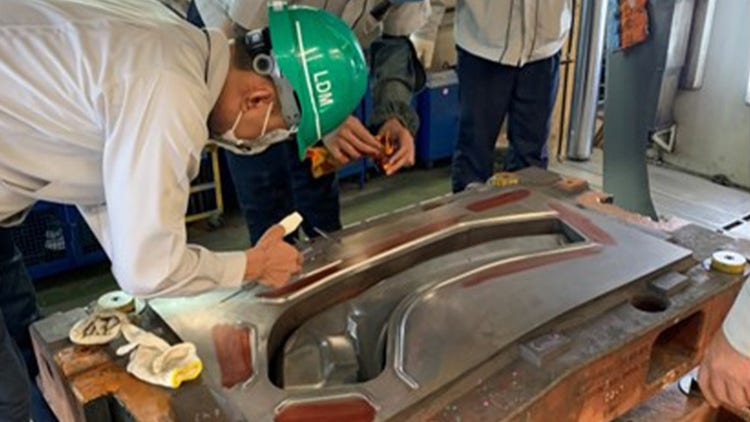
After the die compensation process, SAB transferred the geometry to the tooling department to have a physical prototype of the die made. Figure 4 shows the punch, die and blank holder plate for this project. For high rigidity of the tooling, they prepared a cold work tool steel grade JIS; SKD11 for every part.
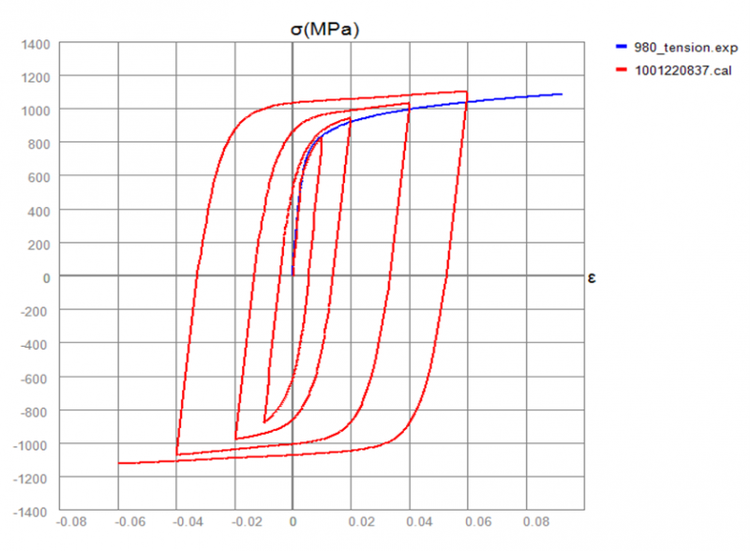
Fig. 2 (Left) The use of material identification software; MatPara

Fig. 3 (Right) The FE simulation results of 980MPa A-pillar
The simulation results speak for themselves

Fig. 5 The comparison of an A-pillar part obtained from the die trial and the FE simulation results with a die allowance of ±1 mm
In their very first die trial, SAB achieved an 84% accuracy (Fig. 5) without ever applying for a restrike process, which was a huge win for their R&D team. It should be noted that their new process dramatically reduced production time by approximately 60 days, as well as lowered the cost of materials.
SAB realized this success because of their dedicated use of Sheet Metal Forming (PAM-STAMP). Their principal benefit is being able to deliver the quality and service their customers expect which they realized because of the production timesaving and the raw material cost-saving as no die improvement loops were required during the die trial. Based on the success of this project, SAB Thailand has generated a new methodology to implement this approach to all similar parts – plus they are pushing to reach an accuracy of 90% in the near future.
For more information visit Summit Auto Body Thailand