
SimulationX 2026: Less Time Building Models. More Time Engineering Better Products.
Explore the latest enhancements in vehicle dynamics, regenerative braking, heat transfer, and hydraulics that simplify engineering workflows and improve simulation confidence.
Every SimulationX release introduces new features and capabilities, and with that it brings an enhanced way for engineers to get their work done.
With SimulationX 2026, instead of focusing on one or two headline feature, this release improves the overall engineering workflow itself. Whether you're developing an electric vehicle, optimizing a thermal management system, designing hydraulic machinery, or building complex multi-domain models, the emphasis is the same: make models more realistic, more robust, and easier to work with.
Rather than simply adding more components, SimulationX 2026 helps engineers answer difficult design questions earlier and with greater confidence.
Smarter Vehicle Models for the Electrification Era
Vehicle development is no longer about designing individual subsystems in isolation.
Braking influences energy recovery. Suspension affects tire behavior. Tire characteristics influence vehicle stability. Battery performance changes how much regenerative breaking can actually be utilized.
SimulationX has always been built around this multi-domain philosophy, and the 2026 release strengthens it even further.
One of the key highlights is the expanded Vehicle Dynamics library.
On the realistic test environment side, we now have a fully configurable road creation and automated track generation for the same. Instead of manually creating road surfaces, driving tracks, and CRG files as separate steps, engineers can now define the road geometry including obstacles directly within the model. SimulationX automatically generates the corresponding driving track and road surface, which can be passed directly to the driver model for closed-loop vehicle simulations. This significantly simplifies the setup of custom driving scenarios, allowing engineers to spend less time preparing test environments and more time evaluating vehicle behavior.
On the vehicle side, engineers now have greater flexibility to represent real suspension kinematics through configurable spring and damper deflection ratios, while support for the latest MF-Tyre/MF-Swift 2506 tire model enables more accurate tire behavior and handling analysis. The updated curve-based wheel example also provides a practical guide for parameterizing tire models, making it easier to build realistic vehicle simulations. Just as importantly, the release includes new sample models that demonstrate complete engineering workflows instead of isolated components.

Detailed road configuration for contact surfaces in SimulationX’s built-in ground model

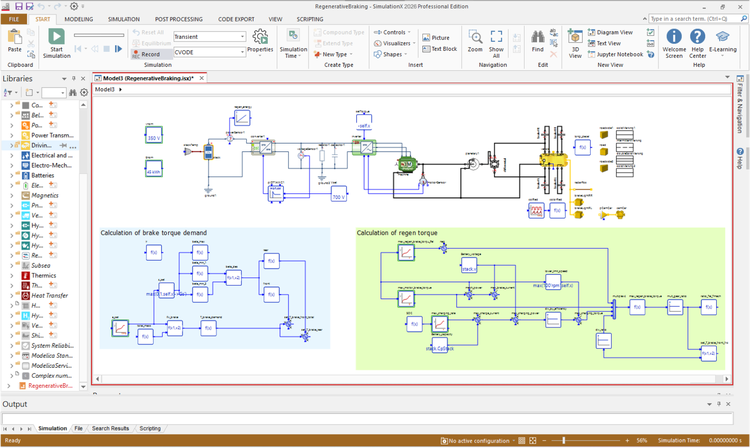
The release also expands its collection of application-focused example models. One example that stands out is the new Regenerative Braking model.
Rather than focusing solely on the electric machine, the example demonstrates how regenerative braking can be modeled by considering the vehicle dynamics, electric motor, drivetrain, and battery as one integrated system. This provides engineers with a practical starting point for exploring braking strategies, energy recovery, and their impact on overall vehicle performance—an increasingly important challenge as manufacturers continue to optimize EV efficiency and driving range.
Taken together, these updates reinforce one of SimulationX's greatest strengths: enabling engineers to evaluate the complete vehicle—from the road beneath the tires to the energy flowing back into the battery—within a single, connected system model.
Thermal Management Continues to Grow in Importance
Ask almost any engineer coming from any domain where development complexity has increased over the last decade, and thermal management will almost certainly be near the top of the list.
Be it cooling batteries, managing electronics, recovering waste heat and or operating across multiple refrigerants and working fluids, thermal & energy management for any modern day product is becoming complex with pressing needs to be cleaner and scalable.
SimulationX 2026 significantly expands its thermal capabilities with improvements that are immediately relevant for these applications.
Heat exchanger models have become considerably more mature. Two-phase heat exchangers have moved beyond beta status, while improvements in evaporation, condensation, and void-fraction calculations provide smoother transitions between operating states and greater numerical robustness. Engineers working close to critical operating conditions will also appreciate improved stability at low flow rates, during flow reversal, and under trans critical conditions.
The release also introduces additional working fluids—including glycol mixtures, seawater, and methanol—together with phase-dependent heat transfer coefficients and a consistent interface across heat exchanger components. These enhancements make it easier to build realistic cooling architectures without spending unnecessary time adapting individual component models.
A new sample models depicts a workflow from simplified models for quick parameter estimation to geometry-based, discretized models with dynamic behavior and detailed temperature distribution.
Rather than simply improving component accuracy, these changes help engineers build thermal systems that are more stable, easier to configure, and better suited for modern electrified products.

Hydraulic Systems Become More Realistic—and Easier to Understand
Hydraulic engineers often balance two competing objectives: physical accuracy and model usability. Here with the latest version, we improve both.
The Hydraulics library introduces a revised treatment of air fraction and density calculations, leading to more realistic mass balance behavior, particularly under low-pressure operating conditions. While this improves physical fidelity, engineers should also be aware that legacy models may show different results after migration—a reflection of the underlying physics becoming more accurate.
Beyond the numerical improvements, SimulationX now makes hydraulic systems much easier to interpret visually.
New valve animations show the valve position in real-time, while animated flow direction indicators provide immediate insight into how fluid moves throughout the circuit during simulation. For debugging and design reviews alike, these visual enhancements make understanding complex hydraulic behavior significantly more intuitive.

The addition of new proportional solenoid models also supports more detailed actuator simulations, including hysteresis effects and parameterization using characteristic maps, giving engineers greater flexibility when developing proportional valve systems.
Small Improvements That Add Up to Faster Engineering
Some of the most valuable improvements in SimulationX 2026 won't appear in product demonstrations.
They're the dozens of workflow enhancements that quietly reduce engineering effort every single day.
Examples include:
- easier initialization using the new Initial Constraint block
- improved FEM visualization with the new FEMVis workflow
- enhanced code export with broader Linux support
- cleaner visualization throughout multiple libraries
Individually, these may seem like incremental updates. Collectively, they remove friction from the modeling process, allowing engineers to spend less time preparing simulations and more time evaluating engineering decisions.
Looking Beyond Individual Libraries
One final addition worth mentioning is the introduction of AI-powered assistance within SimulationX. As engineering systems become increasingly complex, finding the right component, understanding model behavior, or simply navigating large libraries can consume valuable development time. With decades worth of knowledge base in the background, the new AI capabilities are designed to act as an engineering assistant—helping users discover relevant models, answer product questions, and accelerate model development without replacing engineering judgment. The AI assistant is currently available to very limited customers upon specific request at this point and is still in the evolvement phase for broader distribution in the future releases.
Concluding…
Perhaps the biggest takeaway from SimulationX 2026 isn't any single feature.
It's that the release continues to reinforce SimulationX's greatest strength: system-level engineering.
Whether you're studying regenerative braking in an electric vehicle, optimizing thermal management, tuning a hydraulic actuator, or refining vehicle dynamics, the value comes from seeing how these systems interact—not from analyzing them in isolation.
SimulationX 2026 doesn't just introduce better libraries.
It helps engineers connect them more naturally, simulate them more confidently, and ultimately make better engineering decisions much earlier in the development process.
For complete release notes you can visit the documentation section
Join us for the Release HighlightsWebinar on 30 July 3:00 pm Central Europe Time.
Related Posts