
Maintaining Model Fidelity from Device Physics to PIC Design: What's New in RSoft 2027
Photonic integrated circuit (PIC) development spans multiple engineering domains. Device designers optimize waveguides, resonators, modulators, detectors, and other photonic components. Circuit designers assemble those components into larger functional subsystems. System architects evaluate complete optical links, transceivers, and electrical-optical-electrical (EOE) architectures.
While simulation tools have become increasingly sophisticated, transferring information between these stages remains a persistent challenge. Device-level simulation results are often converted into simplified models, manually recreated in downstream environments, or disconnected from later design stages entirely. As PIC complexity increases, engineering teams are placing greater emphasis on maintaining model fidelity throughout the design process. The goal is not simply to optimize individual devices, but to understand how those devices influence overall system performance.
RSoft 2027 introduces several enhancements that support this objective, including expanded ADS Photonic Designer integration, support for additional active photonic components, new waveguide-component capabilities, and Unix-platform support. These additions are incremental improvements, but they point toward a broader trend in photonic engineering: more connected workflows between device simulation, PIC implementation, and system-level analysis.
The Challenge: Preserving Information Across Design Stages
Photonic device behavior is highly dependent on geometry, materials, fabrication assumptions, and operating conditions. Detailed simulation can capture these effects with considerable accuracy, but those results must then be translated into forms that are usable for circuit simulation, layout generation, and verification workflows.
This transition is often where engineering friction occurs. Multiple tools, different abstraction levels, and manual data exchange can introduce inefficiencies and make it difficult to determine how closely downstream models represent the original device behavior. As photonic systems become larger and more integrated, maintaining consistency between design stages becomes increasingly important. The current Keysight photonics solution highlight the importance of connecting component optimization, circuit simulation, foundry workflows, and system-level validation within a continuous design process.

Figure 1. Maintaining continuity between device simulation, photonic circuit design, and system analysis is an important challenge in modern PIC development.
Compact Models as a Bridge Between Device and Circuit Design
One way to address this challenge is through compact model generation and reusable design assets.
Rather than recreating component behavior manually for every new project, detailed simulation data can be translated into models suitable for PIC design environments. These models enable engineers to evaluate larger circuits while retaining information derived from more rigorous device-level analysis.
The Custom PDK Utility described in recent photonic design materials is one example of this approach. By connecting device simulation workflows with foundry-compatible PDK elements, engineers can generate reusable cells that support circuit simulation, layout generation, and verification activities. This reduces manual effort and helps preserve consistency between device-level and circuit-level representations.
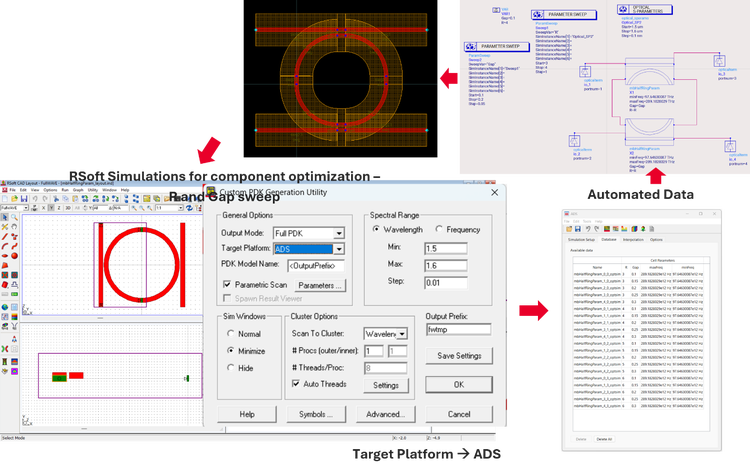
Figure 2. Device simulation results can be converted into reusable design elements that support circuit simulation and PIC implementation workflows.
RSoft 2027 extends this workflow through enhanced integration with ADS Photonic Designer and support for a new RSoft-generated waveguide component derived from simulation data.
Expanding Support for Active Photonic Components
Many modern PICs combine passive structures with active devices such as modulators and photodetectors.
These components influence overall system behavior in ways that extend beyond individual device characteristics. Signal integrity, modulation efficiency, insertion loss, bandwidth, and other factors ultimately affect link-level performance and should be evaluated within a broader design context.
RSoft 2027 adds support for additional active photonic components, including modulators and detectors. This enhancement expands the range of devices that can participate in connected design workflows and reflects the increasing importance of active photonics in communication and sensing applications.
Supporting Diverse Engineering Environments
Simulation workflows often operate within heterogeneous computing environments, particularly in research organizations, foundries, and advanced development teams. Design groups may rely on both Windows and Linux infrastructures depending on their workflows and simulation requirements.
RSoft 2027 extends ADS interface support to Unix platforms, providing additional flexibility for teams that deploy simulation tools across mixed environments. While platform support is not a modeling feature in itself, it can simplify deployment and workflow integration for organizations with established Linux-based engineering environments.
Looking Beyond Individual Devices
As photonic systems continue to evolve, device optimization alone is no longer sufficient. The ability to evaluate how components interact within larger circuits, packages, and systems is becoming increasingly important.
This broader perspective is reflected throughout recent Keysight photonics-development materials, which emphasize workflows spanning device simulation, compact-model generation, PIC implementation, optical interfaces, packaging considerations, and system analysis. The objective is to help engineers maintain visibility across the entire design process, from fundamental device behavior through final application performance.

Figure 3. System-level evaluation helps engineers understand how device behavior influences overall communication performance.
For many engineering teams, the key question is no longer whether a device can be simulated accurately. The question is whether that accuracy can be preserved as designs move through successive stages of development.
Conclusion
PIC development increasingly requires collaboration between device designers, circuit architects, and system engineers. As projects grow in complexity, maintaining model fidelity throughout the workflow becomes an important factor in reducing design iterations and improving confidence before fabrication.
The additions in RSoft 2027, including enhanced ADS Photonic Designer integration, support for active photonic components, simulation-derived waveguide components, and Unix-platform support, represent incremental improvements toward more connected photonic design workflows.
More broadly, they reflect an industry trend toward tighter integration between device simulation, circuit implementation, and system validation. Engineers who can maintain visibility across these stages will be better positioned to evaluate design tradeoffs, understand system behavior, and develop increasingly sophisticated photonic systems.
Suggested Related Resources
- Custom PDK Generation for a Ring Resonator
- Modeling a Ring Resonator
- RSoft Photonic Device Tools Datasheet
- ADS Photonic Designer
Contact us for more information or a demo.
Related Posts