
Keysight Announces 2026 Robert S. Hilbert Memorial Optical Design Competition Results
Keysight is excited to announce the winners of the 2026 Robert S. Hilbert Memorial Optical Design Competition. This annual competition recognizes the innovative work of students in the field of optical design, showcasing their skills and creativity using Keysight’s Optical Design Engineering software. This year’s winners impressed the Keysight team with their projects, and Keysight is proud to share their accomplishments.
This year’s winning designs were submitted by students from:
- CREOL
- Rensselaer Polytechnic Institute
- University of Arizona
- University of Rochester

Julia Barber, University of Rochester
Title: “Drone Mounted LWIR Zoom Lens for Downed Pilot
Rescue Operations”
Keysight Software Product: CODE V
Julia Barber is a student at the University of Rochester studying optical engineering. She is also in NROTC, and this summer she became a Marine. She has an aviation contract with the Marine Corps and was interested in exploring how optical engineering could be used to help aviators in emergency situations. She says, "Using CODE V has been an incredibly valuable and rewarding experience. Starting with a patent, I used the software to explore an improved optical design by evaluating different amounts of lens elements, materials, and optical aberrations."
Her advice to future participants is to choose a project that genuinely interests them and that they will enjoy working on. "Getting stuck is a normal part of the design process, so participants should not get discouraged. When you reach a roadblock, it is okay to seek out a different perspective or approach that can help you move forward," Julia commented.

Ren Lian, University of Rochester
Title: “No Where to Hide: NBI Large FOV Gastroscope for Early Stomach Cancer Diagnosis”
Keysight Software Product: CODE V
Ren Lian is a Biomedical Engineering student at the University of Rochester, with minors in Optics and Computer Science. His project was inspired by Olympus narrow-band imaging technology and an Olympus dual-focus endoscope patent, which led him to explore a compact endoscopic objective with two zoom positions for navigation and detailed imaging.
"Using CODE V, I implemented and optimized both zoom configurations, developed macros to control key design constraints, and used Glass Expert to identify suitable optical materials," said Ren. "My advice to future participants is to define the system requirements clearly, explore multiple design approaches, and learn from every optimization iteration."
Yanzhao (Alex) Lu, University of Arizona
Title: "Design of a Compact and High-Efficiency LCoS Light Engine for Head-mounted Displays"
Keysight Software Products: CODE V and LightTools
Alex is a Ph.D. student in the 3DVIS Lab at the University of Arizona, where his research focuses on freeform optical design for AR/VR head-mounted display systems.
He says, "CODE V and LightTools have been essential tools for completing my optical designs and system simulations. In particular, their macro capabilities are extremely valuable for freeform optics, allowing me to efficiently automate complex design, analysis, and optimization tasks."

Harithra Navaratnam, Rensselaer Polytechnic Institute
Title: “Parametric Analysis of a 3D Printed Baffle Optics Geometry for Glare Reduction and Tailoring Output Beam Intensity Distribution"
Keysight Software Product: LightTools
Haritha Navaratnam is currently pursuing an M.S. in Lighting at the world-renowned Lighting Research Center at Rensselaer Polytechnic Institute, and she is also working as a Lighting Design Intern at Lighting Design Alliance, a Salas O’Brien company, in California. Her research focuses on the intersection of lighting design, technology, and human factors, using optical engineering to optimize beam distribution and fixture efficiency through a novel 3D-printed baffle optic for linear LED luminaires.
Haritha adds, "LightTools, a powerful ray-tracing analysis software, helped me study optical baffle geometries, reshape beam intensity distribution, evaluate fixture efficiency, assess UGR as a glare metric, and generate IES files for further application-based room illumination analysis. My advice to future participants is to begin with a clearly defined problem, use simulation as a dynamic design-thinking tool, and treat the process as an iterative cycle of testing, analyzing, and refining rather than rushing toward a final conclusion."
Haritha is grateful to Keysight’s Optical Design Engineering team for recognizing her work and supporting students and emerging researchers in optical design.
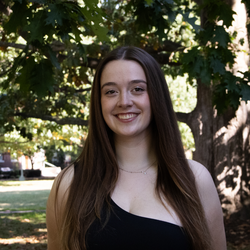
Isabelle Settle, University of Rochester
Title: “PebbleVision - Visible Camera for Olympic Curling Ice Characterization”
Keysight Software Product: CODE V
Isabelle Settle is an undergraduate studying Optics at the University of Rochester, Class of 2027.
The 2026 Winter Olympics inspired her project. She has always found curling to be an interesting sport, and the winter games gave her the perfect opportunity to learn more about it while exploring different avenues of how optical design could contribute to the game.
She says, "CODE V helped bridge the gap between my initial idea and a working design by making it possible to rapidly iterate, optimize, and evaluate different designs before selecting the one that best met the imaging requirements of the curling stone/ice interface."
Her advice to future participants is simple: when a design completely falls apart and participants have to start over, they should take a deep breath, go for a walk, and then get back to designing. Every failed design teaches something, and those lessons make the next one better.

Martin Sipowicz, University of Rochester
Title: “Reverse Engineering the Plasma Diagnostic Collection Lens Within the SMART Tokamak”
Keysight Software Product: CODE V
Martin Sipowicz is pursuing an M.S. in Optics through the HOME program at the University of Rochester while working full-time as an Optical Thin Film Design Engineer. Inspired by his passion for fusion energy and his work alongside startups in the small modular reactor space, his project blended optical monitoring with fusion technology.
He mentioned: "CODE V was instrumental in this effort, providing an intuitive and flexible environment to handle complex coordinate breaks for my off-axis design. My advice for future participants is to pick a topic that deeply interests you, as that enthusiasm can provide extra energy to keep pursuing a project throughout the semester."

Yefu Zhang, CREOL
Title: “End-to-end automated simulation framework of diffractive waveguide AR displays with LightTools and RSoft”
Keysight Software Products: LightTools and RSoft

Zihan (Frannie) Zheng, University of Rochester
Title: “Wide Angle Lens design for Go-pro style video camera for snowboarding/skiing”
Keysight Software Product: CODE V
Zihan (Frannie) Zheng is an Optical Engineering student at the University of Rochester. She was inspired to design a compact wide-angle action-camera lens by her own experience snowboarding and skiing, where she wanted a hands-free system that could safely capture memorable moments with friends on the mountain.
Zihan says, "Using CODE V, I scaled a patented starting design to the selected sensor, used vignetting and glass fitting to improve image quality, optimized chief-ray image heights for f-θ mapping, and iteratively simplified the system from aspheric designs to a fully spherical design while balancing performance and manufacturability."
Her advice to future participants is to understand the purpose behind each optimization choice rather than only chasing the best optimization result.

Cory Kaspar, Ethan Luker, Linden Solgonick, Matias Straub Martinez, University of Arizona
Title: “High NA Microscope Objective with Depth-Dependent Spherical Aberration Correction
Keysight Software Product: CODE V
Cory Kaspar, Ethan Luker, Linden Solgonick, and Matias Straub Martinez are all incoming seniors with a passion for optical design at the University of Arizona’s Optical Sciences and Engineering program. They were largely inspired by their optical design professor, Dr. Yuzuru Takashima, who provided them with encouragement and invaluable knowledge on aberration correction, optical design techniques, and optical systems that gave them an interest in optical design that ultimately led them to undertake this project.
They wanted to pass along this comment: "CODE V was an essential tool used in development that made their project possible through its optimization capabilities and design interface. We encourage participants in this competition to use aberration correction techniques combined with CODE V’s optimization software to develop successful optical systems."
Congratulations to all the winners! We are incredibly proud of the innovative work these students have submitted using Keysight Optical Design Engineering software. Their projects not only push the boundaries of optical design but also inspire future advancements in the field. We look forward to seeing the continued impact of their work in the optical and photonic industries.
About the Robert S. Hilbert Memorial Optical Design Competition
The annual Robert S. Hilbert Memorial Optical Design Competition recognizes excellence in student optical design projects. The competition was established in 2000 by Optical Research Associates (ORA®), now Keysight Optical Design Engineering (ODE), and in 2009 was named in honor of ORA’s former president and chief executive officer, Robert S. Hilbert. To participate, students in North America can enter an optical design class assignment or thesis work that uses Keysight ODE software. For more information, visit https://www.keysight.com/us/en/cmp/2026/robert-s-hilbert-memorial-optical-design-competition.html.
For more information about university and other educational programs with Keysight ODE, visit https://www.keysight.com/us/en/industries/education/optical-design-engineering-university-and-education-support.html.