How do Rolls-Royce engineers make sure their designs are fully castable?
Co-design at Rolls-Royce: a “smart customer” approach to work with the supply chain for cast parts
If Rolls-Royce engineers are in charge of parts design, their suppliers are in charge of defining the best possible manufacturing process. Often times, manufacturing defects or “nonconformances” are found late in the manufacturing development process. Rework is needed, and sometimes even, design engineers must go back to the drawing board just when parts production should have been ready to start – this resulting in avoidable costs and delays, impacting the cost-effectiveness of product development. This situation is even more likely to arise as Rolls-Royce design engineers try to come up with bold designs to improve the sustainability aspects of aircrafts – moving away from conservative designs and thereby being unable to rely on experience.
In line with its Digital First approach, Rolls-Royce engineers are shifting away from physical try-out towards a digital workflow based on Keysight CAE’s casting simulation software Casting (ProCAST). Nick Calcutt, Materials and Process Modelling Engineer at Rolls-Rolls in Derby, UK, calls it the “smart customer” approach.
Checking part castability within minutes using Keysight CAE Casting (ProCAST)
Whether creating new geometries or looking for a new supplier, Rolls-Royce engineers have adopted a “smart customer” approach. They now try to design with manufacturing in mind right from the start.
Relying on a co-design workflow embedded in Casting (ProCAST) enables them to be more proactive, and to support the work of Rolls-Royce’s design, stress, and manufacturing experts. They can integrate the output of the co-design workflow in their Design for Manufacturing sessions (DfMs), which empowers them to identify most manufacturability issues, such as thickness and porosity defects, before the part design is sent to the supplier. The team can immediately look for potential solutions, and even evaluate the cost of rework, all very early in the manufacturing process development.
When it comes to tackle current manufacturing issues in the supply chain, Nick Calcutt’s team can also be more reactive. They can use Casting (ProCAST) to find the root cause of a recurring defect – whether on their side or the supplier’s – and take corrective steps, such as correcting the geometry.
Again, the co-design workflow provides a solid basis to discuss the cost of rework and enables teams to check suppliers’ diagnoses if needed.
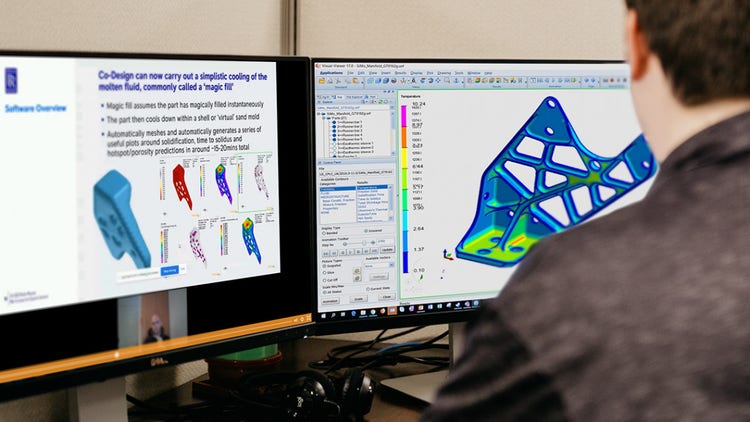
Rolls-Royce engineers use the co-design workflow embedded in their casting simulation software. In around ten minutes, the team can run a detailed prediction for their part and get early confidence in whether a part is castable.
With a simulation run of around ten minutes, our newly implemented co-design workflow gives us the ability to locate 97% of potential casting issues associated with designs. It is accessible to most engineers, not only FEA simulation specialists. It would be difficult to justify why you wouldn’t run a co-design simulation, especially for large and/or expensive cast parts
Nick Calcutt
Materials and Process Modelling Engineer, Rolls-Royce
Image: Thickness analysis for a solenoid bracket, using the software Casting (ProCAST). Image courtesy of Rolls-Royce.
Rolls-Royce’s design engineers also routinely perform a cooling simulation they call “Magic Fill”. It quickly predicts the parts properties after the cooling of the molten alloy – assuming an instant cooling set-up, which does not require material or process data that may be belong to the supplier’s intellectual property.
Image: “Magic Fill” functionality in Keysight CAE Casting (ProCAST), used here for cooling simulations at Rolls-Royce. Image courtesy or Rolls-Royce.