
From Equations to Intelligence: Integrating a Machine Learning Optimizer into Compact Model Extraction
Accelerate semiconductor device modeling workflows with machine learning–driven electronic design automation software solutions built for complexity
Key takeaways:
- The Keysight ML Optimizer offers a promising AI/ML-based solution to bridge the gap between modeling expertise and extraction complexity, making device modeling more accessible and efficient.
- Unlike gradient-based or random-sampling optimizers, the ML Optimizer uses adaptive learning strategies to intelligently explore high-dimensional parameter spaces
- Optimizer supports multi-objective optimization and adhere to physics-based constraints, making it suitable for modeling next-gen devices like quantum transistors, cryogenic CMOS, and novel materials—while reducing reliance on deep domain expertise.
Semiconductor device compact models have evolved in the past few decades from a few parameters found in BJT Gummel-Poon model to several hundreds of parameters in BSIM-BULK model for MOSFETs. Advanced semiconductor technology nodes have introduced new secondary effects to be modeled such as short-channel effects, quantum-confinement effects etc. Adding new equations means increasing complexity of building parameter extraction strategy needed to resolve the inter-dependencies between parameters. With the growing shortage of talent in semiconductors, there is a need to explore AI/ML alternatives to help bridge the gap between parameter extraction complexity and modeling expertise. New breakthroughs like the Keysight Machine Learning (ML) Optimizer are a step forward to fill this gap and improve existing device modeling workflows.
What is the Keysight ML Optimizer?
The Keysight ML Optimizer is a derivative-free optimizer which leverages machine learning techniques to explore complex, high-dimensional parameter spaces and uses proprietary cost function to simultaneously extract more than 40 parameters across device sizes, biases and operating conditions while adhering to physics-based constraints. By dynamically adapting its search strategy, it reduces the number of required optimization steps while improving solution quality, making it especially suited for device modeling with many parameters and atypical starting values. The figure shows a typical workflow when using this optimizer.

Figure 1. ML-based extraction flow
Traditional optimizers vs. Keysight ML Optimizer
Global optimizers have been used for searching the entire parameter range space, but they are computationally inefficient and often do not yield an accurate solution. Local search optimizers mostly are gradient based and tend to get stuck in local minima and convergence issues. On the other hand, Keysight ML Optimizer explores the parameter search space and learns from each trial thereby converging to a better solution with each new iteration. In contrast, other derivative-free optimizers such as Particle Swarm Optimization (PSO) and Genetic algorithm get their performance influenced by the quality of initial random sampling and require excessive iterations.
Below is a comparison table of derivative-free and derivative-based optimizers:

Parameter extraction use-cases
Diamond Schottky Diode
To show how the Keysight optimizer can effectively extract multiple parameters in one step, we start with a simple diode example with modeling equation shown below. It has 3 parameters that need to be simultaneously extracted: IS, RS, N. Setting this up in Keysight EDA device modeling tools is easy once the initial value and wide ranges for the above parameters are identified. Then we selected the number of iterations as 800 for ML optimizer with a stopping RMS error of 0.0001% and in a matter of seconds can see the fitting results shown in figure below.


Figure 2. Fitted diode forward-bias characteristics
Bulk CMOS Transistor
Next, we use the ML Optimizer to fit multiple device characteristics of a Si-MOSFET to prove its ability to work with multi-objective problems when traditional optimizers fail to give optimal results, such as when all linear and saturation transfer characteristics, output characteristics, and trend plots are simultaneously optimized for a given set of parameters. In the example below, we adjust 12 parameters for a wide-long device using BSIM4 model and obtain acceptable best-fitting results with just 250 iterations in a matter of minutes.


Figure 3. Final Si-MOSFET characteristics
Bipolar Transistor
Next, we also use the optimizer to fit the Bipolar Junction Transistor (BJT) current-voltage characteristics using the SPICE Gummel-Poon (SGP) model by optimizing a total of 16 parameters using 1500 iterations in less than 10 minutes. SGP input and output fitting results in the MBP tool are shown in the figure below.
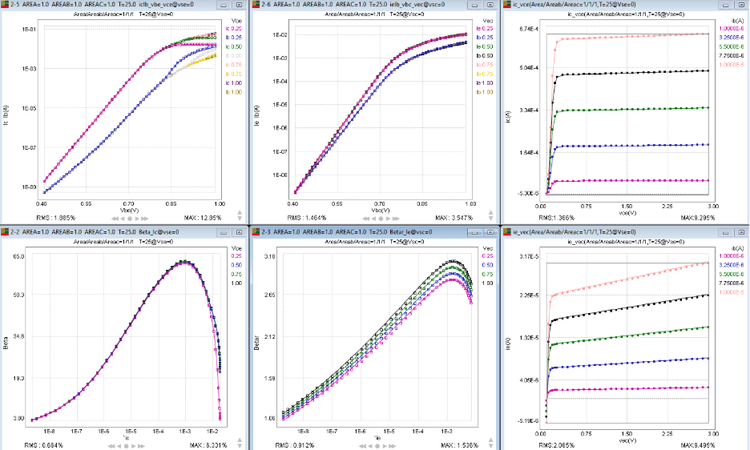
Figure 4: Fitted Bipolar characteristics
GaN-HEMT Transistor
Finally, we apply the same optimizer to fit measured data of a GaN-on-SiC HEMT device to ASM-HEMT DC model. We consider 35 model parameters to optimize simultaneously across a reasonably wide range of their values. Upon running optimization for about 6000 steps, we obtain the fitting results below with an RMS error of 0.0019%.

Figure 5. GaN-on-SiC HEMT DC model fitting
Why does this solution matter?
The Keysight ML Optimizer stands out from other optimizer solutions currently available for device modeling in terms of offering superior outcomes for multi-objective and multi-dimensional problems commonly faced by device modeling engineers. This solution also has a few limitations, such as reduced effectiveness when 100s of parameters are optimized simultaneously, and it requires large iterations for larger problem sizes, but mostly can be overcome by limiting to 40 parameters and taking advantage of a powerful CPU. This solution also offers high potential to automate a full extraction of compact models, thereby reducing dependence on domain expertise to a greater extent.
Common Frequently Asked Questions (FAQs):
- How does ML Optimizer integrate within Keysight device modeling tools?
It is available in IC-CAP 2025 and MBP 2026, making it accessible directly within device modeling workflows used by both industry and academic researchers. - Why is the Keysight Optimizer called Machine Learning based, and how does it learn?
The Keysight ML Optimizer is called machine learning–based because it continuously refines its understanding of the problem space as it runs. Instead of relying on fixed search strategies, it builds and updates an internal knowledge representation of the parameter landscape using structured matrices. This allows it to intelligently balance exploration (searching for promising new regions) and refinement (improving existing solutions), adapting dynamically to each optimization task. - Do you pre-train any model or use neural networks inside the optimizer?
No. The Keysight ML Optimizer does not rely on pre-training or neural networks. Instead, it learns dynamically from scratch for each optimization task, allowing it to adapt to the specific characteristics of the problem. This approach avoids the computational overhead and instability often associated with neural networks, while still leveraging domain-specific heuristics to improve efficiency for EDA and device modeling applications. - How does the ML Optimizer handle noisy or incomplete measurement data?
It is robust against measurement noise and outliers by leveraging adaptive search strategies. However, preprocessing and good measurement practices still play an important role in achieving reliable results. - How scalable is the Keysight ML Optimizer for emerging technologies like quantum, cryogenic, or novel materials?
The optimizer is technology-agnostic. As long as the compact model equations are defined, it can adapt to new devices, including quantum transistors, cryogenic CMOS, and novel III-V or 2D materials.
Relevant resources:
Contact us for insights and information on EDA for Device Modeling and Characterization.
Learn more:
Machine-Learning-Based-Automatic-Parameter-Extraction
Bootcamp: AI/ML Innovations in Device Modeling