
AI Design Has a Data Problem. It’s Time to Fix the Foundation.
Everyone wants to talk about AI models. But in semiconductor design, the real question is whether your engineering data is organized, secure, and trustworthy enough for AI to use. If the data is scattered, duplicated, poorly governed, or hard to access, AI does not solve the problem, it exposes it.
That is the reality many engineering organizations are facing right now.
Over the past year or two, the AI conversation in chip design has moved very quickly. At first, many companies were asking the obvious questions: How do we use AI in our design flow? How do we train a model? Can we build a copilot? Can we automate more of the design, verification, or debug process?
Those are still important questions. But as companies move from experimentation to implementation, a more fundamental issue keeps surfacing: the data is not ready.
AI depends on context. It needs access to the right information, in the right form, at the right time. In semiconductor design, that is not a trivial requirement. Engineering data is often spread across multiple tools, repositories, file servers, collaboration platforms, and geographic locations. Some of it is revision controlled. Some of it is not. Some of it is well documented. Some of it exists only as tribal knowledge. Some may be buried in logs, simulation results, test outputs, specifications, layout files, emails, or project folders that only a small group of people knows how to navigate.
That has always been inefficient. In the AI era, it becomes a strategic blocker.
AI makes data quality impossible to ignore
For years, engineering teams have found ways to work around fragmented data. They have relied on experienced engineers, CAD teams, internal conventions, scripts, checklists, and institutional memory. It may not have been perfect, but people made it work.
AI changes that equation.
If an engineer asks an AI assistant to help diagnose a design issue, summarize project history, identify related changes, or recommend a next step, the system must be able to retrieve accurate and relevant context. If the underlying data is incomplete, duplicated, outdated, or poorly labeled, the AI may produce an answer that sounds confident but is wrong. That is one reason hallucinations are such a concern. The model matters, of course. But the quality and structure of the data feeding the model matter just as much.
This is why data management has become a front-line issue in AI-driven design. It is no longer just about storing files. It is about making engineering knowledge usable.
That means data must be structured, tagged, versioned, secured, and connected. It must be machine-readable. It must have context. It must have lineage. Teams need to know where data came from, who changed it, which version is authoritative, who is allowed to access it, and whether it can safely be used in a model, workflow, or automated process.
In other words, AI-ready design requires AI-ready data.
The hidden cost of fragmentation
One of the biggest problems we see is fragmentation.
A company may have one team using a formal engineering data management system, another using a file server, another using SharePoint, another using Confluence, and another using a separate system brought in through an acquisition. Multiply that by global design sites, partner relationships, IP suppliers, security requirements, and different tool flows, and the result is predictable: data chaos.

That chaos has real consequences.
Engineers waste time looking for the right file. Teams duplicate work because they cannot see what already exists. Incorrect versions get reused. Project decisions are made without complete context. Security policies become harder to enforce. Audit trails are incomplete. And when AI enters the picture, the problem compounds because the system may have to search across many disconnected sources, increasing latency and reducing confidence in the output.

This is where the idea of a single source of truth becomes critical.
A single source of truth does not mean all engineering data magically lives in one monolithic location. It means the organization has a governed, traceable, and trusted way to know what data exists, where it lives, how it relates to other data, who can access it, and which version should be used. That foundation is essential for collaboration. It is essential for security. And it is essential for AI.
We need to rethink what data is worth keeping
AI also changes the value of data that many teams historically treated as temporary.
Simulation runs, test results, logs, intermediate outputs, verification data, and debug history were often discarded once a specific task was complete. That made sense in traditional workflows, where storage costs, performance constraints, and process habits encouraged teams to keep only what they immediately needed.
But machine learning changes the economics of engineering knowledge. A simulation run that used to be thrown away may now help train a model. A test result may help correlate design intent with real-world behavior. A log file may help an AI assistant predict runtime, memory usage, or likely failure modes. Historical design decisions may become useful context for future projects.

That means organizations need to think differently about retention, metadata, storage, and retrieval. They need to capture more of the design process, not just the final outputs. But they also need to do it intelligently. More data is not automatically better. More usable data is better.
The goal is not to create a bigger landfill of engineering files. The goal is to create an engineering data backbone that can support faster design cycles, better reuse, stronger governance, and more confident AI-driven workflows.
Security and governance are now part of the AI conversation
There is another reason data management has become more complex: security.
Semiconductor design data is among the most valuable intellectual property in the world. RTL, schematics, layouts, waveforms, verification results, test data, and IP blocks must be protected. Add AI into the flow, and companies immediately have to ask difficult questions.
Which data can be used by an AI system? Which data is export controlled? Which data can be accessed by which team, in which geography? Can sensitive information become part of model learning? How do we prevent IP leakage? How do we prove compliance? How do we maintain traceability from concept through production?
These are not just engineering questions. They involve CAD teams, IT, security experts, legal teams, compliance leaders, and engineering management. That broadens the buying group and complicates decision-making, but it also reflects the importance of the problem.

AI is not just another tool plugged into the design flow. It touches the company’s data strategy, infrastructure strategy, security model, and governance framework.
The rise of the engineering data steward
As data becomes more central to AI-enabled design, organizations will need new roles and responsibilities. Some people have started calling this the “EDA data librarian.” Whatever title is used, the need is clear.
Someone must ensure that engineering data is structured correctly, enriched with the right metadata, governed by the right access controls, connected to the right project context, and available to the right tools and users. Someone must think about data quality, provenance, retention, classification, and reuse.

This may not sound as glamorous as building an AI model. But it is foundational. Without trusted data, AI becomes unreliable. With trusted data, AI becomes far more useful.
That is the shift we are seeing now. Companies are realizing they cannot skip the foundation. They cannot jump directly to advanced AI workflows if their data is fragmented, insecure, or poorly understood.
From data management to competitive advantage
The good news is that this challenge is solvable.
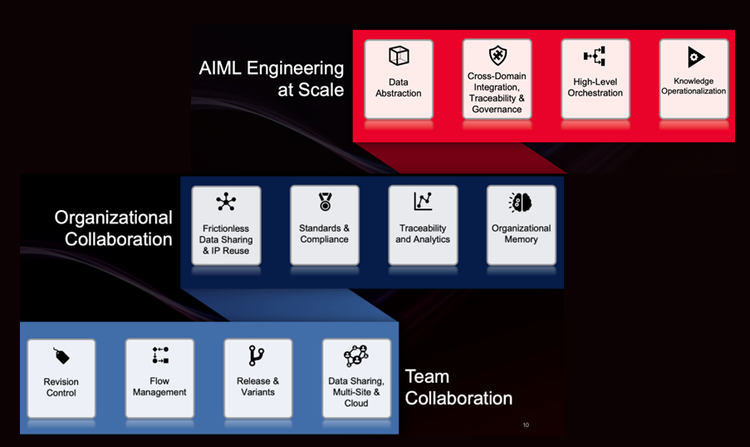
Modern engineering data management gives organizations a path to bring clarity, confidence, and reliability to the design process. It helps teams collaborate without fear, govern data without unnecessary bureaucracy, and create the traceability needed for both human decision-making and AI-assisted workflows.
For engineers, that means less time searching for files, fewer mistakes caused by version confusion, and more confidence in what changed and why. For managers, it means better visibility, stronger governance, and more predictable execution. For the business, it means engineering data becomes more than a cost center. It becomes a strategic asset.
That is especially important as AI becomes more embedded in semiconductor design. The companies that get their data foundation right will be in a much stronger position to apply AI effectively. They will be able to reuse IP more confidently, automate more intelligently, collaborate more securely, and make better decisions with better context.
The companies that do not address the foundation may find themselves stuck, not because AI failed, but because the data underneath it was never ready.
AI may reshape semiconductor design. But first, it is reshaping how we think about engineering data. The model gets the attention. The data foundation will determine the outcome.
Watch the webinar to learn more: SOS for Visual Studio Code: Design Data Management for Digital Design Teams
Related Posts