
Adding GPU Acceleration to Electromagnetic Simulations in FullWAVE FDTD
Achieve up to 80x speed improvements
The finite-difference time-domain (FDTD) method is a critical technique for electromagnetic simulation and analysis. As the need for lighter, more compact optical systems expands and simulation requirements increase, traditional central processing unit (CPU) calculations may seriously affect design efficiency, taking days or even weeks. To solve this problem, RSoft Photonic Device Tools' FullWAVE FDTD software supports graphics processing unit (GPU) acceleration, significantly accelerating simulation speeds compared to CPU-based calculations through the parallel computing power of NVIDIA GPUs.
Based on test data, GPU acceleration delivers up to an 80x increase in computational performance only with four GPUs, enabling the design of many systems that were previously too time-intensive to simulate. GPU acceleration is particularly well suited for micro-LEDs, CMOS image sensors, nanophotonic devices, grating couplers, and other complex electromagnetic simulation applications.
RSoft GPU acceleration technology is compatible with CUDA 12.3 or later and supports multiple GPUs for computation. This allows you to fully leverage their high-performance computing resources, improve simulation efficiency, and shorten product development cycles.
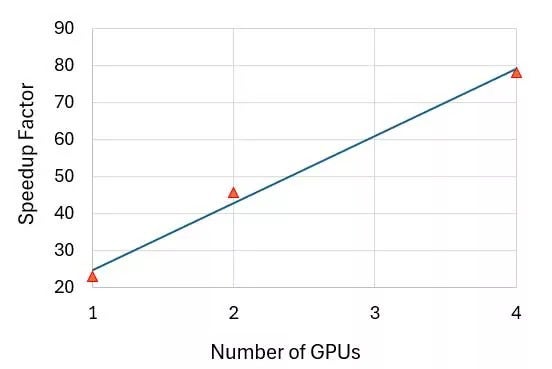
Figure 1. RSoft GPU acceleration supports multiple GPUs to improve simulation efficiency. Benchmark performed using multiple NVIDIA H100 GPUs versus a 12-core Intel Xeon E5-4667 CPU
Advantages of GPU acceleration
FullWAVE FDTD GPU acceleration provides many advantages, including:
- GPU computation without additional modeling.
- Dramatic speedups. Simulation speeds can be increased by tens to hundreds of times through the GPU parallel computing architecture, effectively reducing computation time.
- Support for large-scale simulations. Simulations that require higher resolution and a larger range of models can be easily handled, making high-precision optical analysis more feasible.
- Reduced computing bottlenecks. Significantly reduces the computational burden on the CPU, increases overall system efficiency, and supports multi-GPU configurations to further enhance performance.
Example: Micro-LED design
In micro-LED design, light field distribution, light extraction efficiency, and microstructure design are closely related, and these analyses require accurate, high-resolution FDTD simulations. Time-intensive CPU computations may cause delays in the development cycle and even affect design decisions. With GPU acceleration, engineers can complete high-precision micro-LED simulations in a short period of time and quickly evaluate the performance of different design solutions.

Figure 2. Micro-LED design
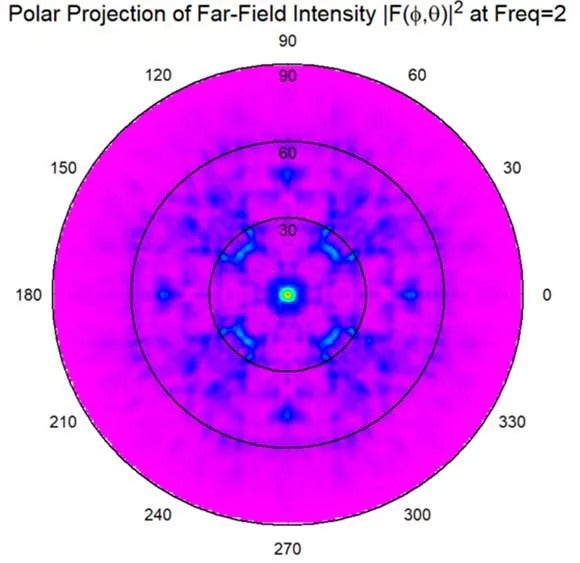
Figure 3. Polar projection of far-field intensity at freq=2
This case shows that even on a typical workstation, GPU acceleration can dramatically reduce simulation time, enabling a cost-effective simulation solution. Test results show that using a single NVIDIA RTX A4000 GPU provides a nine-time speedup compared to using an Intel Xeon W-2255 10-core CPU.
Example: CMOS image sensor design
CMOS image sensors are widely used in smartphones, monitors, and in-vehicle camera systems, and simulating their optical response requires intensive FDTD calculations. With the help of GPU acceleration, these calculations can be completed in less time, enabling engineers to more efficiently evaluate the optical performance of the sensor and further optimize the design.
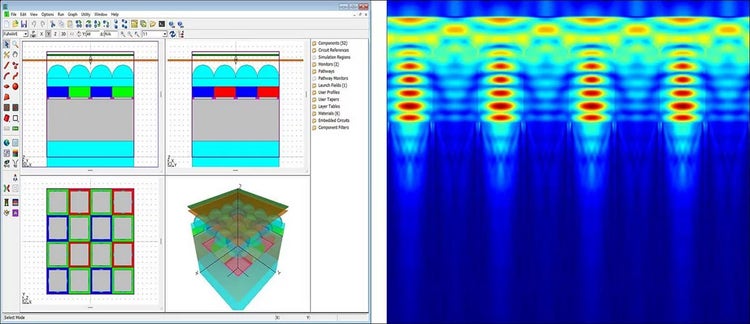
Figure 4. CMOS image sensor design and analysis in FullWAVE FDTD using GPU acceleration
In this case, using higher-specification computing equipment significantly improved simulation performance. Measurements show that using a single NVIDIA H100 GPU can deliver a speedup of up to 15 times compared to using an Intel Xeon E5-4667 24-core CPU, or around 23 times compared to a 12-core CPU. Benchmarking with both real FDTD, where the fields are real-valued (i.e. for normal incidence), and complex FDTD, where the fields are complex-valued (i.e. tilted incidence), demonstrate consistent GPU/CPU acceleration achieving speedup in the 22-25x range. The overall speedup factors can reach around 80x when using 4 GPUs in parallel. Note that the CMOS example used realistic analysis options, including a reflection monitor, an absorption monitors over the active region, and a far-field monitor. So, the benchmarking results include their overhead and reflect real-word workflows.
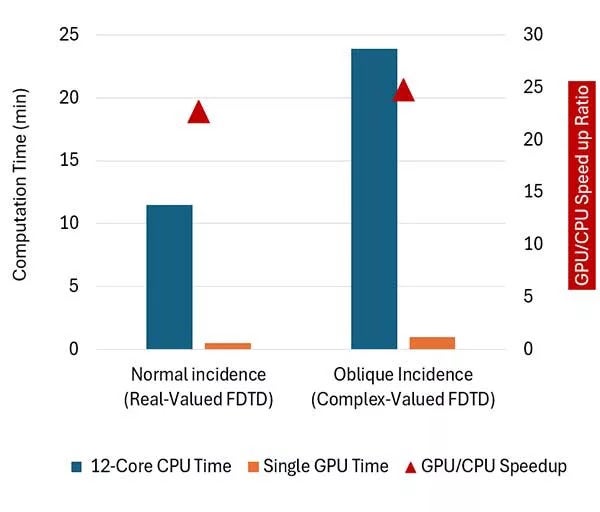
Figure 5. GPU-accelerated CMOS image sensor simulation results showing computation time and GPU/CPU speed-up ratio under real and complex valued FDTD simulations
Balancing simulation accuracy and computation time is a challenge for photonic device engineers. FullWAVE FDTD GPU acceleration solves the challenge by using NVIDIA CUDA parallel computation, enabling higher-resolution, larger-scale simulations for micro-LEDs, CMOS image sensors, gratings, surface plasmonic polymers (SPPs), and other photonics applications.
In addition, by supporting multiple GPUs running in parallel, GPU acceleration in FullWAVE FDTD can further increase computational efficiency, ensure highly accurate simulation results, and speed product development.
Get started with GPU-accelerated FullWAVE FDTD
Ready to accelerate your electromagnetic simulations? Discover how GPU-accelerated FullWAVE FDTD can help you deliver micro-LEDs, CMOS image sensors, and many other applications to market with efficiency and accuracy. Contact us today for a demo or trial license.