
Insertion Loss Testing
Cable and antenna testing is essential for ensuring the reliability and performance of telecommunications systems, especially as cables, connectors, and antennas degrade over time due to environmental exposure or physical stress. These components are often the root cause of cellular base station issues, leading to poor coverage and unnecessary handovers. Insertion loss testing is a key diagnostic method used to measure how much signal is lost as it passes through these components. Whether installed outdoors—where they face rain, snow, wind, and lightning—or indoors—where they may be exposed to heat, vibration, or mishandling—cables and antennas are susceptible to damage. Issues such as moisture ingress, cracked insulation, or improper cable bending can significantly degrade signal quality. Insertion loss testing helps detect these problems early by quantifying signal attenuation, allowing RF engineers and technicians to maintain system performance and prevent costly failures.
Modern handheld analyzers, like the Keysight FieldFox Analysers, are designed specifically for cable and antenna testing (CAT), offering fast and accurate insertion loss testing across a wide frequency range. These tools are invaluable for both installation and maintenance, enabling field technicians to verify system integrity, locate faults, and assess individual component performance without dismantling the entire setup. Insertion loss testing not only ensures that new installations meet performance standards but also supports ongoing troubleshooting by pinpointing degraded or damaged components. As wireless infrastructure continues to expand, especially with the demands of 5G networks, the role of insertion loss testing becomes increasingly critical in maintaining high-speed, low-latency communication systems.
What is insertion loss in RF systems?
Insertion loss in RF (Radio Frequency) systems refers to the reduction in signal power that occurs when a device or component is inserted into a transmission line. It is typically measured in decibels (dB) and quantifies how much signal is lost due to the presence of the component. This loss can be due to resistive losses, dielectric losses, or impedance mismatches.
Insertion loss is also known as cable loss and increases with both frequency and cable length. Insertion loss is a critical parameter for verifying the performance of RF cables and antennas, especially in field testing scenarios.
Insertion Loss Formula
A lower insertion loss indicates a more efficient component with minimal signal degradation. Insertion loss is expressed in decibels (dB) and is calculated using the formula:
IL (dB) = 10 * log10(Pin / Pout)
Where:
- Pin is the input power to the device under test (DUT)
- Pout is the output power from the DUT
How Do Insertion Loss Impact RF System Performance?
Verifying and troubleshooting electrical performance of RF and microwave transmission systems and antennas starts with accurate cable and antenna measurements. Installation, operation, and maintenance of communications systems cause wear and tear on connecting cables, adapters, and antennas over time. This degradation can result in poor cellular signal, reduced coverage area, and unnecessary cellular handovers. Before testing system components, it is important to verify the performance of the cables and antennas so you can better troubleshoot system level issues.

In this blog, I cover different techniques and configurations to help you make cable and antenna test (CAT) quick and easy.
The insertion loss of a transmission line or coaxial cable is the amount of energy dissipated in the cable. Insertion loss is also defined as the energy lost due to mismatch reflection between the source and the load. Ideally the source (transmitter), transmission line (coaxial cable), and the load (antenna) are all designed for the same characteristic impedance, usually 50 or 75 Ohms. You can also represent insertion loss by the S-parameters S21, or S12 in a 2-port network. The ratio between the input and output signals, from one end of the cable to another, or from one port to the other, represents the total insertion loss of the cable. Ideally, lossless cable will have an insertion loss of 0. If you’d like to learn more about insertion loss and s-parameters, check out this previous blog.
Insertion Loss Test Basics with Keysight FieldFox Analyzers
When a cable is installed in a system, it is often difficult to physically connect test equipment to both ends of a very long cable. Adding very long cables to the test set up is impractical. Under these conditions, you may need to perform a one-port insertion loss measurement. FieldFox analyzers can operate in Cable and Antenna Test (CAT mode), where you can perform traditional two port insertion loss measurements, or in a one-port measurement mode, where insertion loss is measured from only one end of the cable.
A traditional two-port set-up requires you to connect the cable under test to two separate ports on the FieldFox analyzer, as seen in the image below:

The FieldFox injects a signal into the cable from the RF OUT port, conveniently positioned along the top of the analyzer. As the signal passes through the cable, the cable absorbs a small portion of the energy, typically due to resistive and dielectric losses in the cable. Discontinuities from cable connectors, including bends or other damage, will also reflect some energy back into the source. This results in an increase in the measured insertion loss. The remain signal coming out of the cable is then measured by FieldFox at the RF IN port.
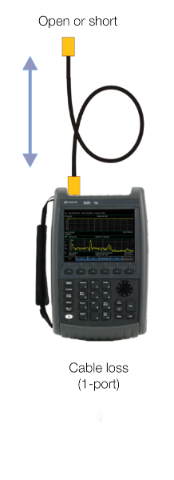
When testing a very long cable, it can be difficult to access both ends of that cable under test. In situations like this, you can execute the test using the one port measurement technique in CAT mode on the FieldFox. This allows you to measure cable insertion loss from only one end of the cable under test, eliminating the need to carry extra-long, high-quality field test cables. In this configuration, the FieldFox injects a signal into the cable from the RF OUT port, just like the 2-port measurement technique. The test signal passes through the cable, reflects at the open end, and passes bacj through the cable a second time, where the Fieldfox measures the result on the RF OUT port. Once the reflected measurement is complete, the FieldFox uses a built-in model for coaxial cable dispersion to compute the cable insertion loss as a function of frequency.
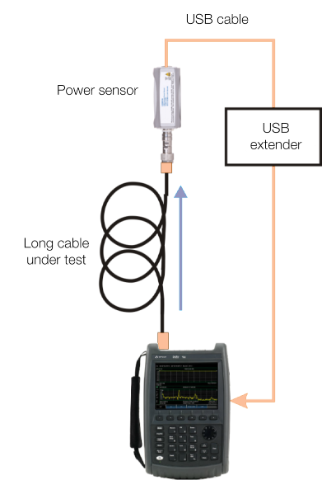
Another configuration for measuring cable insertion loss that does not require a return path cable involves setting up the test with a power meter connected to a power sensor. One end of the cable under test is directly connected to the RF OUT port of FieldFox analyzer. The other end of the cable is connected to the USB power sensor (Keysight U2000 Series USB power sensor). The FieldFox analyzer generates a CW signal at the RF OUT port, which is transmitted along the cable, and measured by the USB power sensor. The USB sensor can be connected back to FieldFox through a USB cable extender. With this configuration you do not need to run an expensive coaxial cable from both ends of the instrument. As with any test set-up, there are pros and cons; the main constraint with this configuration is that swept frequency measurements are not available, so changing test frequencies must be done manually.
With these techniques, you can easily perform insertion loss measurements on any cable, anywhere – rain or shine. For more information on making handheld insertion loss measurements, check out the app note, “Techniques for Precise Cable and Antenna Measurements in the Field.”
Insertion Loss Testing FAQs
- Higher Accuracy: The two-port method directly measures the signal transmitted from one end of the cable to the other, providing a more accurate representation of insertion loss. It minimizes the influence of reflections and mismatch effects that can distort results in one-port setups.
- Direct S21 Measurement: This technique measures the S21 scattering parameter, which is the industry-standard metric for insertion loss. It reflects the actual signal attenuation through the cable without relying on assumptions or models.
- Ideal for Lab and Controlled Environments: When both ends of the cable are accessible—such as in lab testing or during initial installation—this method is straightforward and provides reliable, repeatable results.
- Less Susceptible to Mismatch Ripple: Since the signal is not reflected back from an open or short, the measurement is less affected by impedance mismatches, which can cause amplitude ripple in one-port measurements.
- Single-End Access: The most significant advantage of the one-port method is that it only requires access to one end of the cable. This is especially useful in field scenarios where the other end of the cable is inaccessible—such as when it’s already installed in a tower, underground, or behind sealed equipment.
- Simplified Setup: The one-port method eliminates the need for long jumper cables or additional equipment to reach the far end of the cable, reducing setup complexity and equipment burden in the field.
- Quick and Convenient: Using FieldFox’s built-in reflectometer and CalReady calibration, technicians can perform insertion loss testing immediately upon powering on the device, without needing external calibration kits.
- Efficient for Long Cable Runs: For very long cables, where signal degradation and physical access are concerns, the one-port method provides a practical solution to estimate insertion loss without compromising the cable’s installation.
- Optional Ripple Reduction: Although the one-port method may introduce amplitude ripple due to mismatches, this can be mitigated by using a 50 Ω load and memory subtraction techniques, improving measurement quality.
Return loss is a key measurement in RF and microwave systems that quantifies how much of a signal is reflected back toward the source due to impedance mismatches in a transmission line. These mismatches can occur at connectors, splices, or any point where the impedance of the cable or device deviates from the system’s characteristic impedance (typically 50 or 75 ohms). Return loss is expressed in decibels (dB) and is always a positive number. A higher return loss value indicates better impedance matching and less signal reflection, which is desirable for efficient signal transmission.
In practical terms, return loss helps determine how well a cable, antenna, or component is matched to the system.
Return loss is preferred over VSWR in many modern RF applications because it provides better resolution for small reflections and is easier to interpret on a logarithmic scale. It is a critical parameter in cable and antenna testing, as poor return loss can lead to signal degradation, increased noise, and reduced system reliability. Tools like the Keysight FieldFox analyzer are commonly used in the field to measure return loss and ensure optimal system performance.
Insertion loss and return loss are two critical parameters used to evaluate the performance of cabling systems, particularly in RF and microwave applications. While both are measured in decibels (dB) and indicate signal quality, they describe different phenomena.
Insertion loss refers to the amount of signal power lost as it travels through a cable or component. This loss, also known as attenuation, is a natural effect caused by resistance, dielectric absorption, and imperfections in the cable or connectors. It increases with cable length, frequency, and temperature, and is also affected by the number of connection points such as splices and connectors. In copper systems, for example, higher frequencies and smaller conductor sizes result in greater insertion loss.
On the other hand, return loss measures how much of the signal is reflected back toward the source due to impedance mismatches or discontinuities in the transmission path. A high return loss value indicates minimal reflection and better signal integrity, whereas a low return loss suggests significant signal reflection, which can interfere with the original signal and degrade system performance. In RF systems, return loss is closely related to VSWR (Voltage Standing Wave Ratio), and in optical systems, its inverse is known as reflectance, which is expressed as a negative dB value. Reflectance quantifies the amount of light reflected at a specific point, such as a connector interface.
The relationship between insertion loss and return loss is also important. Poor return loss (i.e., high reflection) can contribute to increased insertion loss, as reflected signals reduce the amount of power reaching the destination. Therefore, a system with high return loss (low reflection) typically exhibits lower insertion loss. Both parameters are essential for diagnosing and maintaining the health of a cabling system. Excessive insertion loss can prevent signals from being properly interpreted at the receiving end, while poor return loss can cause signal distortion, increased bit error rates, and crosstalk in copper systems. Accurate measurement of both parameters using tools like the Keysight FieldFox handheld analyzer ensures reliable performance in both field and lab environments.