Ultra-Low Phase Noise, Multi-Channel Source with Phase Coherent Switching
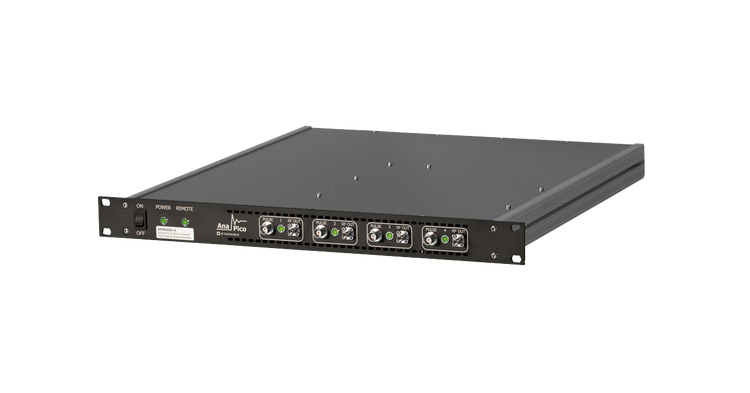
Simulating and testing multi-antenna systems such as phased arrays or beamforming antennas requires a test system capable of providing multiple signals with deterministic frequency and amplitude with a stable, user-adjustable phase relationship among those signals. Keysight’s multi-channel G2 Analog Signal Generator provides a well-designed solution for these applications, packing unique phase coherent signal features into a compact design. The G2 Analog Signal Generator (AP5012A) is a compact signal generator with up to four channels and a frequency range from 300 kHz up to 40 GHz, cost-effectively fulfilling the demanding requirements for many new test applications.
Terminology
When talking about signals and phase coherence, various terms are sometimes used interchangeably, although each term has a very specific meaning. Here are the important definitions used in this article.
- Phase continuity and discontinuity: A signal is phase continuous if, after switching frequency, the phase of the signal is the same as before the switch occurred. If the phase changes after switching, the signal is phase discontinuous.
- Phase coherence between two channels: If the phase relationship between two signals remains constant, the signals are considered phase coherent.
- Phase coherent switching: Phase coherent switching defines the state of the signals’ phase once frequency switching is complete. Two signals at frequency f and with relative phase ϕ are said to be phase coherently switched if the relative phase is again ϕ whenever they go back to frequency f.
- Phase memory: A signal has phase memory if, when switched from frequency f1 to frequency f2 and back to frequency f1, the signal’s phase is the same as if it had run continuously at f1.
- Phase matched outputs: A multichannel signal generator has phase matched signals if the outputs have 0-degree relative phase at all output frequencies.
The G2 Analog Signal Generator is a multi-channel synthesized signal generator that is now available with frequency coverage to 40 GHz and with one to four channels in a compact 1U 19-inch rackmount enclosure. It provides tight stability, phase coherence, and extremely fast tuning speeds, and each channel’s frequency, phase, amplitude, and modulation can be independently programmed.
Other features include a compact design, excellent phase noise, high output power, accurately leveled output, and simplicity of control. The exceptionally low phase noise and high correlation of the independent channels yield outstanding phase coherence, both short- and long-term. The high stability synchronization circuit shared among all the channels of a single unit, with proprietary techniques for exact frequency synthesis, ensures little systematic phase drift between channels, even after hours or days of uninterrupted use.
Some applications require more than four independent outputs, maintaining phase stability over long time periods. The G2 Analog Signal Generator offers a dedicated clock synchronization mode, using two ports on the rear panel to maintain phase coherence among a cascaded group of G2 Analog Signal Generator sources. In this way, the unique features of the G2 Analog Signal Generator can be scaled to virtually any number of channels.

Figure 1. Phase stability measured over 10 hours
To demonstrate the phase stability over time, Figure 1 shows the measured phase difference between two 5 GHz output signals over 10 hours. The excellent phase stability between two individual channels of the G2 Analog Signal Generator is shown by the blue trace. Similarly, the excellent stability when synchronizing two separate units is shown by the green trace.
In comparison, phase locking two independent signal generators using an external, 100 MHz reference results in significant phase drift — several hundred milliradians — shown by the red trace. Synchronizing with a common 10 MHz reference yields even worse performance. In addition to the excellent channel-to-channel phase stability, the G2 Analog Signal Generator supports both phase coherent switching and phase memory (see Figure 2).

Figure 2. The signal generator has phase coherent switching (a) and phase memory (b)
Its channels can be synchronized to maintain a defined phase relationship at all times at any set frequency. As an example of phase coherent switching, consider two channels set to the same frequency, f1, with a phase offset of ϕ degrees. After switching both channels to any other frequency and then back to the initial frequency f1, they will have the same phase offset ϕ. The G2 Analog Signal Generator can also be programmed to phase match the outputs (ϕ = 0 degrees). Programming one channel does not affect the signal from the other channels; only the channel being programmed has a phase discontinuity. With phase memory, whenever a channel hops frequency, then goes back to a previous frequency, it behaves as if it had always been running at the first frequency. All these features can be extended beyond four channels by cascading and synchronizing multiple G2 Analog Signal Generator units.
The following table summarizes the key specifications of the G2 Analog Signal Generator.
The G2 Analog Signal Generator supports the requirements of a wide range of applications, such as testing phased arrays, beamforming antennas, satellite payloads, and implementing quantum computing. With a unique design, the signal generator provides outstanding channel-to-channel phase coherence and is scalable to virtually any number of channels. The PHS option adds phase coherent switching, phase memory, and phase matching features.
Interested in more information about our products?