
Security Highlight: DS1050A – Choosing the Right Setup for Device Security Testing
A few weeks ago, we introduced the DS1050A Next-Generation Embedded Security Testbench, a modular and scalable PXI-based solution that's changing how security professionals approach fault injection (FI) and side channel analysis (SCA). But this is only the beginning of what's possible in Device Security Testing. One of the core components of the Embedded Security Testbench is Inspector, Keysight’s software platform for advanced side channel analysis (SCA) and fault injection. Paired with a powerful PXI chassis and controller, it enables everything from test orchestration to deep data acquisition. To achieve that, we rely on standard configurations and, more importantly, select the right configuration for your security needs.
Understanding the Building Blocks of Device Security Testing
Security testing methodologies may be shared across industries, but the required setup varies significantly depending on the device under test. Whether you're working on advanced microcontrollers, secure SoCs, smartcards, or edge AI processors, the right configuration matters. These technologies are deployed in several industries, including semiconductor manufacturing, automotive, aerospace, IoT, research, and government applications; each with its own unique testing challenges.
Each configuration of the DS1050A is designed to support both early-stage exploration and expert-level analysis, so you can evolve your test environment over time, without starting from scratch. The scalable PXI-based architecture ensures seamless integration and expansion, allowing you to add capabilities as your security testing requirements grow.
Let’s explore the three standard configurations and how they align with real-world test demands.
Power SCA/FI: Breaking Through the Front Door

Think of physical security testing like breaking into a house. The power supply is like the “front door”, it's the most obvious entry point, and also where manufacturers focus their strongest defenses. Power-based fault injection attacks this primary barrier directly, making it the essential starting point for any security testing program.
This configuration excels across all industries where side channel and fault injection validation are critical. Whether you're working in semiconductor manufacturing, validating chip designs, to government programs requiring comprehensive security validation, side channel analysis provides the foundation for understanding device vulnerabilities.
This setup includes:
- Trigger Generator for precise timing
- Glitch Generator to simulate voltage faults
- The new Glitch Amplifier for delivering fault pulses
- Current Probe for high-resolution power monitoring
- Measurement capabilities for noise free and accurate digitization of analog signals
Integrated with Inspector software, this configuration allows testers to inject, measure, and analyze power-based anomalies with extreme accuracy laying a strong foundation for more advanced testing.
Electromagnetic SCA/FI: Exploring Every Window and Back Door
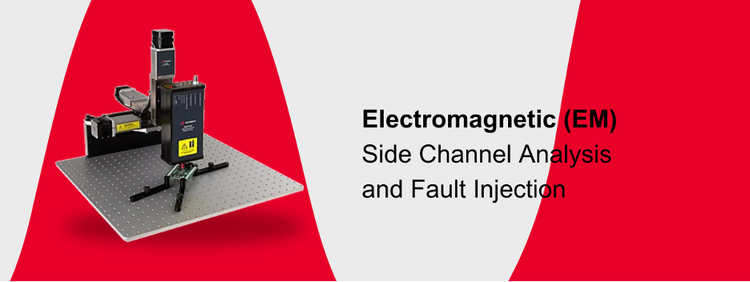
When the “front door” proves too secure, attackers explore the entire perimeter, checking windows, back doors, and any other potential entry points. Electromagnetic testing does exactly this for security chips, providing both side channel analysis and fault injection capabilities that can target specific regions within a device.
This approach is critical across all security-conscious industries. It encompasses tasks ranging from validating complex SoC designs and testing hardened ECUs with advanced power protections, to examining systems built to withstand conventional attacks and probing devices with unknown countermeasures.
Building on the power setup, this package adds:
- XYZ-Stage for sub-millimeter probe positioning
- High-Precision EM Probe for capturing EM emissions
- Bidirectional EM-FI Probe for simultaneous injection and measurement
- Unidirectional EM-FI Probe for the most powerful EM glitching
Inspector’s EM modules integrate seamlessly with this hardware, providing detailed mapping of emissions and fault points.
Optical SCA/FI: Ripping Off the Roof

When all doors and windows are sealed, only the most determined intruder attempts to remove the roof entirely, a difficult, specialized approach reserved for the most challenging targets. Optical fault injection represents this ultimate level of attack sophistication, using precise laser systems to create faults at the transistor level within silicon.
This configuration meets the most demanding requirements across high-security sectors. By using laser pulses to disturb transistor behavior, it enables advanced testing in defense-grade applications, secure element analysis, and R&D labs tackling highly protected chips.
Building on the EM setup, it adds:
- Laser System with certified safety housing
- Multi-mode and Single-Mode Lasers for targeting silicon in various precision
- TLS/OBIC/EMMI capabilities for specialized optical injection
Inspector provides real-time synchronization between laser activity and data capture, helping teams link fault timing to system response and uncover weaknesses even in the most secure silicon.
Making Your Configuration Decision
Every test environment is unique. Choosing the right configuration depends on:
- Your threat model
- The device under test (size, packaging, countermeasures)
- Your industry's compliance needs
- Your lab’s maturity and plans to scale over time
Whether you’re starting with power-based testing or jumping directly into EM or optical techniques, the DS1050A’s modular PXI design—and the flexibility of Inspector Software—ensures your system evolves with you.
Learn more about DS1050A Next-Generation Embedded Security Testbench here.
Related Posts