
Inside the Magic of Modern Satellite Communications
Key takeaways:
- All satellite communications (SATCOM) have to use radio, microwave, infrared, and visible light bands.
- Different orbital altitudes and velocities involve their own benefits and limitations that make them suitable for specific SATCOM use cases.
- Advances like phased array antennas, non-terrestrial 5G networks, and high-throughput satellites are revolutionizing telecom and internet connectivity in particular.
While you're reading this, some 6,000+ satellites are giving homes and offices around the world access to broadband Internet. More than 100 satellites are helping people everywhere navigate their roads, and perhaps thousands of satellites are ensuring our national security. For all these capabilities, you can thank the magic of satellite communications.
This blog post introduces you to the workings of satellite communications for telecommunications, broadcasting, internet connectivity, and defense uses. Get to know how key satellite characteristics are determined for a use case, and learn about the latest advances in satellite technology.
What are satellite communications?
SATCOM involves the use of satellites to wirelessly relay signals between transmitters and receivers on the ground when terrestrial wireless signaling between them is impractical due to their locations or the distances between them.
Satellite communications are used for:
- telecommunication purposes, such as making calls with traditional satellite phones or using modern 5G non-terrestrial networks for wireless calling, messaging, and data
- broadcasting radio or television signals to large areas
- broadband connectivity to access the internet from remote locations
Most of these communications systems are also relevant to other fields, like remote sensing and global positioning that use satellites. However, they use satellites as sensors that measure something rather than mere relays.
How do satellite communications work?
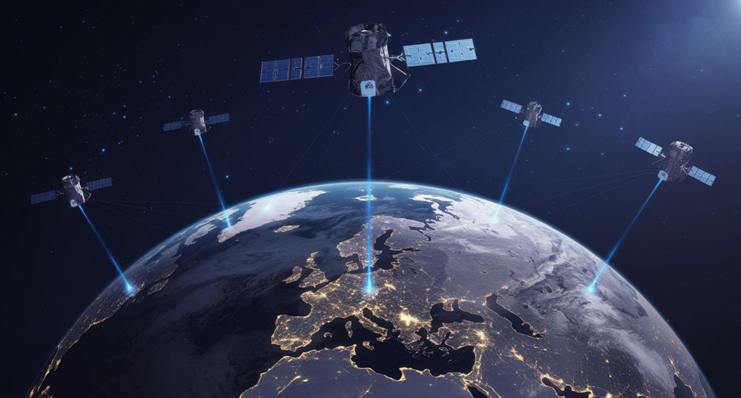
The orbits of communications satellites can range from 160-36,000 kilometers (km), or 100-22,400 miles. To communicate wirelessly over such distances, satellite communications have to rely on electromagnetic (EM) waves.
The Earth's atmosphere and ionosphere are opaque to most EM frequencies, except for some bands in the radio, microwave, visible light, and infrared frequencies.
Our focus will be on satellite communications using radio frequency (RF), microwave, and infrared signals.
Communication segments and links
Every satellite communication system has a space segment and a ground segment.
The space segment consists of all the satellite or satellite constellations as well as the ground station control systems responsible for tracking, telemetry, control, and monitoring (TT&C, or TTC&M).
The ground segment consists of the ground stations or terminals that transmit data to or receive data from the satellites and their interconnections over terrestrial wired or wireless networks.
The wireless link from a terminal or ground station going toward a satellite is called an uplink. A link going from a satellite toward a terminal (or ground station), in turn, is called a downlink. An end-to-end link between two terminals via one or more satellites is a channel. Data flow in a link may be one-way for some use cases (like broadcasting) or two-way (like internet connectivity). However, TT&C communication is always two-way.
What are the different types of satellites used for communication?
The satellites used in these fields are categorized based on their orbits, use cases, or functions.
Orbital parameters like altitude, inclination, and velocity are crucial in the design of satellite communications. Orbital altitudes can range from 160-36,000 kilometers. The lower the height, the faster the satellite has to orbit around the Earth to counteract its gravitational pull. Simultaneously, due to its rotation, each point on the Earth's surface moves underneath a satellite by some kilometer every minute (27 km at the equator). All these aspects have to be accounted for while establishing uplinks and downlinks.
Altitude is the most important parameter. Based on it, there are the following types of satellites:
- Geosynchronous earth orbit (GEO or GSO): A geosynchronous orbit satellite has the same orbital period of 24 hours as the Earth at a circular altitude of about 36,000 km. While a geosynchronous orbit can be slightly inclined and therefore seems to drift a little, a geostationary orbit is exactly above the equator and appears fixed in the sky.
- Low earth orbit (LEO): LEO satellites have circular orbits at altitudes of 160-2,000 km with speeds of 25,000-28,000 km/hour. In one second, an LEO satellite moves by about 7 km.
- Medium earth orbit (MEO): MEO satellites have circular orbits at altitudes of 2,000-36,000 km.
- High earth orbit (HEO): HEO satellites have highly elliptical orbits with maximum altitudes of 36,000 km and minimums comparable to LEOs. They are used for coverage of high-latitude and polar locations.
A satellite orbit is chosen based on its use case and function. Each orbit has pros and cons. For example:
- LEO is ideal for low-latency use cases like internet connectivity. However, due to high velocities, ground receivers have to accurately track them across the sky.
- MEO is preferred by positioning constellations because the semi-geosynchronous orbit enables global coverage with a small number of satellites.
- GEO satellites can each provide coverage to almost an entire hemisphere and so are ideal for broadcasting, country-specific sensing, and reconnaissance.
How do radio satellite communications work?
RF and microwave frequencies are the most common bands currently used in satellite communications. These frequencies are divided into a number of bands with different designations as shown below

Figure 1. RF and microwave frequency bands (not to scale)
What is the role of frequency bands in satellite communications?
The bands are chosen based on the use case. For example:
- C-band: C-band, covering the 4-8 gigahertz (GHz) range, is widely used for television broadcasting since it performs better under adverse weather conditions. However, its power is restricted to minimize interference with terrestrial microwave systems.
- Ku-band: The Ku-band (12-18 GHz) is also commonly used for television broadcasts and some internet services.
- Ka-band: The Ka-band (27-40 GHz) allows high-bandwidth satellite services like broadband internet.
Importantly, the uplink and downlink frequencies are always different but operate within the same band. If they're the same, the uplink filter of a satellite can't differentiate between legitimate input signals from a ground station and feedback from its own downlink antenna.
What is the RF architecture of a satellite?

Figure 2. RF block diagram of a relay satellite
Ground stations and mobile satellite terminals transmit radio signals to satellites using quadrature amplitude modulation (QAM). These signals are received by the satellite and are either decoded or relayed.
The communications payload of a relay satellite consists of a transponder and antennas as shown above. It consists of these main components:
- Receiver subsystem: The receiver subsystem receives data (only on relay satellites) and TT&C commands.
- Receiver antenna: The receiver antennas should be sensitive enough to pick up weak signals. Horn antennas are used with 4 GHz and above if wider beams are required. For 10 GHz and above, parabolic antennas are preferred.
- Input filter: The input filter ensures that only the designed input frequencies are let through.
- Low noise amplifier: The weak input signals are amplified.
- Intermediate frequency (IF) downconverter: The gigahertz frequency is downconverted to an intermediate frequency for easier signal processing.
- IF amplifier: The IF signal is amplified.
- Upconverter: The IF frequency is boosted back to the correct transmission frequency.
- Power amplifier: The wattage of the output signal is boosted to tens or even hundreds of watts.
- Transmitter antenna: The output signal is sent over the transmitter antenna.
For decoding TT&C commands and received data, the following additional components are required:
- Demodulator: The QAM demodulator splits an input analog signal into Q and I waveforms.
- Decoding baseband processor: The decoding baseband processor's analog-to-digital converters (ADCs) decode analog waveforms into digital data.
For transmitting data, the following components are required:
- Encoding baseband processor: The encoding baseband processor's digital-to-analog converters (DACs) encode data to Q and I analog waveforms.
- QAM modulator: Digital data requires too much bandwidth. So, the QAM modulator converts the waveforms into a QAM signal.
How does optical satellite communication work?
Some modern satellite constellations use inter-satellite optical links to communicate with each other. These use infrared lasers to carry commands and data. High bandwidths and lower susceptibility to interference are some of their benefits.
What are the primary applications of satellite communication in various industries?
Satellite communications are used in multiple industries:
- Defense: The defense industry uses satellites extensively for real-time battlefield monitoring, communications, reconnaissance, and navigation systems, like the American Global Positioning System (GPS) or Japan's Quasi-Zenith Satellite System.
- Telecommunications: The telecommunications industry has been deploying satellite phone systems for decades. More recently, satellites have allowed 5G networks to provide high-speed communications services to anywhere in the world where traditional mobile towers can't be installed.
- Internet providers: A new generation of internet service providers is providing high-speed broadband connectivity to all corners of the planet using large global networks of commercial satellite constellations.
- Media broadcasting: Media companies provide television and radio content over satellites.
What are some technological advances in satellite communications?
Some recent developments and advances in satellite communications include the following:
- Phased array antennas: The emergence of communications satellites in LEO necessitates the tracking of such satellites as they pass overhead. Mechanical tracking of satellites can result in tracking errors and failures over the long term. So, clever RF engineering is used instead. A phased array consists of hundreds to thousands of small antennas. By manipulating the phases of the signal waveforms from each antenna, their constructive interference at specific angles can be electronically controlled. This trick is used to track fast-moving LEO satellites, for example, for constant internet connectivity.
- High-throughput satellites: These satellites employ special beamforming techniques and channel modulation techniques to simultaneously cater to a large number of users.
- Non-terrestrial networks for 5G/6G: Non-terrestrial networks, as segments of 5G/6G access networks, enable satellites to act as base stations and allow users to make and receive mobile calls, messages, and data from any location on Earth.
- Artificial intelligence (AI): AI and machine learning are increasingly used for smart network management, predictive analytics, and network optimization.
Keysight empowers your satellite communications
This blog post outlined the major concepts and subsystems that make up satellite communications and gave an overview of recent advances in the field.
Keysight has an extensive portfolio of test and measurement products and software to cater to every subsystem of your satellite communication systems and provide satellite mission assurance.
Contact us for expert insights and recommendations on optimizing your satellite communications.