
Considerations for a New Waveform in 6G
Historically, each generation of cellular technology has introduced innovations in waveforms. Orthogonal Frequency Division Multiplexing (OFDM) was introduced during 4G LTE, with its novel ability to efficiently transport data using multiple orthogonal sub-carriers. In 5G, OFDM continued to provide the core modulation technique, with improvements to support the higher data rates, lower latencies, and new use cases associated with 5G. By providing gains in spectral efficiency, capacity, performance, and robustness, ODFM has well served the waveform requirements in two cellular generations.
Now, with the prospect of 6G, there is increasing demand to study new waveform candidates that can improve and enhance OFDM. It seems likely that OFDM will continue to provide the foundational structure for a third consecutive cellular generation. Innovation is expected in coding and modulation techniques to improve energy efficiency, spectral efficiency/cost, and performance in high Doppler environments.
As the industry gets ready for 6G, we are seeing a slower rate of growth in cellular data volumes. The overall data consumption, however, continues to be extremely high and keeps growing, and so does the associated need for spectrum. Initial expectations were that millimeter wave and Sub-THz frequencies would be used in 5G and 6G, respectively, to support the demand for faster and higher volume data and wider bandwidths. However, millimeter wave technology has fallen short of delivering its promise thus far in 5G. Currently, 6G is slated to use the upper mid band FR3 frequencies from 7.125 – 24.5 GHz, not Sub-THz.
While spectrum challenges continue, we need to gear up for new use cases in 6G and the rapid adoption of AI. Finally, the enormous cost of cellular power consumption continues to grow to unsustainable levels and will need to be addressed with resolve and focused innovation at all levels. 6G is offering the opportunity to usher in innovation and make real the ongoing decades-long research in new waveforms.

Figure 1. Frequency – Time Representation of an OFDM Signal
Research Focus
Some of the new 6G use cases include supporting extremely high mobility in dense multi-path environments with extremely low latency communications in the uplink as well as downlink, sensing and ubiquitous coverage, and more. Novel waveform research emphasis has been focused on the following:
- Solving current challenges such as energy efficiency, spectral efficiency, uplink coverage
- Enabling new use cases such as extremely high mobility, extremely low latency, sensing (JCAS/ISAC), and satellite/ aerial non-terrestrial networks (NTN)
- Leveraging AI/ML for at least the most in-demand areas such as channel estimation/ prediction and cloud/ network edge implementations
Amongst the many candidate waveforms being proposed for 6G, Orthogonal Time Frequency Space (OTFS) modulation has been getting a lot of attention. However, whether OTFS or any of the other new waveforms will adequately address energy efficiency remains to be seen.
Orthogonal Time Frequency Space Modulation - a Front Runner?
There has been significant attention on OTFS, with hundreds of technical papers recently published by eminent university research professors and authors. It utilizes a multicarrier modulation technique that is resilient in channel environments consisting of high-Doppler multipaths (1).
Leveraging the principles of previous waveforms, such as CDMA and OFDM, OTFS uses a novel approach to transform the time-varying multipath channel into a two-dimensional channel in the Delay-Doppler domain (2). This elegant technique enables each transmitted symbol to experience near-constant channel gain even in high Doppler conditions that are characteristic in high mobility/ high density environments, massive MIMO deployments, and satellite/ non-terrestrial networks.

Figure 2. Orthogonal Time Frequency Space Modulation

Figure 3. OTFS System Diagram using the Discrete Zak Transform
OTFS, however, is not expected to adequately address the staggering need for higher energy efficiency, as it is not expected to improve power amplifier peak to average power ratio (PAPR). Nor is it expected to significantly improve spectral efficiency that remains a few bits/second/Hz even after five generations of cellular technology.
Whether OTFS techniques can displace OFDM or not is a broader question to be resolved by researchers, industry, and standards bodies. However, the underlying methods to test the new waveforms, and also the network elements/ components that are likely to use these waveforms, deserve critical inquiry. Here are a few examples of scenarios ensuing from new waveform research that we at Keysight are studying and grappling with:
- OFDM diminished demands on the equalizer with inherently lower inter-symbol interference and efficient cyclic prefixes. OTFS, on the other hand, promises a much more robust channel estimation that is nearly immune to high Doppler. However, it assumes efficient equalization.
- Even though OFDM is more susceptible to channel gain than OTFS, it uses relatively simple time and frequency domain DSP techniques. OTFS, on the other hand, performs multiple complex operations in order to achieve Doppler resilience.
- By more effectively packing reference signals, OTFS enables more sparse and compact channel representation than OFDM. The improved channel estimates are expected to reduce dependence on pilot signals and therefore overall network simplification and performance.
These are merely three scenarios with underlying assumptions that need to be tested. These can be modeled and tested using Keysight's digital twins and deterministic test solutions.
Candidate Waveforms for 6G
New candidate waveforms will likely preserve the interference resilient mechanisms of Cyclic Prefix (CP-OFDM), the lower energy benefits with Discrete Fourier Transform-Spread-OFDM (DFT-s-OFDM), and spectrum sharing with FDSS. A few promising innovations include the following:
- Orthogonal Time Frequency Space (OTFS) that we have addressed in the above section
- Promising for high-mobility and high-Doppler environments (e.g., V2X, satellite)
- Better resilience to channel variations compared to OFDM
- Generalized Frequency Division Multiplexing, proposed in 5G (GFDM)
- Flexible subcarrier spacing and time slotting
- Potential for low-latency and low-PAPR applications
- Filter Bank Multi-Carrier (FBMC, proposed in 5G)
- High spectral efficiency
- Reduced out-of-band emissions
- AI-Optimized Waveforms
- Use of machine learning to dynamically adapt waveform parameters
- Still in early research phase
In past communications, I have lamented the diminished focus on 6G sustainability. I cannot help but express that despite the many legitimate accolades for OFDM, there is a clear need for innovation to solve the grittiest problems with energy and spectral efficiency. There is opportunity for candidate waveform research to play a role in resolving this issue.
A Word on Testability
At this early stage of 6G waveform innovation, there are many theoretical and model-based predictions on the likely performance of waveforms, especially the front runner OTFS. A like-for-like comparison will need to ensure proper testing to a common set of criteria, test parameters, and test conditions.
Keysight has a long history of testing waveforms, and also the systems/devices that use those waveforms.
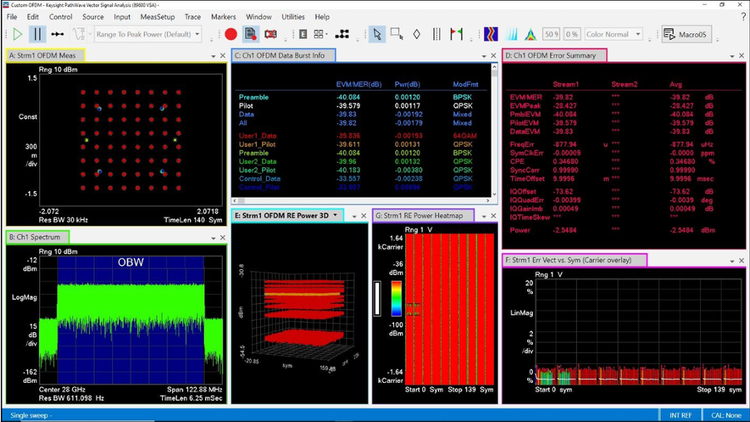
Figure 4. Keysight VSA Software Customer OFDM Modulation Analysis
We are in exciting times with an unprecedented pace of innovation. Keysight leads in providing cutting edge test solutions to researchers and industry in all 6G areas, including testing new waveforms, the capabilities that these waveforms will enable, and all the way to deployment and the user experience. Stay with us on this journey, and tune in for more on this topic from Keysight.