
Modernizing Asia’s Grids: Connecting Power, Policy, and Practical Testing
Reflections from Future of the Grid 2026 on regional interconnections, AI, and the engineering work needed to support reliable power.
At Future of the Grid in Singapore on October 27–28, I caught up with Keysight’s Michael Reser, one of the guest panelists, to discuss the challenges facing Asia’s power grids.

Michael Reser, Director of the EV Segment for Automotive and Energy Solutions at Keysight Technologies, shares his takeaways from discussions on Asia’s grid challenges at Future of the Grid 2026 in Singapore.
He highlighted the difficulty of securing enough energy while connecting grids across countries, sharing resources, and putting regulatory structures in place. Questions about AI and the safety of electricity supply add to that work.
Living in Singapore has made me conscious of the differences in electricity access across Southeast Asia. While major cities plan for data center growth, an estimated 18 million people in the region still lacked electricity access in 2023, according to the IEA’s 2024 outlook. Meeting these different needs requires coordination across power systems, policy, and engineering.

Tackling different power needs across Asia – from power-intensive data centers, to off-grid remote communities storing solar power in re-purposed lead-acid car batteries.
Powering Data Centers and Growing Communities
In October 2026, the IEA projected that Southeast Asia’s electricity demand would grow by around 5.4% annually from 2026 to 2030, driven by cooling, industry, and data centers.
Johor offers a nearby example of the region’s rising demand for electricity. Wood Mackenzie projects that data centers could account for approximately 40% of the Malaysian state’s electricity demand by 2035. While generation remains sufficient for near-term growth, access to transmission and distribution infrastructure is emerging as a constraint.
For developers waiting for a connection, available generation elsewhere cannot resolve a local substation bottleneck. Utilities must also plan for everyday household needs as rising incomes make appliances more affordable and hotter temperatures increase cooling demand.
Connecting Countries Takes More Than Cables
Michael’s point about sharing resources and establishing regulatory structures is particularly relevant to cross-border power connections. Countries need agreements on electricity trading, operating responsibilities, and emergency response alongside the infrastructure.
Sun Cable’s proposed Australia-Asia PowerLink illustrates the scale of that ambition: it aims to supply Singapore with 1.75 GW of low-carbon solar electricity from Australia’s Northern Territory through approximately 4,300 km of subsea cables. Singapore’s Energy Market Authority had granted conditional approval in October 2024. However, a recent article by Australia’s ABC News highlighted major challenges that Sun Cable must overcome. Besides reaching a commercially viable price and securing approvals from all jurisdictions, including countries that the cables cross, the cables will also need to handle the stress and strain from a seismically active region.
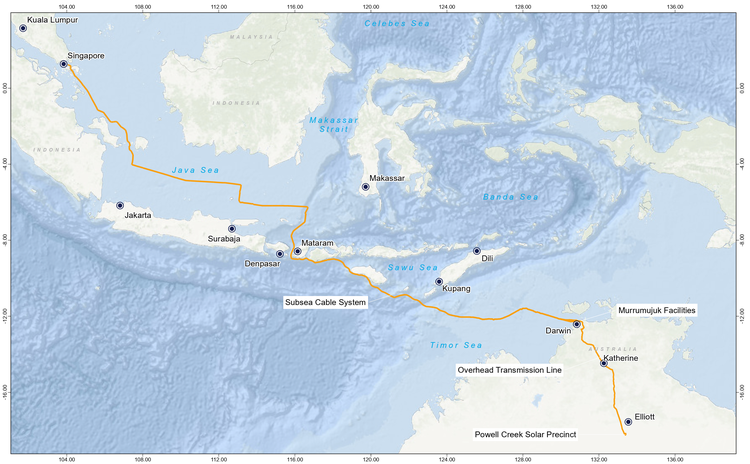
An early project map from 2022 illustrating the Australia-Asia PowerLink Infrastructure, not representative of actual cable route. (Source: NTEPA)
Validating AI for Grid Operations
To ensure power resilience for an increasingly connected grid, engineers will need to establish whether protection systems coordinate correctly, how controls respond when communications are delayed, and whether equipment from different vendors interoperates properly during a disturbance. Simulation and controlled testing can help teams investigate these interactions before commissioning. Artificial intelligence (AI) is increasingly being used in large-scale power management.
As utilities adopt AI for tasks such as forecasting and anomaly detection, Michael’s comments about AI and safe electricity supply raise a practical question: how do we check that these tools can be relied on?
The checks depend on what the AI does and what could happen if it fails. If it alerts an operator to a problem, can it spot warning signs reliably and early enough? If it adjusts equipment automatically, will its actions keep the system within safe operating limits when data arrives late?
Testing should examine the data and connections between AI tools and operational systems, such as supervisory control and data acquisition (SCADA) and distributed energy resource management systems (DERMS). Teams also need to check access permissions, monitoring, and recovery procedures.
Preparing for the Worst Hour of the Worst Day
Weather also puts power grid systems under pressure. For example, Vietnam’s disaster authority reported that Typhoon Bualoi and associated severe weather disrupted electricity to 2.7 million customers in 2025. Preparing for weather conditions beyond past experience calls for better tools to assess vulnerabilities, test grid responses, and plan recovery.
Alongside stronger physical infrastructure and restoration resources, engineers need to test how protection, controls, and communications respond when parts of the network become unavailable. A voltage disturbance combined with delayed communications may expose problems missed when components are tested separately.
Grid simulation and power emulation allow teams to investigate these scenarios in the laboratory before deployment. Operational monitoring can then help identify problems and support response efforts in the field.
For me, the engineering task that follows this conversation is clear: bring validation into projects early, then revisit it as equipment, software, and operating conditions change. That gives teams better evidence for decisions about connections and safe operation.
Keysight provides tools for grid simulation and emulation to help utilities and the power grid ecosystem validate grid infrastructure and operations.
Explore Keysight’s grid modernization solutions:
Contact us for expert advice on grid modernization.