
Accelerate 1.6T Optical Transceiver Testing Without Sacrificing Accuracy
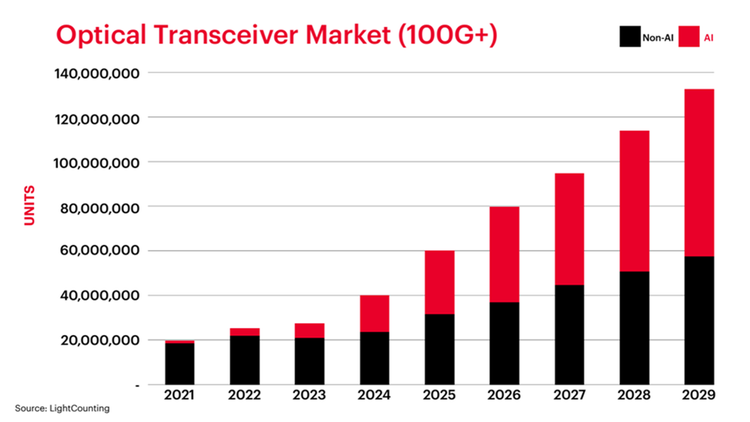
The rapid rise of AI data centers has driven the demand for next-generation optical transceivers — including 800G, 1.6T, and advanced packaging technologies like co-packaged optics (CPO) and near-packaged optics (NPO). According to LightCounting, the 100G+ optical transceiver market is projected to grow from 60 million to over 120 million units from 2025 to 2029. As transceiver designs become more complex and data rates continue to increase, network equipment manufacturers (NEMs), especially optical transceiver manufacturers must maintain the highest quality standards while scaling their production efficiently.
Key Challenges in Validating Transceivers for AI Demands
Ensuring 1.6T Device reliability
One failed or unoptimized transceiver could disrupt an entire AI workload, wasting considerable time and money, so manufacturers must ensure high-quality devices through rigorous testing at both the physical layer and protocol / network layers. Many test engineers rely on sampling oscilloscopes to fine-tune optical transceivers during manufacturing.
In a tight feedback loop, the production system writes initial configuration settings such as laser bias or modulator voltage into each transceiver module, then immediately measures a key performance metric like transmitter and dispersion eye closure quaternary (TDECQ). Based on this result, the settings are adjusted, and the metric is measured again, iterating until optimal performance is reached.
Improving test efficiency
Second, modern hyperscale data centers house more than 50,000 fibers with an optical transceiver at each end. Once a transceiver design is finalized, manufacturers must ramp up volume production quickly to meet the intense demand from AI data centers. Delays in manufacturing can mean missing critical market windows, yet cutting corners is not an option. Maintaining high yields is essential to avoid shipping faulty units that could cause failures in deployment.
Speeding up production often risks compromising reliability, while intensive testing processes can slow down manufacturing and inflate costs. Manufacturers need to balance speed with accuracy, especially when devices must be tested across multiple channels and thermal conditions. However, testing all 8 lanes of thousands of transceivers becomes a productivity bottleneck unless the process is properly optimized.
Boost AI Transceiver Reliability with 224 Gb/s Validation
The Keysight DCA-M sampling oscilloscopes, paired with Keysight’s test optimization software, can help you with these test challenges head-on, accelerating production while enhancing device reliability.
At the core of every DCA-M system is Keysight’s proprietary technology: custom MMICs, in-house–designed ASICs, and signal paths manufactured in our dedicated indium phosphide (InP) and gallium arsenide (GaAs) fabs. This enables ultra-fast, high-integrity measurements powered by edge-sharpening diodes that boost bandwidth and precision.
The DCA-M sampling oscilloscopes deliver the precision and speed needed for AI transceiver validation. With <15 µW noise and 90 fs jitter, they ensure accurate signal analysis at high data rates, up to 224 Gb/s. With the extra measurement margin afforded by better signal integrity, validation engineers can better characterize performance to identify faulty units earlier and achieve faster throughput.
Achieve Faster Test Cycles with Higher Hardware Utilization
Keysight’s test optimization software enables a single sampling oscilloscope to test multiple 224 Gb/s PAM4 lanes simultaneously. It helps unlock the full potential of their existing DCA-M sampling oscilloscopes. Engineers can test multiple lanes and modules in parallel through optimized lane sequencing and integration with optical switches to improve throughput. Test optimization software also automates complex signal analysis processes like TDECQ measurements, reducing human error and minimizing time per device. Manufacturers can get optimized, production-ready modules faster by streamlining the tuning-feedback loop.
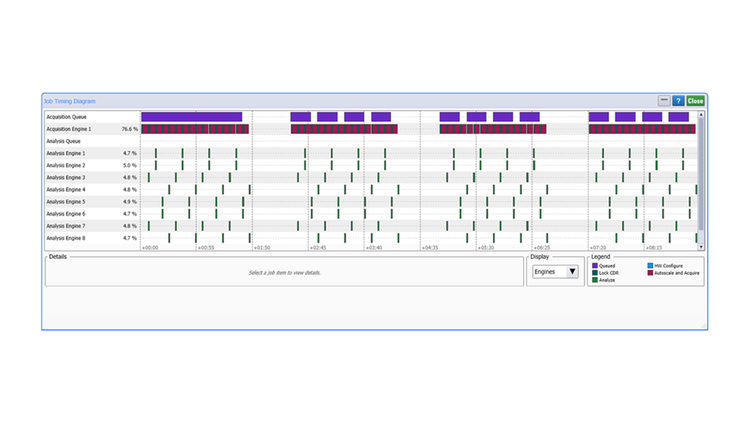
The platform features a simple SCPI interface, making integration into existing manufacturing systems and automation scripts easy. Engineers can also monitor key metrics continuously, ensuring consistent performance across production batches.
Real-World Use Case: 1.6T Optical Transceiver Manufacturing Test
Let’s explore how the DCA-M sampling oscilloscopes, combined with test optimization software, are streamlining optical transceiver testing and driving smarter, faster transceiver manufacturing tests.
In high-density 1.6T applications, manufacturers must simultaneously analyze multiple 224 Gb/s PAM4 optical lanes. Test optimization software, combined with high-bandwidth DCA-M oscilloscopes and optical switches, enables parallel acquisition and analysis — eliminating idle time and boosting throughput. This configuration reduces test time, ensures tighter quality control, and increases yield.
Smarter Testing for Scalable Production
As transceiver complexity and demand continue to rise, manufacturers need testing solutions that scale without compromising reliability.
With automated TDECQ measurement, synchronized multilane testing, and easy deployment into existing systems, our solutions drive down the cost-of-test while boosting throughput to ensure your production ramps are as smart as they are fast.
Ready to accelerate your production test without compromising quality? Contact us for a free quote.