










- Overview
- All Models
- Support
General-purpose signal generation
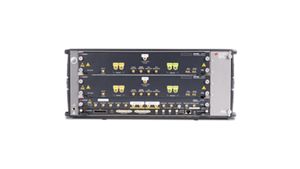
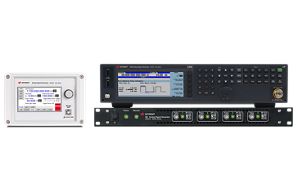
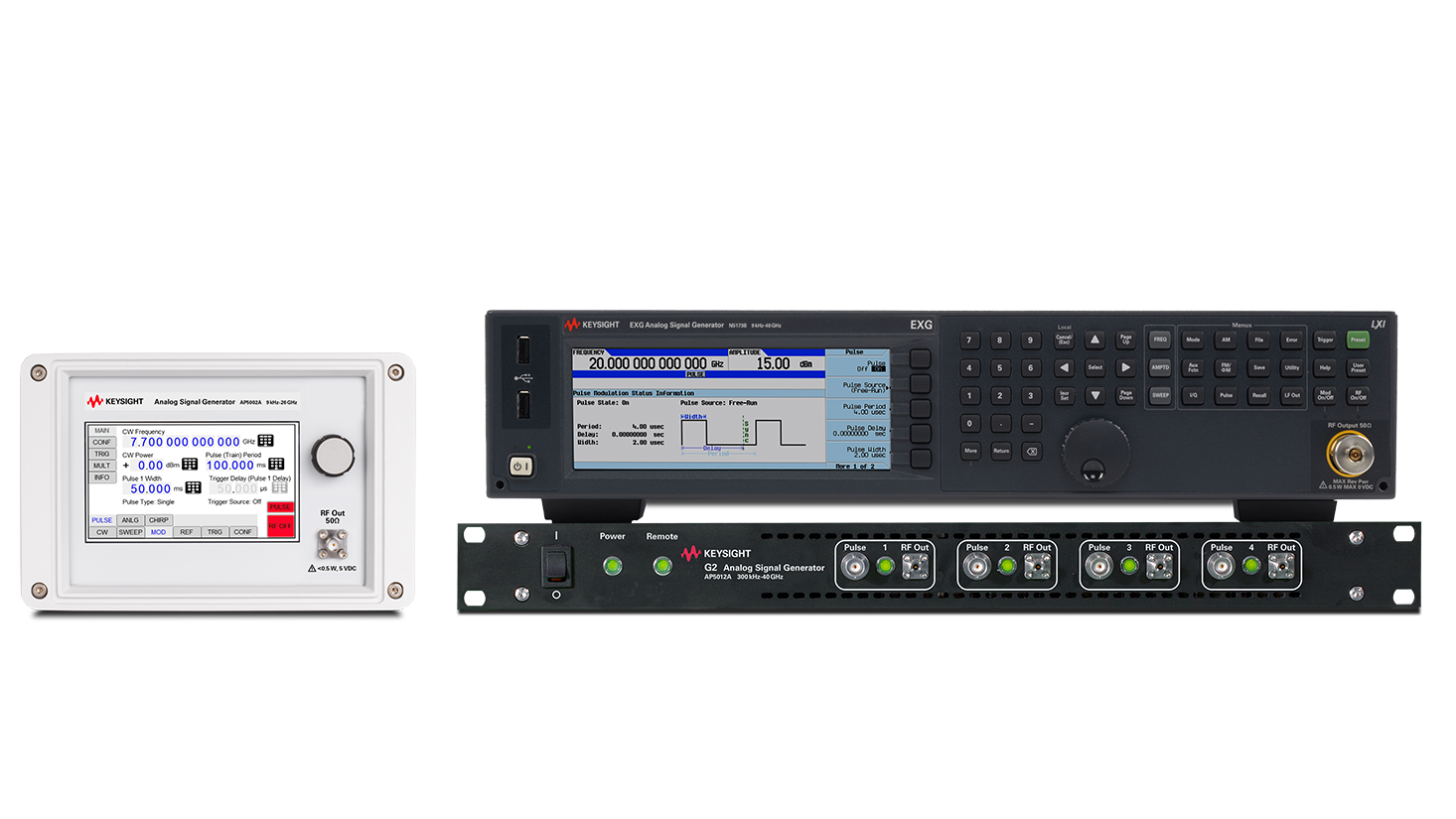
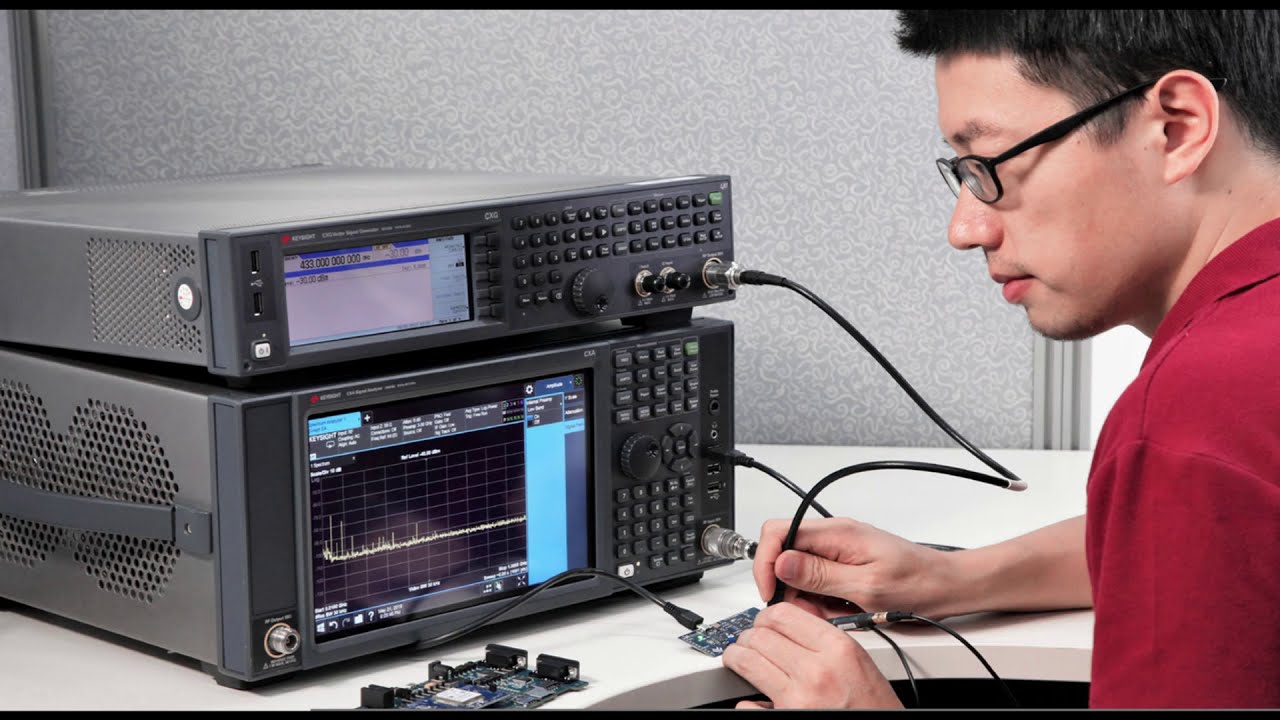
Keysight Essential analog signal generators come in two classes. The XG1-class includes the AP5001A, AP5002A and the XG2-class includes the AP5011A, AP5012A, N5171B, and N5173B. Essential analog signal generators feature low phase noise, a wide output power range, and fast switching speeds needed to test a variety of devices and communication systems. Additionally, select Essential models are available in four phase-coherent output configurations with a 40 GHz max frequency, ideal for evaluating the signal strength, frequency response, or noise performance in multiport receiver testing. Choose one of our most popular configurations or build the one you need for your application. Need help selecting? Check out the resources below.
Low phase noise
Provides a clean, stable signal ideal for testing high-precision components like oscillators, mixers, and amplifiers in applications including 5G, Wi-Fi, and general wireless applications.
High output power
Compensate for system loss, enhance SNR, and test components from short-range wireless systems to long-distance communication links with greater than +17 dBm output power.
Fast switching speed
Simulate real-world signal transitions with rapid switching speeds, ideal for testing pulse and burst signals such as radar or enabling low-duty measurements for thermally sensitive devices like power amplifiers.
Modulation capabilities
Leverage modulation capabilities such as AM, FM, PM, and pulse modulation to generate complex analog waveforms for thorough testing of RF receivers, components, and systems.

-
Phase noise @1 GHz (20 kHz offset)
-130 dBc/Hz to -122 dBc/Hz
-
Output power @1 GHz
17 dBm to 25 dBm
Most popular configurations

XG1-class Analog Signal Generator

XG2-class Analog Signal Generator
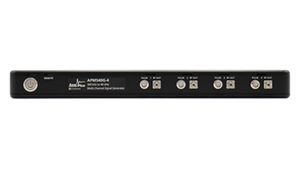

XG2-class Analog Signal Generator
Services and support
Innovate at speed with curated support plans and prioritized response and turn-around times.
Get predictable, lease-based subscriptions and full lifecycle management solutions—so you reach your business goals faster.
Experience elevated service as a KeysightCare subscriber to get committed technical response and more.
Ensure your test system performs to specification and meets local and global standards.
Make measurements quickly with in-house, instructor-led training, and eLearning.
Download Keysight software or update your software to the newest version.
Frequently asked questions
RF output power measures the strength or intensity of the radio frequency signal emitted from a transmitter or an RF amplifier. It quantifies how much energy is being radiated or delivered to the antenna in watts (W), milliwatts (mW), or commonly in decibel-milliwatts (dBm). This power level is critical because it determines the range, quality, and effectiveness of the RF signal transmission.
High RF output power ensures that signals reach their intended destinations with sufficient strength to overcome noise and interference while also being regulated to prevent disruption to other devices. RF output power can be measured as peak power, average power, or, in the case of pulsed systems, pulse power, with each measurement offering unique insights into the signal's characteristics.
Path loss refers to the decrease in signal strength of an electromagnetic wave, such as a radio frequency (RF) signal, as it travels from a transmitter to a receiver through space or a medium. This phenomenon represents the natural attenuation caused by distance and environmental factors.
Real-world factors such as absorption by air or foliage, reflection off buildings, diffraction around obstacles, and scattering from rough surfaces increase signal loss, making it a crucial consideration in wireless systems like cellular networks and Wi-Fi. Measured in decibels (dB), path loss determines how far a signal can travel effectively. It guides engineers in designing transmitter power and antenna placement to tackle challenges like urban clutter and non-line-of-sight scenarios, ensuring dependable communication despite the signal’s unavoidable fading.
RF frequency, or radio frequency, refers to the rate at which an electromagnetic wave oscillates within the radio portion of the electromagnetic spectrum, typically ranging from about 3 Hz (hertz) to 300 GHz (gigahertz). It represents the number of cycles per second of an RF signal, measured in hertz, and determines the wavelength and propagation characteristics of the wave.
RF frequencies are used in various applications, such as wireless communications (e.g., AM/FM radio, Wi-Fi, cellular networks), radar, television broadcasting, and satellite systems. In practical terms, the specific RF frequency selected for a system dictates its bandwidth, range, and capability to penetrate obstacles, making it a crucial factor in the design and operation of RF devices like signal generators, transmitters, and receivers.
For example, in FM radio broadcasting, an audio signal causes the carrier frequency to oscillate around its center value, embedding the information within these frequency changes. The modulated signal occupies a wider bandwidth than AM, producing sidebands that extend based on the modulation index, and is demodulated at the receiver by detecting these frequency variations to recover the original signal. FM provides superior noise immunity and signal fidelity compared to amplitude modulation (AM), making it ideal for high-quality audio broadcasting, two-way radio, and applications such as television sound, although it requires more bandwidth and is less effective for long-range transmission.